
Close & Closer: Deciphering the Visual Language of Human Relationships
Close & Closer: Discover social relationship from photo collections
"Close & Closer" is a social imaging application deployed on Facebook that automatically quantifies interpersonal closeness from private photo collections. It utilizes face detection and clustering integrated with a novel spatial-frequency closeness metric and a high-performance distributed computing framework.
TL;DR
"Close & Closer" is a pioneering social application that bridges computer vision and social network analysis. By analyzing who appears together in your Facebook photos—and how close they stand to each other—it automatically ranks your "closest" friends. To make this feasible for the web, the authors developed a distributed computing framework that turns an hour-long processing task into a sub-3-minute operation.
Background: The Social Value of a Photo
In the late 2000s, tagging photos was a manual, tedious chore. Yet, hidden within these pixels is a goldmine of social data. While most research at the time focused on who was in the photo (Face Recognition), this paper asks a deeper question: What does their positioning say about their relationship? This shifts the paradigm from simple "Annotation" to "Relationship Discovery."
Problem: The Computational Wall
The authors identified two primary hurdles:
- Defining "Closeness": How do you mathematically represent friendship? Is it just the number of times you meet, or does the distance you stand from each other in a group photo matter?
- The Wait Time: Face detection and clustering are "computation-extensive." processing 1,000 photos in an hour is fine for a batch job, but for a web user expecting instant results, it’s a "severe hurdle."
Methodology: The Math of Intimacy
The core innovation is a closeness metric that incorporates three key heuristics:
- Spatial Proximity: If faces are physically close in the image, the social tie is likely stronger.
- Crowd Dilution: If a photo has 20 people, the distance between two individuals is less "trustworthy" than in a duo portrait.
- Consistency: Frequent co-appearance increases the confidence of the bond.
The formula involves normalizing the pixel distance between face centers and weighting it by the square root of the number of faces, then applying an exponential decay based on the total number of co-appearances.
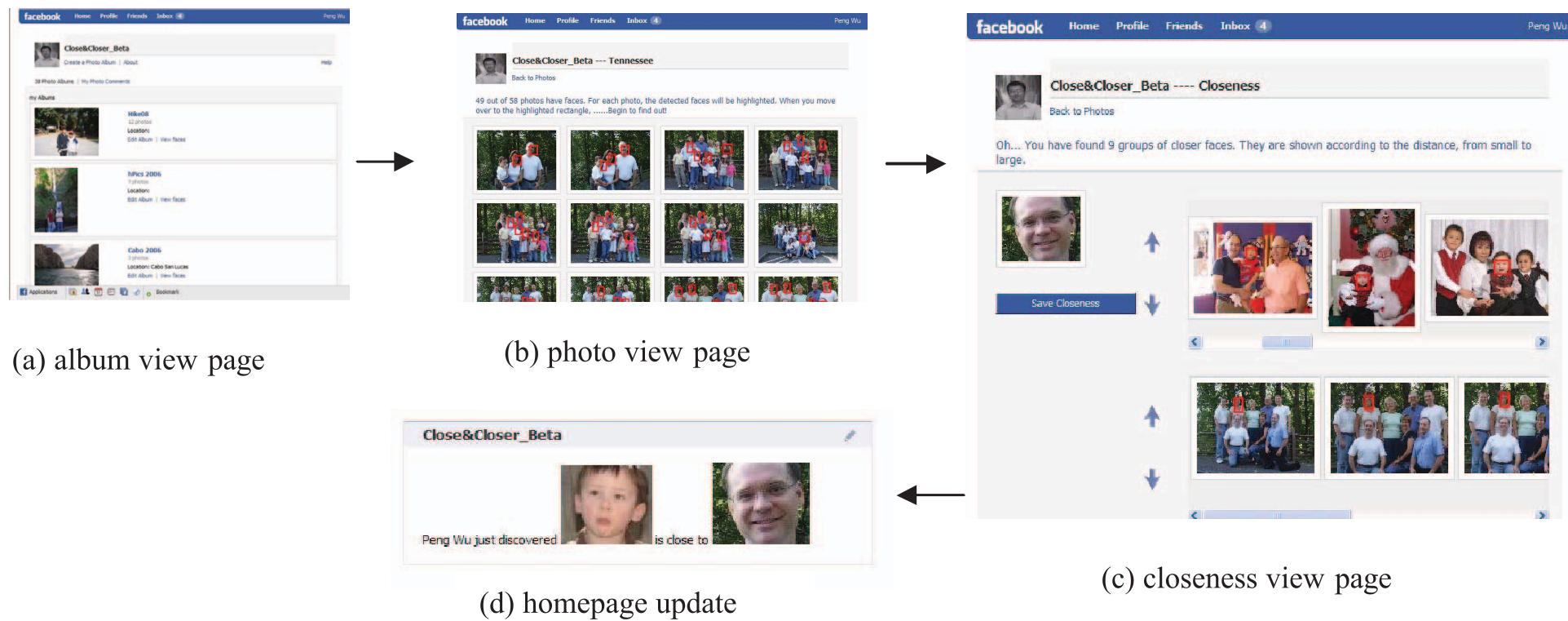 Figure 1: The UI allows users to see detected faces and interactively refine the "Closeness Rank" generated by the algorithm.
The "Computing Engine"
To solve the speed issue, the authors moved away from time-driven scheduling (like the common "Quartz" library) toward a resource-driven distributed model. Using a listener design pattern, as soon as a server node has a free CPU cycle, it grabs a pending job—a precursor to modern serverless and elastic compute concepts.
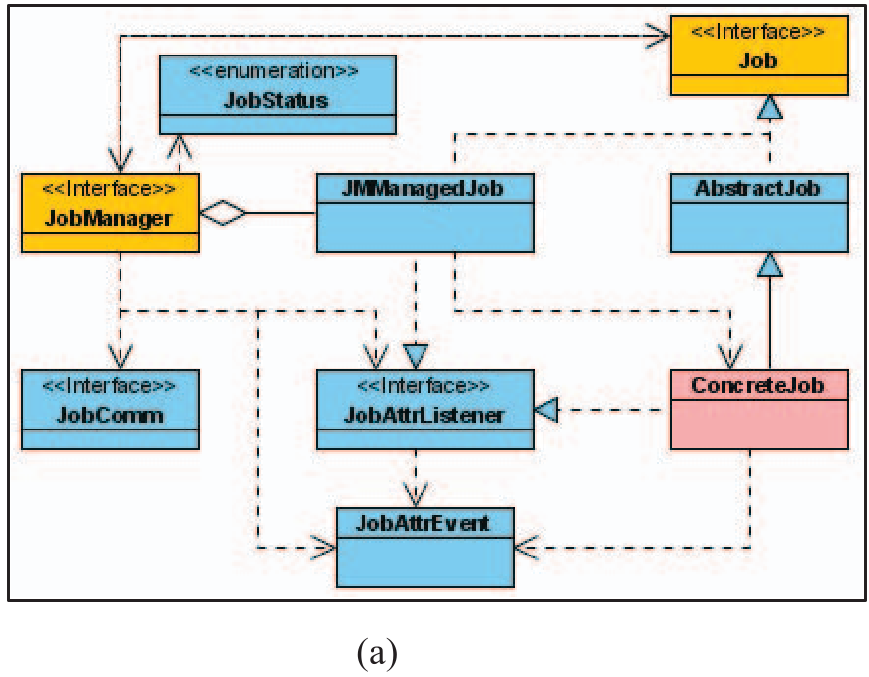 Figure 2: The distributed architecture ensuring that the complex task of face clustering doesn't bottleneck the user experience.
Experiments: Speed and Accuracy
The results were validated on the Facebook platform:
- Relationship Accuracy: The metric successfully placed immediate family members (like father/son) at the top of the generated rankings.
- Scalability: The system demonstrated near-linear scaling. While a single node would struggle, a 3-node cluster processed thousands of photos in seconds, proving the usability of the distributed framework.
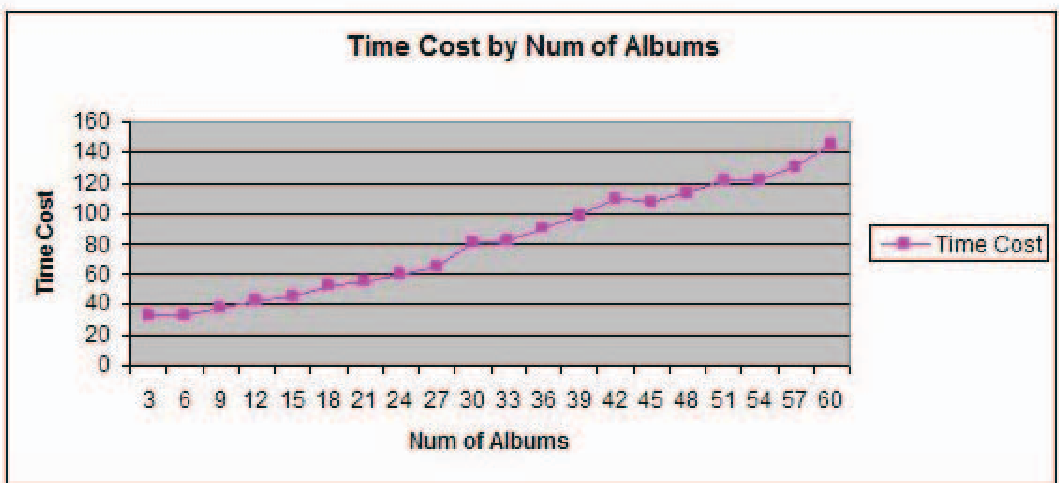 Figure 3: Throughput analysis showing the efficiency of parallelizing face detection across multiple albums.
Critical Insights & Future Outlook
"Close & Closer" was ahead of its time in treating photos as social signals rather than just files. However, its reliance on geometric center-points for faces is a "shallow" feature compared to modern sentiment analysis or body language decoding.
Limitations:
- The metric might be skewed by "photo-bombers" or professional group settings where physical proximity doesn't imply social intimacy.
- The dependency on specific face detectors of the era (pre-Deep Learning) likely limited the recall in low-light or occluded scenarios.
Takeaway: This work laid the groundwork for modern "People" albums in Google Photos and Apple Photos. It reminds us that for any "Deep" feature to be commercially viable, it must be supported by an equally robust, distributed "Shallow" plumbing architecture.