
Boroughs and 2-Clubs: Decoding the Architecture of Close Social Communities
Close communities in social networks: boroughs and 2-clubs
This paper introduces the concept of "boroughs" to analyze close communication structures in social networks. By focusing on 2-clubs (maximal subgraphs with diameter 2), the authors classify close communities into three types—hamlets, social circles, and coteries—and demonstrate that boroughs serve as disjoint topological containers for these groups.
TL;DR
Social networks are more than just clusters; they are ecosystems of "close communication." This paper introduces Boroughs, a structural unit that contains and organizes 2-clubs (subgraphs where everyone is at most two steps apart). By decomposing networks into these boroughs, researchers can identify "hamlets," "social circles," and "coteries" with surgical precision, even in massive datasets like the European corporate elite or DBLP co-authorship maps.
Background: The Limits of the Clique
In social network analysis (SNA), the "clique" (where everyone knows everyone directly) is often too restrictive. Real human groups—like small villages or artist colonies—operate on the principle of distance 2: "I know you, or we have a mutual friend." These are modeled as 2-clubs.
The challenge? Finding all maximal 2-clubs is an NP-hard problem. Previous works often looked for the largest group, but this paper seeks to map the entire landscape of close communication.
The Taxonomy of Close Communities
The authors categorize 2-clubs into three levels based on their "compactness" (determined by the diameter of their shortest spanning tree):
- Coteries (Level 1): Centered around a single "ego" node. Tightly meshed, primarily involving triangles.
- Social Circles (Level 2): No single center, but organized around a "central pair" of adjacent nodes.
- Hamlets (Level 3): The widest form of close communication. No central node or pair; connections are made via a "double-star" architecture.
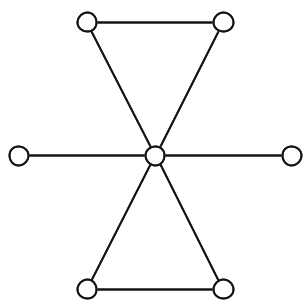 Smallest examples of (a) Hamlet - C5, (b) Social Circle - C4, and (c) Coterie - C3.
Introducing the "Borough"
The breakthrough insight of this paper is the Borough.
Think of a borough as a "super-community." Mathematically, it is a maximal union of edge-chained basic cycles ().
- Why it matters: Every nonseparable 2-club is contained within exactly one borough.
- Topological Significance: By identifying boroughs first, we can partition the graph into "areas of close communication" and the "outback" (the non-basic edges that represent remote contacts).
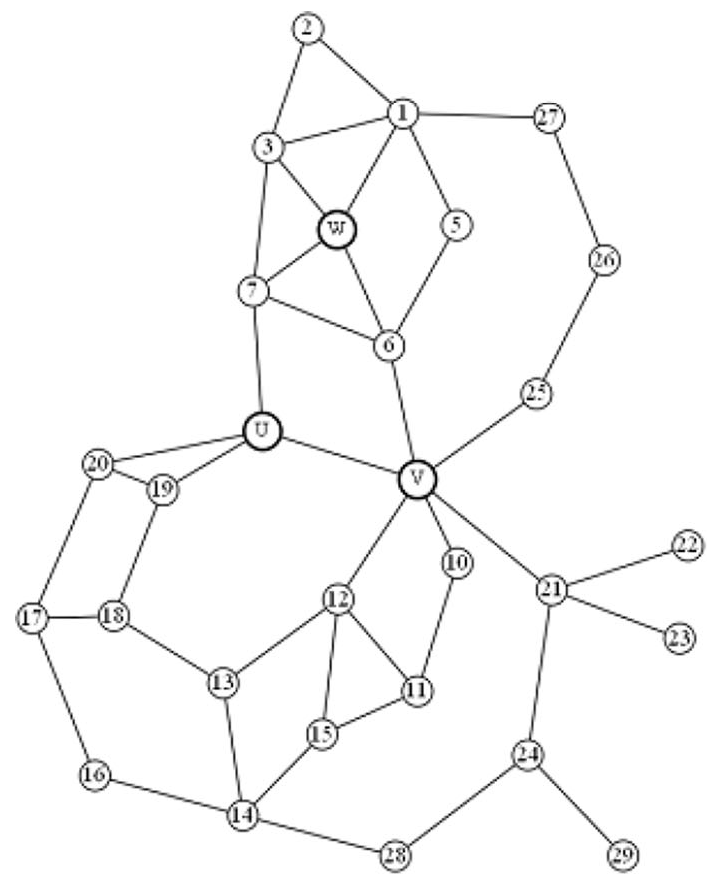 A graph partitioned into two distinct boroughs (red and blue) and the "outback" (black dashed lines).
Real-World Applications
1. Zachary’s Karate Club: Predicting the Split
Re-analyzing this classic 34-node dataset, the authors found that 2-club membership was a superior predictor of which faction a member would join. Specifically, node 9—a historically "mysterious" case—was shown to belong to five 2-clubs dominated by the teacher ("Mr. Hi"), explaining his eventual loyalty despite having ties to the club president.
2. European Corporate Boardroom (2010)
Analyzing interlocking directorates among 286 top European firms, the authors identified a "Giant Borough" of 225 companies.
- Findings: The network was dominated by French firms. The Belgian firm Compagnie Nationale à Portefeuille was found in nearly 50% of all 2-clubs, revealing its role as a massive cross-European liaison, particularly within the Francophone sub-network.
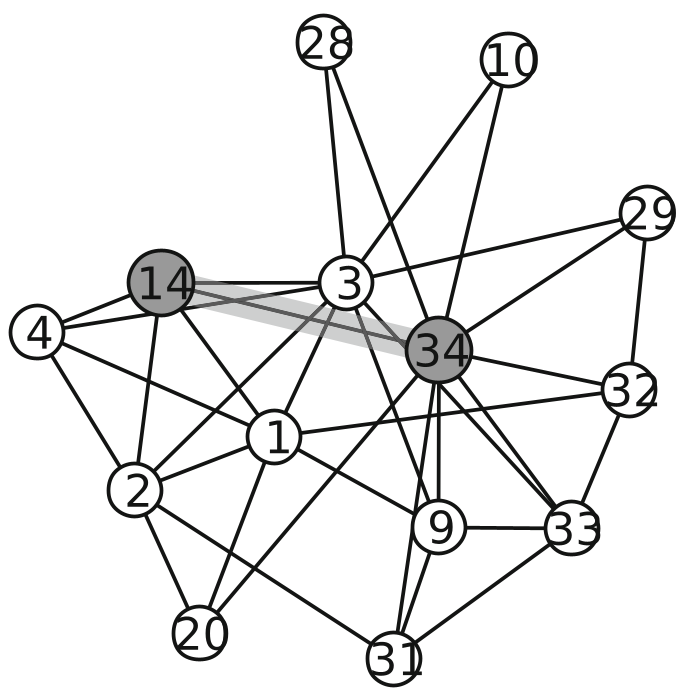 A Social Circle of 25 companies within the European corporate borough.
3. Scaling to Big Data (DBLP)
In co-authorship networks with over 150,000 nodes, the borough structure revealed a "Giant" component and thousands of smaller silos. The size of these boroughs follows a power-law distribution, typical of naturally occurring social structures.
Critical Analysis & Conclusion
The "Borough" framework effectively bridges the micro-macro gap in social network science. By focusing on diameter-2 subgraphs, it captures the physical intuition of "close communication" better than standard cluster algorithms.
Limitations: While identifying boroughs significantly reduces the search space for 2-clubs, the computational cost for high-density large graphs remains significant. Future work could integrate this with distributed graph processing to handle networks with millions of edges.
Final Takeaway: To find the true heart of a social network, don't look for the biggest cluster—look for the boroughs.