
Logic in the Community: How Shared Traits and Subjective Priorities Shape Social Networks
A Closeness- and Priority-Based Logical Study of Social Network Creation
Deeply rooted in Dynamic Epistemic Logic (DEL), this paper explores the logical mechanisms of social network formation based on agent similarity. It introduces a subjectively weighted closeness model (WCT) and provides sound and complete axiom systems for describing network updates through threshold-based strategies.
TL;DR
Why do we become "friends" with some people and not others? This paper shifts the focus from social influence to social creation. By leveraging Dynamic Epistemic Logic (DEL), the authors provide a formal framework where network links are forged based on "Closeness"—the overlap of traits—and "Priority"—the subjective importance agents assign to those traits.
Motivation: Moving Beyond Static Networks
Traditional social network analysis often treats the "graph" as a given. However, in real-world scenarios—be it dating apps, organ donor matching, or professional networking—links are created through a similarity-based strategy. Most prior logical models measured dissimilarity (distance). Smets and Velázquez-Quesada argue that humans often focus on what they share (closeness) rather than what divides them, and more importantly, they don't value all traits equally.
Methodology: From Objective Distance to Subjective Closeness
The authors transition from standard Social Network Models (SNM) to Extended Social Network Models (XSNM).
1. The Core Infrastructure
In a standard SNM, agents are defined by a set of traits . The Closeness between two agents and is simply the count of traits they both have or both lack:
2. Introducing Subjective Weights (XSNM)
The breakthrough of this paper is the introduction of a priority ordering . For one agent, "political alignment" might be a dealbreaker (high weight), while for another, it's irrelevant compared to "shared hobbies."
The model partitions traits into layers :
- : Most important traits.
- : Next tier of importance.
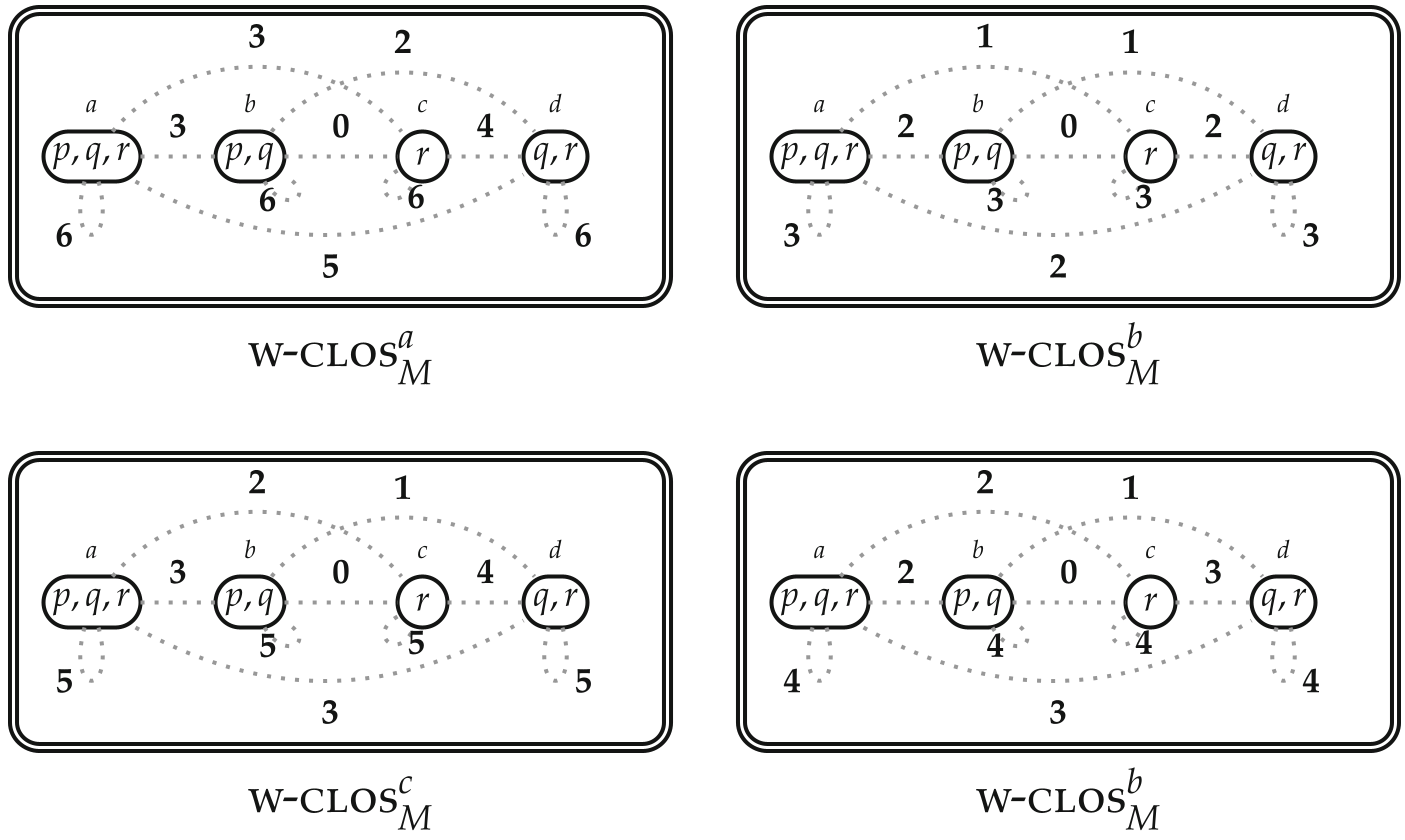 In the figure above, different thresholds ( vs ) applied to weighted similarities result in fundamentally different social topologies.
3. Threshold Updates
A link is created if the (weighted) closeness exceeds a threshold . This represents a "compatibility" requirement.
Critical Insight: The "Weighted World" vs. The "Weightless World"
The paper reveals a fascinating mathematical divergence:
- In the weightless world: Social networks created by closeness are naturally symmetric. If I am similar to you, you are inevitably similar to me.
- In the weighted world: Reflexivity and symmetry can break. If I value a trait we share but you don't value it, I might consider you a "social contact" while you remain indifferent to me. This explains asymmetric friendships and one-way influence often seen in virtual societies.
Experimental Insight: Cluster Graphs and Diversity
Through "uniformly distributed" trait experiments (Proposition 7), the authors show that when trait distribution is restricted, the threshold update naturally organizes agents into cluster graphs (disjoint fully connected components). However, when diversity increases, "bridge agents" emerge, connecting diverse groups and potentially facilitating informational cascades.
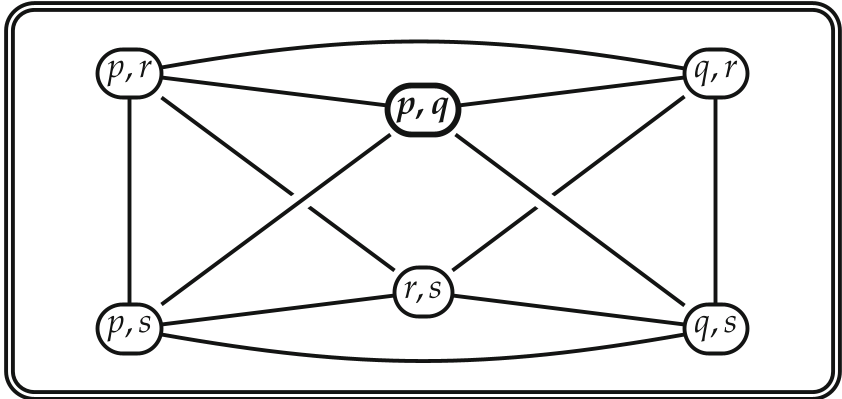 Example of overlapping clusters where agents act as bridges between dissimilar groups.
Conclusion and Future Outlook
This paper provides the "missing link" in social logic by formalizing how networks are born. The total recursive axiomatization means these updates can be integrated into automated reasoning systems.
Where do we go from here? The ultimate frontier is the co-evolutionary loop:
- Choice: Agents form networks because they are similar.
- Influence: Once connected, they become more similar (homophily).
- Reshaping: This new similarity triggers further network updates.
Modeling this "tandem" process is the next major challenge for the field of formal social epistemology.