
Cloud-Aided Privacy: Balancing Social Proximity and Data Security in MSNs
A Cloud Aided Privacy-Preserving Profile Matching Scheme in Mobile Social Networks
This paper introduces a cloud-aided privacy-preserving profile matching scheme designed for Mobile Social Networks (MSN). By utilizing Paillier homomorphic encryption and cloud-assisted computation, it enables secure fine-grained social proximity measurement (dot product) while achieving significant computational offloading for mobile users.
TL;DR
In the age of Mobile Social Networks (MSN), finding like-minded friends often requires comparing personal profiles. This paper presents a novel scheme that offloads the heavy lifting of "fine-grained" matching (dot product calculations) to the cloud. By leveraging Paillier Homomorphic Encryption and clever masking, the system ensures that neither the cloud nor the potential friends can peek at your private data, all while the cloud handles up to 99% of the computation.
The Dilemma: Accuracy vs. Battery Life
Mobile Social Networks thrive on discovery. To find a "best match," systems usually calculate social proximity through profile matching.
- Coarse-grained methods (set intersections) are fast but lack depth.
- Fine-grained methods (dot products of interest vectors) are accurate but demand heavy cryptographic operations.
For a mobile user, running complex Homomorphic Encryption (HE) locally is a battery killer. Conversely, uploading raw profiles to a cloud server for faster matching is a privacy nightmare. The authors identify this "efficiency-privacy" wall as the primary obstacle for modern MSN services.
The Insight: Delegating Without Distrust
The core intuition of this work is that we don't need the cloud to understand the data to process it. The authors employ a multi-step protocol involving Alice (initiator), Bob (receiver), and a Cloud Provider.
Methodology & Architecture
The scheme relies on the Paillier Cryptosystem, which allows for additive homomorphism: .
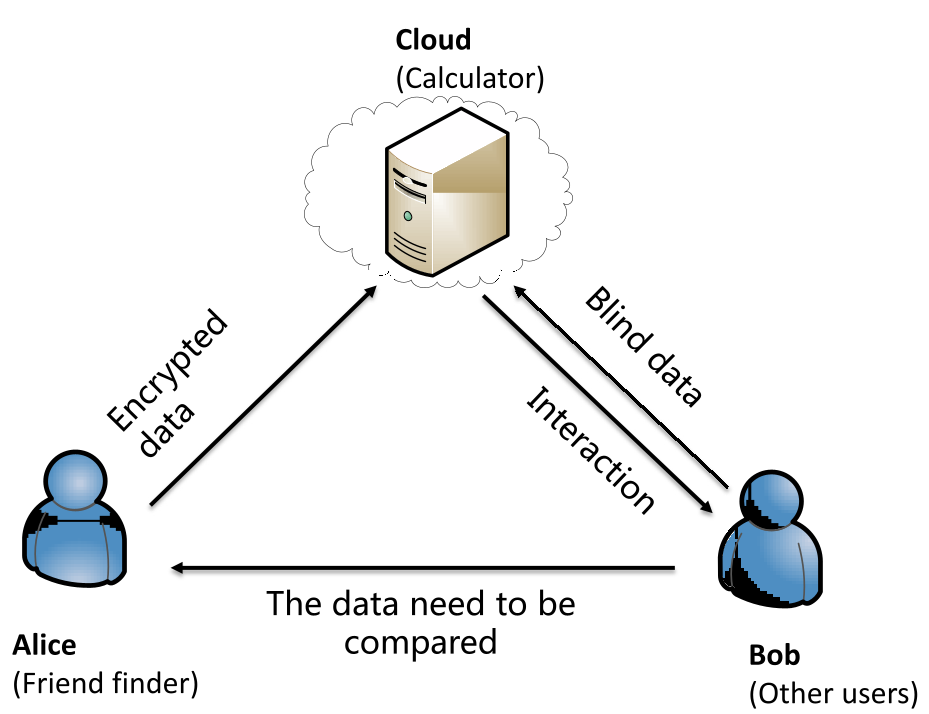
The Process:
- Bliding & Encryption: Alice encrypts her vector and sends it to the cloud. She also sends a masked threshold and random factors to Bob.
- Double Masking: Bob generates his own random integers to mask his vector , transforming it into , which is sent to the cloud.
- Cloud Computation: The cloud computes a partial dot product using the ciphertext and Bob's masked vector.
- Threshold Verification: Through a series of exchanges involving random integers and , Alice eventually decrypts a value . If , the proximity exceeds her threshold.
Crucially, because of the random factors, the cloud sees only random-looking numbers, and Alice only sees the final "Yes/No" result regarding the threshold, not Bob’s actual interests.
Evidence of Efficiency
The most striking result of this study is the Computation Offloading Ratio. As the dimensionality of the user profiles increases, the cloud's share of the work grows exponentially.
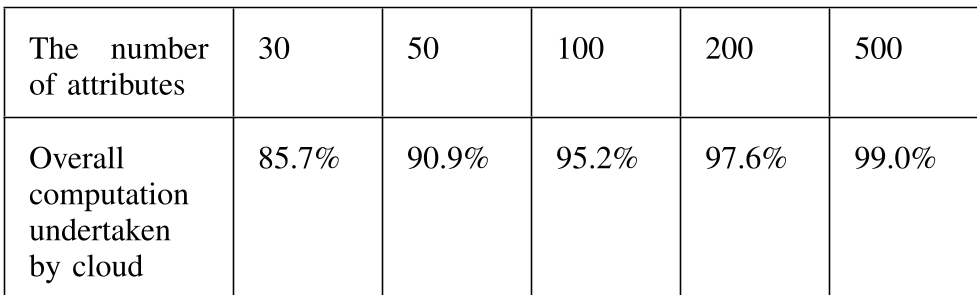
At 100 attributes—a standard size for a detailed social profile—the cloud handles 95.2% of the work. For 500 attributes, this rises to 99.0%, leaving the mobile device to handle only minimal encryption and decryption tasks.
Critical Analysis
Strengths
- Low Complexity: By moving from to relative to attribute count (compared to earlier Sheng et al. models), the scheme is ready for real-world MSN deployments.
- Privacy Rigor: The use of two random integers ensures that even the final result doesn't leak the exact dot product value to Alice.
Limitations & Future Work
The scheme operates under the Honest-but-Curious (HBC) model. While standard in academic literature, it assumes the Cloud and Bob will not collude. In a real-world adversarial environment, a "Malicious Model" would be required to prevent parties from deviating from the protocol to extract information. Future research might integrate Zero-Knowledge Proofs (ZKP) to verify that the cloud actually performed the calculation correctly without needing to trust its integrity.
Conclusion
This paper provides a robust blueprint for "Privacy-as-a-Service." It proves that the cloud can be a powerful ally in cryptography, not just a storage bin, provided we design protocols that treat the server as a "blind worker" rather than a trusted gatekeeper.