
HYBRID: Bridging the P2P Latency Gap with Cloud-Assisted Social Overlays
Cloud-assisted dissemination in social overlays
This paper introduces HYBRID, a cloud-assisted P2P dissemination protocol for decentralized social networks. It combines gossip-based social overlays with passive cloud storage to overcome message delays caused by peer churn, achieving latencies comparable to centralized servers while maintaining friend-to-friend privacy.
TL;DR
Decentralized social networks often face a "trade-off trap": you either get privacy through Peer-to-Peer (P2P) social overlays but suffer from hours of delay due to user churn, or you use a centralized server for speed but sacrifice data control. This paper presents HYBRID, a protocol that uses a passive cloud "safety net" to patch P2P connectivity gaps. It reduces long-tail latencies from hours to minutes while keeping monetary costs negligible for most users.
The Problem: The "Churn" Crisis in Social Overlays
The core charm of a Social Overlay (SO) is that data only travels through friends. However, humans aren't servers; they log in and out unpredictably. This "churn" creates transient partitions in the network graph. If the one friend who connects your "ego network" to the rest of the world goes offline, you are cut off from updates for hours.
Prior work (PURE P2P) showed that 1% of receivers might experience delays over 3 hours—a total dealbreaker for anyone used to the instantaneous nature of Facebook or X (formerly Twitter).
The Solution: A Hybrid "Quenching" Mechanism
The authors propose that each user maintains a Profile Store in a high-availability cloud (like Amazon S3). Instead of a costly "active" cloud instance (like an EC2 server running 24/7), this is a passive, encrypted data bucket.
The HYBRID Protocol Logic:
- Gossip First: Try to send the update via the P2P social overlay.
- Strategic Polling: If a friend hasn't heard an update for a time , they poll the cloud.
- Access Quenching: Once a node hears from the cloud (even if there is no update), it pushes a "QUENCH" message to the P2P network. This tells other friends: "I checked the cloud at time , and there's nothing new. You don't need to pay for a cloud request for the next minutes."
 The protocol aims to satisfy the soft delay bound , ensuring updates are ready upon a user's next login.
Methodology: Randomization for Efficiency
A naive polling strategy leads to "thundering herds" where many nodes poll the cloud simultaneously, wasting money. HYBRID introduces a randomized component to the polling interval (), scattering access times and allowing the first node that polls to "quench" the others effectively.
Experimental Results: Performance & Cost
Using a sample of 700 real-world ego networks from the Orkut crawl, the authors compared HYBRID against pure P2P and centralized servers.
1. Latency Breakdown
HYBRID effectively "cuts the tail" of the delay distribution. The 99th percentile receiver delay drops from 1.5 hours in pure P2P to under 10 minutes in HYBRID.
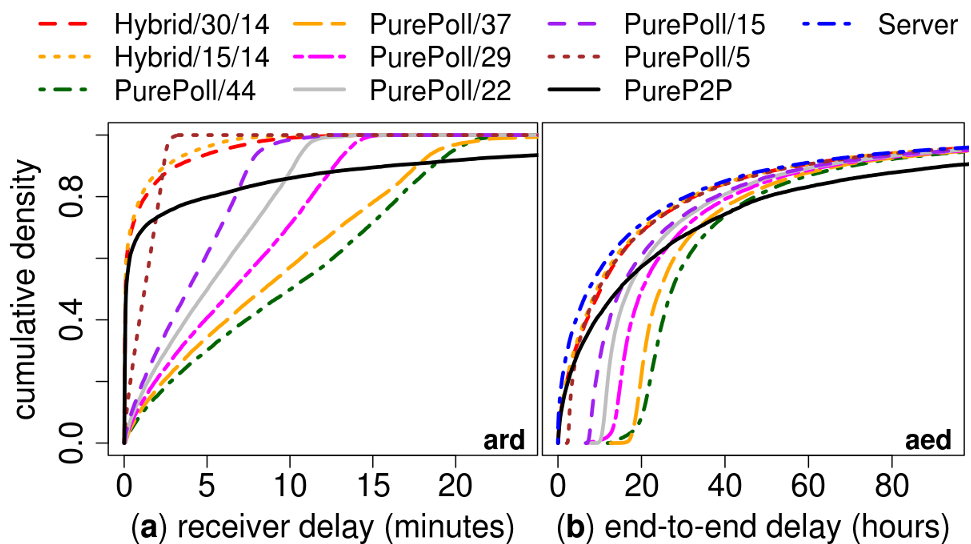 The CDF clearly shows HYBRID (left curves) performing significantly closer to the ideal SERVER model than PURE P2P.
2. Is it Cheap?
Using Amazon S3 pricing, the study found:
- Flat Cost Model: Most users pay ~$1.42 per year.
- Degree Model: Highly connected users (the "influencers" of the overlay) pay more, but for users with under 1,000 friends, the cost remains under $21/year—far cheaper than hosting a dedicated server.
Critical Analysis & Takeaways
The genius of this work lies in Access Quenching. By treating the cloud as a shared resource that the P2P network "samples" only when necessary, the authors solve the reliability problem of decentralized networks without the astronomical costs of centralization.
Limitations:
- High-Degree Nodes: Users with 30,000+ friends face high bandwidth and monetary costs. The authors suggest "trimming" friend lists, but in a modern social context, this might not be feasible for public figures.
- Metadata Privacy: While data is encrypted, the cloud provider still sees who is polling whose profile and when.
Final Thought: HYBRID proves that decentralized social networks don't have to be slow. By using the cloud as a "stateless relay" rather than a "data owner," we can have our privacy and our real-time updates too.
References
- Mislove et al. Measurement and analysis of online social networks. IMC 2007.
- Mega, Montresor, and Picco. Cloud-assisted dissemination in social overlays. DISI Tech Report 2013.