
Beyond Storage: Building Predictive Intelligence into Healthcare Clouds
Building Cloud-Based Healthcare Data Mining Services
This paper introduces a specialized cloud-based healthcare data mining framework designed to transition healthcare IT from simple data storage to active knowledge discovery. The authors implement a specific service for predicting a patient's Future Length Of Stay (FLOS) using ensemble learning methods like Random Forest and Gradient Boosting Machines, achieving superior predictive accuracy over traditional linear baselines.
Executive Summary
TL;DR: This paper bridges the gap between healthcare data storage and actionable clinical intelligence. By proposing a modular Cloud-based Healthcare Data Mining Framework, the authors demonstrate how we can move past "just storing" Electronic Health Records (EHRs). They showcase this through a robust service that predicts a patient’s Future Length Of Stay (FLOS), utilizing Ensemble Learning to outperform standard cloud-based linear models.
Positioning: This work serves as a foundational blueprint for Healthcare-as-a-Service (HaaS), shifting the focus from IT maintenance to predictive clinical interventions.
The "Data Silo" Struggle: Why This is Hard
The healthcare industry currently treats data like a digital filing cabinet. While Cloud Computing has made storage cheaper, the information remains trapped by three major hurdles:
- Heterogeneity: Medical data is a messy mix of categorical (gender), ordinal (pain scales), and numerical (lab results) values.
- Infrastructure Gap: Existing hospital systems are optimized for billing, not for the intensive compute required for deep data mining.
- The Expertise Silo: Building a predictive tool requires a rare alignment of medical domain knowledge, data science, and cloud systems engineering.
Methodology: The Logic of Ensemble Learning
The core of the paper lies in how the authors choose their "weapons." They break down the difficulty of prediction using a mathematical lens, categorizing errors into:
- Approximation Error: Does our model have the "shape" to fit the data?
- Estimation Error: Do we have enough data to fill that shape?
- Optimization Error: Can we actually find the best version of this model in a reasonable time?
To balance these, the authors advocate for Ensemble Tree-based Methods.
Model Architecture
The framework is divided into layers, ensuring that data integration is transparent to the data scientist, and the resulting model is easily accessible to the clinician.
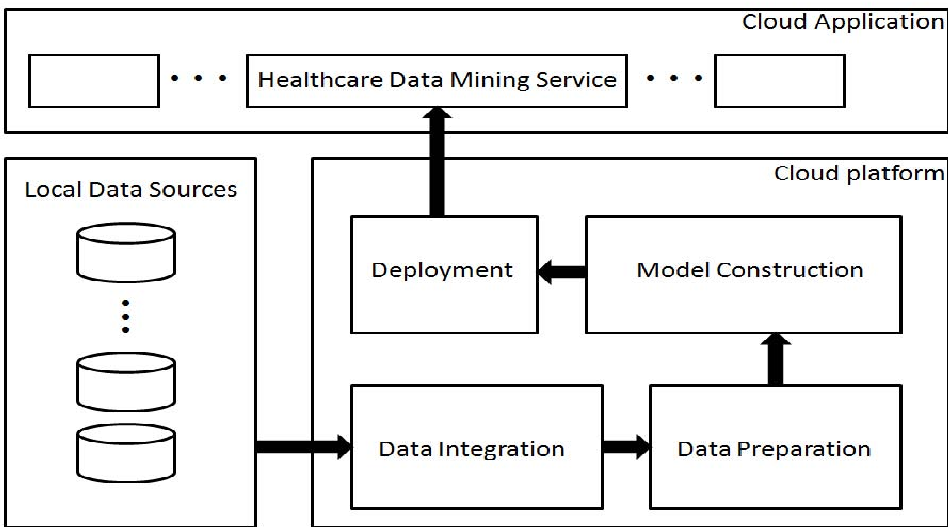 Fig 1: The proposed cloud-based healthcare data mining framework showing the flow from raw data to user-facing applications.
By using Random Forest (RF) and Gradient Boosting Machines (GBM), the authors exploit the "Stability vs. Flexibility" trade-off. RF is robust against small data samples (reducing estimation error), while GBM is a powerhouse for large datasets (reducing approximation and optimization errors).
Experimental Insights: RF vs. GBM
The researchers tested their approach on a real-world dataset of ~147,000 records. The goal was simple: Predict how many days a patient will spend in the hospital next year.
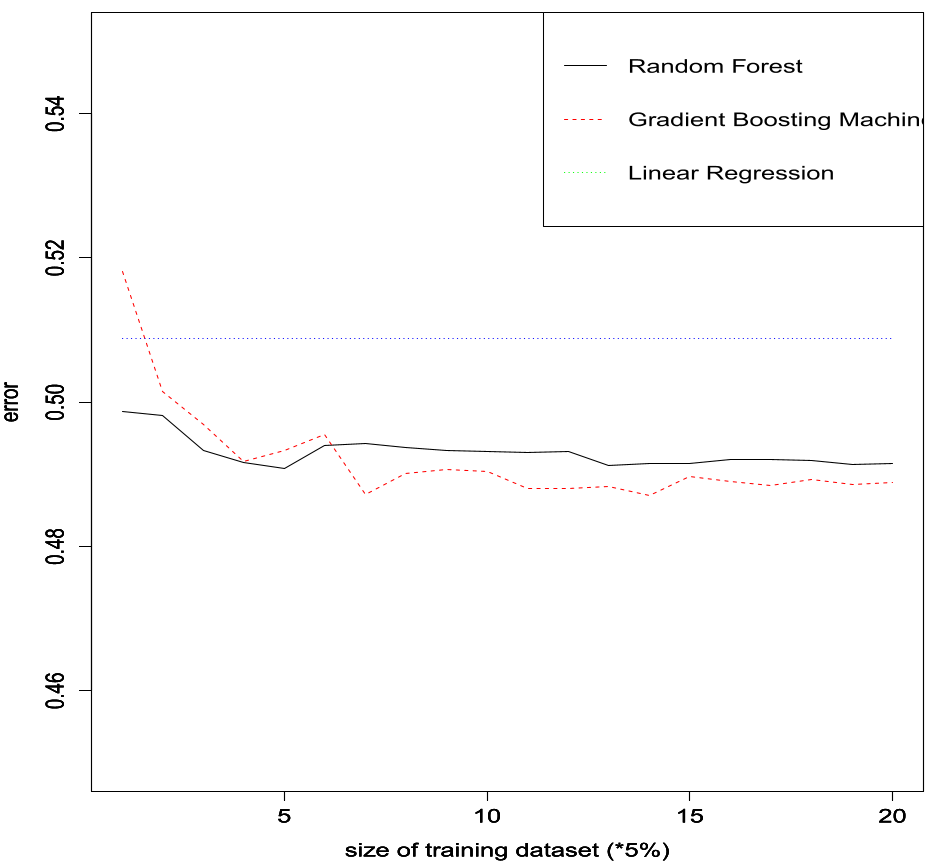 Fig 2: Error rates (Logarithmic RMSE) across different training set sizes.
Key Findings:
- The Baseline Killer: Both RF and GBM significantly beat the Amazon Machine Learning Linear Regression benchmark.
- Data Scaling: As the training data increases from 5% to 100%, GBM's error rate drops more sharply than RF's. This confirms that for massive healthcare datasets, sequential optimization (Boosting) is superior to parallel averaging (Bagging).
- Distribution Matching: The models successfully captured the "long tail" of hospital stays—where most patients stay 0-1 days, but a critical few require much longer care.
Critical Analysis & The Future
The authors successfully move the needle toward Preventative Healthcare. By predicting FLOS, hospital administrators can identify patients at risk of Potentially Avoidable Hospitalizations (PAHs) and intervene before an emergency occurs.
Limitations: While the cloud provides the "brawn," the paper leans heavily on traditional ensemble methods. In the current era of LLMs and Multi-modal transformers, the next step for this framework is integrating unstructured data (doctor's notes, medical imaging) which remains largely untapped in this study.
Takeaway: The future of healthcare isn't just in the cloud—it's in the specialized mining services on that cloud that turn "records" into "insights."