
P2PRioEP: Revolutionizing Precision Agriculture through Advanced IoE Protocols
A cloud-based prototype for the monitoring and predicting of data in precision agriculture based on internet of everything
This paper presents a cloud-based prototype for precision agriculture that leverages the Internet of Everything (IoE) and a novel communication protocol, P2PRioEP, to monitor and predict environmental variables like soil moisture and humidity. The system integrates Wireless Sensor Networks (WSN) with cloud-based data mining to provide actionable insights for farmers, specifically targeting productivity issues in the Indian agricultural sector.
TL;DR
To combat the agricultural crisis in India, researchers have developed a cloud-based prototype utilizing the Internet of Everything (IoE). The core innovation is the P2PRioEP protocol, a peer-to-peer registry-based system that allows sensors to communicate efficiently, facilitating real-time monitoring of soil and climate data to optimize crop yields and prevent drought-related failures.
Context & Motivation
Agriculture remains the backbone of the Indian economy, yet nearly half of the community faces hardship due to "unfortunate rain" and climatic volatility. The challenge is not just collecting data, but transmitting it reliably across disparate nodes in a field. Current IoT frameworks often struggle with standardizing how devices discover and talk to each other in a hybrid network. The authors argue that a transition to Internet of Everything (IoE)—where people, process, data, and things are interconnected—is essential for the next leap in "Smart Agriculture."
Methodology: The P2PRioEP Protocol
The heartbeat of this research is the Peer-to-Peer Central-Registry biased Internet of Everything Protocol (P2PRioEP). Unlike generic protocols, it is designed specifically for Device-to-Device (D2D) interaction within a hybrid network.
1. Architectural Anatomy
The protocol runs on top of TCP to leverage its inherent reliability (retransmission and sequencing). It employs a stateful communication model, maintaining connections through distinct phases:
- Authenticating (S1) & Authenticated (S2): Ensures only authorized devices access the registry.
- Ready to Send (S3) & Receiving (S4): Manages the handshake between a sender and a receiver.
- Processing (S5) & Acknowledgment (S6/S7): Facilitates the actual data exchange and ensures the loop is closed.
 Figure 1: Comprehensive operational structure of IoT in diverse agricultural actions.
2. Message Format
Messages use a strict format starting with &_, followed by a msg_id and up to five header fields, ending with a Carriage Return (<CR>). This enables the protocol to support arbitrary message lengths—a critical feature for varying sensor payloads.
Experimental Deployment & Analysis
The prototype was deployed in a farmhouse in Chennai, India. The hardware architecture utilized IEEE 802.15.4 for local communication and GPRS modules to transport JSON-formatted data to the cloud.
Data Mining and Prediction
The authors didn't just stop at monitoring; they applied three machine learning paradigms to the collected data:
- Linear Regression
- Neural Networks
- Support Vector Machines (SVM)
By using a 70/30 split for training and testing, the system could forecast objective parameters like soil humidity.
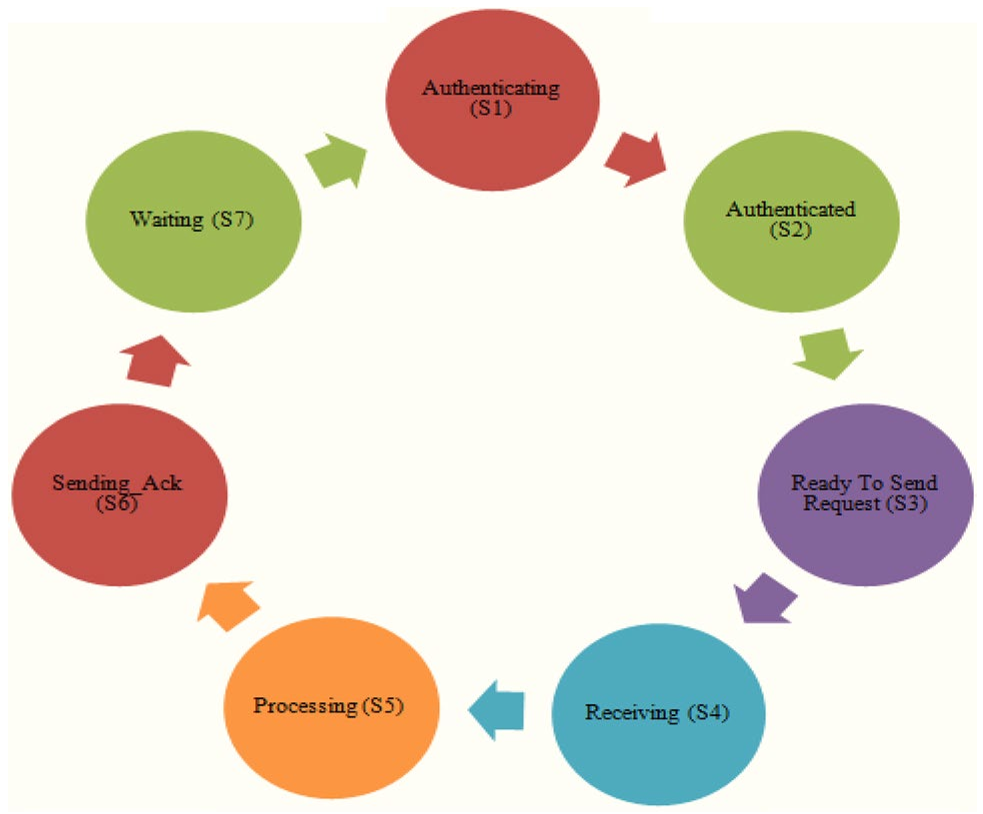 Figure 2: The state transition logic ensuring reliable P2P delivery.
Key Results
Over a three-month period (January to April), the system tracked significant moisture loss across four different nodes. For instance, Node 2 showed a drop from 70 KPA to 50 KPA. Such precision allows for a "Smart Watering" system that only hydrates crops when essential, optimizing water usage.
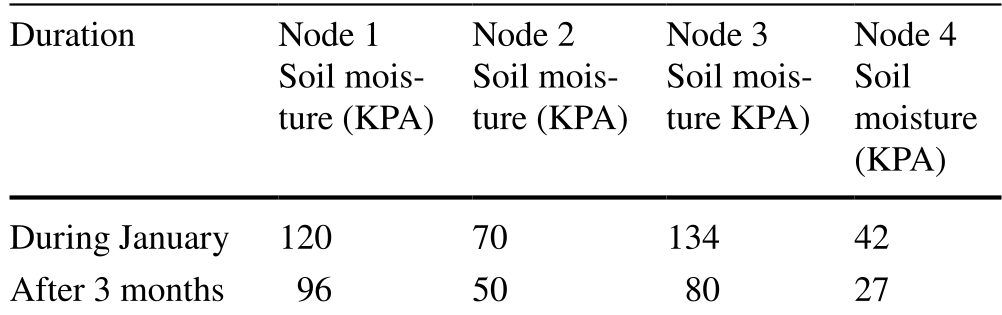 Table 1: Soil moisture tracking across 4 nodes over a 3-month duration.
Critical Insight & Future Outlook
While the P2PRioEP protocol introduces a robust state-transition mechanism, it does have a noted limitation: a maximum of five fields per message. This might restrict more complex multi-sensor payloads in the future.
Takeaway: This work proves that precision agriculture's success depends less on the "sensors" themselves and more on the reliability of the protocol stack connecting them. The authors suggest that future iterations will incorporate Image Processing and high-resolution cameras to move from environmental monitoring to visual health diagnostics of crops.
Conclusion
By bridging the gap between low-cost hardware and sophisticated P2P registry protocols, this prototype provides a blueprint for "Smart Pest Control" and mechanical irrigation systems that could potentially save the livelihoods of thousands of farmers in drought-prone regions.