
FSN: Elevating Robo-Advisors via Financial Social Networks and Group Dynamics
SPECIAL SECTION ON CLOUD-BASED ROBOTIC SYSTEMS FOR INTELLIGENT SERVICES
This paper introduces a Financial Social Network (FSN) framework integrated with collaborative filtering to provide robo-advisor services for groups. The core method, FSN-based group recommendation, leverages transaction relationships to enhance prediction accuracy and has achieved SOTA performance on both the MovieLens benchmark and a real-world commercial bank dataset.
TL;DR
Modern robo-advisors often operate in a vacuum, focusing on individual users while ignoring the social context—such as family units—that governs real-world financial decisions. This paper introduces the Financial Social Network (FSN), a graph-based recommendation framework that incorporates transaction relationships into collaborative filtering. By treating asset allocation as a group activity, the model achieves a significant boost in returns (8.26% vs. 6.38%) while drastically reducing risk volatility.
Background: Beyond the Individual Investor
Asset allocation is rarely an isolated behavior. Whether it is a couple saving for a house or parents planning for education, financial decisions are deeply embedded in social structures. Traditional Collaborative Filtering (CF) models struggle because:
- Data Sparsity: Users interact with only a few financial products.
- Cold Start: New investors have no historical profile.
- Group Conflict: Individual preferences in a family often clash (e.g., one aggressive investor vs. one cautious investor).
The Problem & Motivation
The researchers identified that "Financial Social Choice" is missing from current robo-advisors. Prior works focused on individual preference aggregation but failed to model the influence investors have on one another within a network. The motivation was to leverage "Financial Social Networks" to fill high-dimensional rating voids using social similarity.
Methodology: The FSN Framework
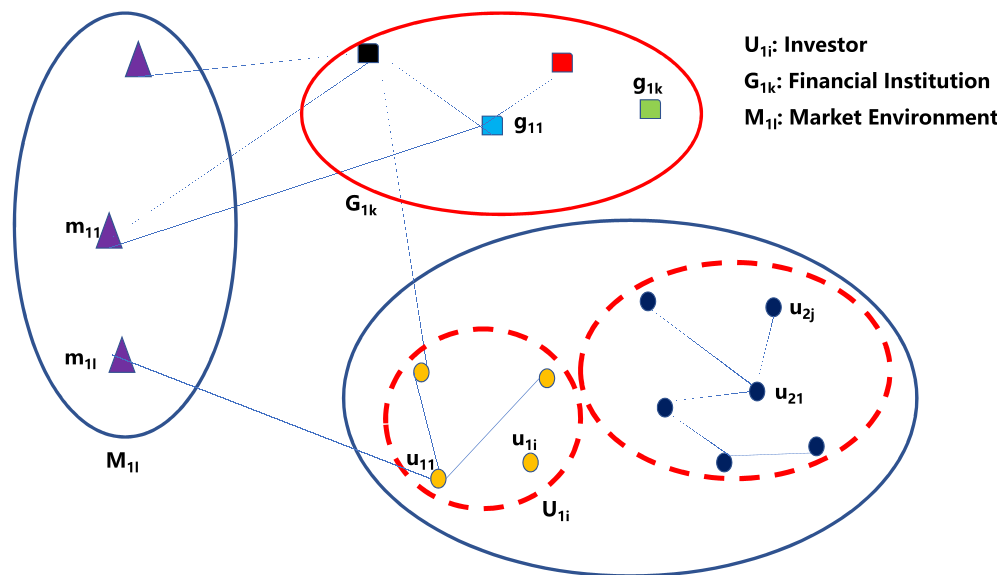
The core of the methodology lies in the construction of an undirected link graph , where nodes represent investors and edges represent transaction relationships.
1. Financial Social Network Construction
The framework connects investors (), items/products (), and groups (). It identifies "strongly connected subgroups" (like families) to understand collective risk appetite.
2. Similarity and Matrix Completion
Using Pearson Correlation Similarity (PCS) combined with transaction-based tags, the model calculates the proximity between investors. This allows the system to predict how a user might rate a product based on the behavior of socially linked neighbors, effectively solving the cold-start problem.
3. Group Aggregation Strategies
To handle group recommendations, the paper employs:
- Average Strategy: Maximizes the mean satisfaction.
- Least Misery Strategy: Ensures no single member of the family is "miserable" with the risk level, which is critical for financial safety.
Experiments & Real-World Validation
The authors tested the model on two primary datasets: the standard MovieLens benchmark and a massive real-world dataset from a commercial bank in China (BCSs) containing 679,000 investors.
Key Performance Metrics
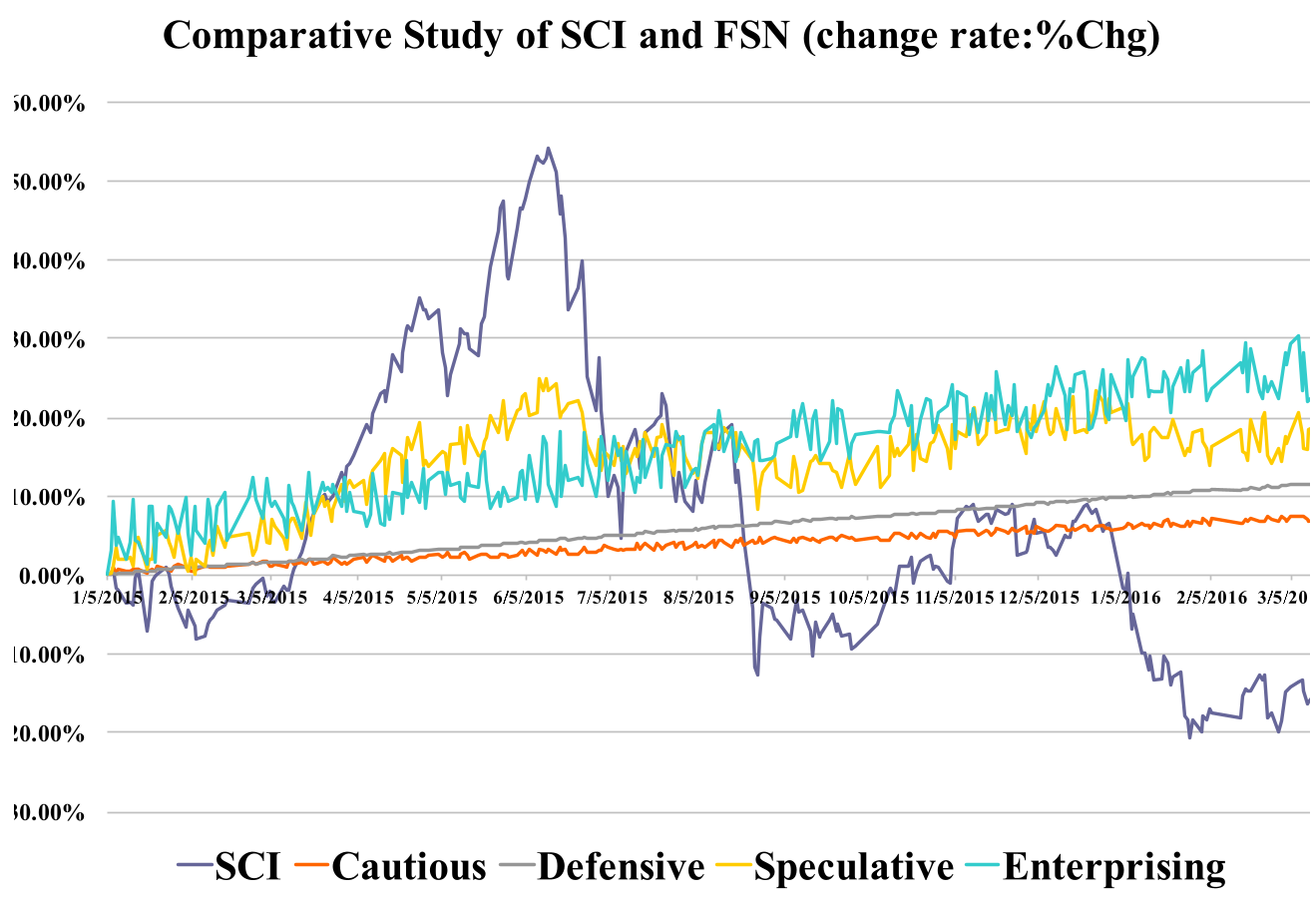
The results demonstrate a clear "social dividend" in financial accuracy.
| Model | Expected Return | Maximum Drawdown (Risk) |
|---|---|---|
| Traditional CF | 6.38% | 4.68% |
| Group Rec with FSN | 8.26% | 1.56% |
As shown in the data, the FSN-enhanced model doesn't just increase profit; it significantly stabilizes the portfolio, reducing the Maximum Drawdown (the peak-to-trough decline) by nearly 3x compared to baseline methods.
Critical Analysis & Conclusion
Takeaway
The integration of social graphs into financial recommendations is not just a theoretical improvement—it is a practical necessity for robo-advisors serving households. By utilizing the Financial Social Network, institutions can provide recommendations that are both collaborative and risk-aware.
Limitations & Future Work
While the FSN model is robust, it primarily uses undirected graphs. Future iterations could benefit from Directed Graphs to model social influence (e.g., an "expert" investor influencing a novice). Additionally, exploring Graph Convolutional Networks (GCNs) could further improve the extraction of latent features from complex transaction topologies.
FSN proves that in the world of finance, who you know is just as important as what you buy.