
Beyond Connectivity: Bridging Social Trust and Vehicular Networks (SAVNET)
5834_A Cloud-Based Trust Evaluation Scheme Using a Vehicular Social Network Environment.
Summary
Problem
Method
Results
Takeaways
This paper proposes a Comprehensive Trust Evaluation Mechanism for Socially Aware Vehicular Networks (SAVNET). It introduces a multi-dimensional trust model combining direct neighbor evaluation, friendship-based social relationships, and historical interactions to enhance data security and routing reliability in dynamic vehicular environments.
## TL;DR
This paper introduces a **Comprehensive Trust Evaluation Mechanism** for Socially Aware Vehicular Networks (SAVNET). By merging physical proximity with social friendship metrics, it provides a robust defense against malicious nodes, ensuring that vehicular communication is not just fast, but reliable.
## The Motivation: Why "Social" Matters in VANETs
Traditional Vehicular Ad-Hoc Networks (VANETs) treat every node as a transient IP address. However, in the real world, vehicles often follow repeatable patterns—commuting routes, shared destinations, and recurring interactions.
Current protocols are vulnerable to:
- **Black-hole attacks**: Malicious nodes dropping critical traffic data.
- **False Information**: Spoofed data causing artificial traffic jams.
- **High Mobility**: Rapidly changing topologies that break traditional trust chains.
The authors' **insight** is to leverage the "Social Domain." If a vehicle is a "friend" (frequent/stable interaction), its trust weight should be handled differently than a fleeting "neighbor."
## Methodology: The Anatomy of Global Trust
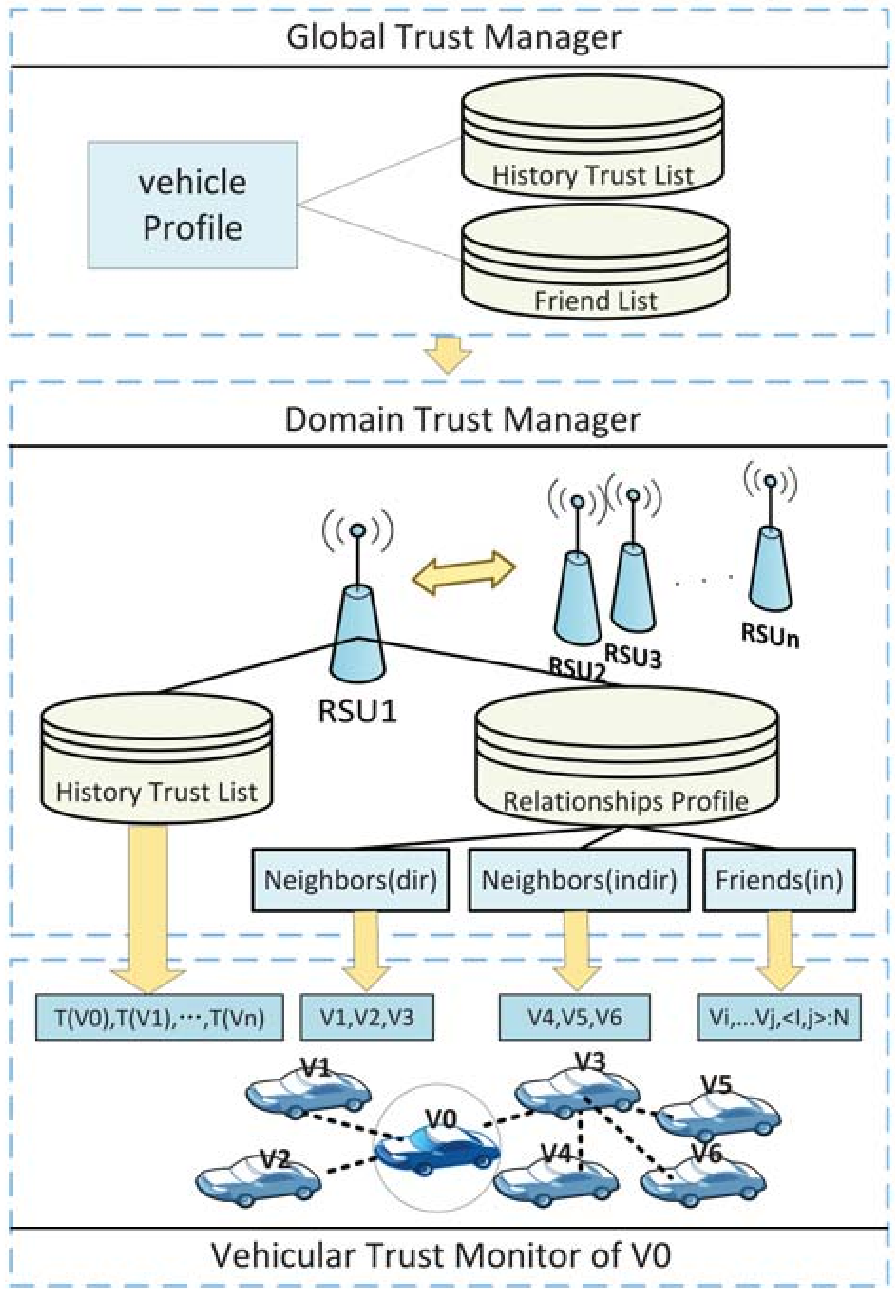
The core of the paper is the **Global Trust Evaluation (GTR)**. Instead of a single score, it is a weighted aggregate of three distinct dimensions:
1. **Neighbors' Trust (NTR)**: Based on direct observation and indirect feedback from immediate 1-hop and 2-hop physical neighbors.
2. **Friends' Trust (FTR)**: Divided into **Internal Friends** (same domain/route) and **External Friends** (different domain). This accounts for long-term social reliability.
3. **History Trust (HTR)**: A temporal decay model that remembers past behavior but prioritizes recent performance.
### Mathematical Logic
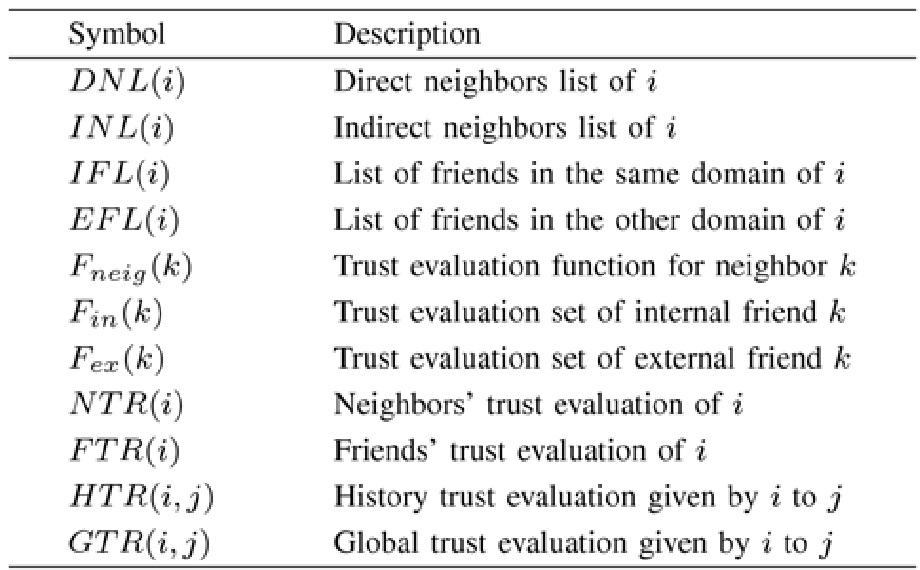
The trust evaluation function $F_{neig}(k)$ and the friend sets $F_{in}(k)$ allow the system to cross-reference multiple viewpoints. This creates a "manifold" of trust where a single malicious report cannot easily subvert the network's consensus.
## Experimental Validation
The researchers simulated the environment using a **Two Ray Ground** path loss model and **AODV** routing.
### Key Performance Metrics:
- **Resilience**: The system maintains a high packet delivery ratio even when under threat from malicious nodes.
- **Efficiency**: Despite the multi-dimensional calculation, the end-to-end delay remains within acceptable bounds for vehicular safety applications.
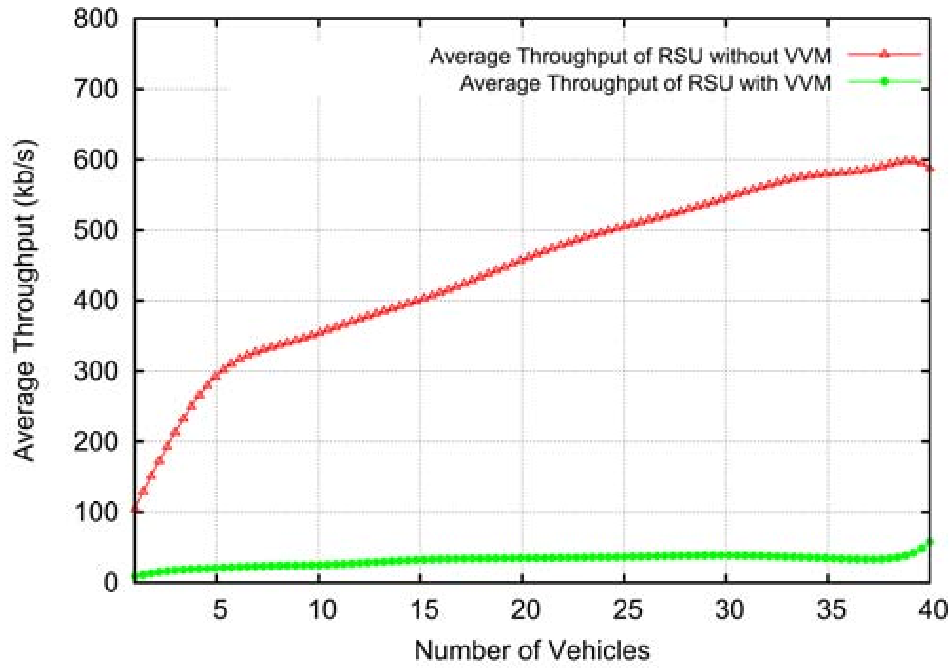
The results indicate that as the number of vehicles increases, the "Social" aspect provides a more stable backbone for trust than purely distance-based or signal-based metrics.
## Critical Analysis & Conclusion
### Takeaway
The integration of social attributes (friendship lists, domain membership) into vehicular routing is a significant step toward **Autonomous Cooperative Driving**. By quantifying "Social Trust," the network becomes self-healing against sporadic malicious behavior.
### Limitations & Future Work
- **Privacy Concerns**: The paper focuses on security but does not deeply address the privacy implications of sharing "friendship lists" between vehicles.
- **Computational Overhead**: As the network density grows, global trust calculation could become a bottleneck.
- **Future Path**: Integrating this trust model with **Reinforcement Learning (RL)** could allow vehicles to dynamically adjust trust weights based on environmental stress.
In summary, this work proves that in the future of V2X, who you "know" is just as important as who you "see."