
Cloud vs. Local Server: Empirically Testing the Scalability Myth
6666_Performance and load testing of cloud vs. classic server platforms (Case study Social network application).
This paper presents a comparative performance study between traditional Windows Server platforms and Azure Cloud infrastructure using a university social network application. Through empirical load testing and Software Reliability Engineering (SRE) methodologies, the study evaluates scalability, response time, and reliability across different user loads.
TL;DR
Is the Cloud truly faster than a high-performance local server, or is it just marketing hype? This research puts Microsoft Azure against a powerful Windows Server using a real-world University Social Network application. The verdict: while local servers hold their own under light loads, the Cloud's horizontal scaling wins decisively when traffic spikes, maintaining significantly lower response times.
Background & Motivation
For years, the industry has pushed the transition from classic "on-metal" or private server platforms to the Cloud. However, small to medium enterprises (SMEs) often ask: If I buy a server with a faster CPU and more RAM than a basic Cloud instance, won't it perform better?
The authors observed that most claims of "infinite scalability" lack empirical data using standardized Software Reliability Engineering (SRE) processes. They aimed to bridge this gap by testing two platforms using the same tech stack (ASP.NET, MSSQL) and similar hardware profiles to see where the breaking point lies.
Methodology: The SRE Approach
The researchers didn't just smash the servers with random requests. They developed an Operational Profile—a mathematical representation of how real users interact with the app.
- Operation Identification: Actions like Register, Search, and Post Scrap were tracked.
- Probability Assignment: Search was identified as the most frequent operation (approx. 60% probability).
- Test Execution: Using Visual Studio's load testing tools, they simulated two scenarios:
- Normal Load: 30 concurrent users.
- Stress Load: 200 concurrent users.
 Figure 1: The workflow for constructing a reliable operational profile to guide testing.
Hardware Comparison
To keep the fight fair, the environments were balanced:
- Local Server: AMD Opteron Dual-Core (2.2GHz), 40GB RAM.
- Azure Cloud: 3 "Small Instances" (1.6GHz each), totaling ~5.1GB RAM.
- Network: Both capped at 100Mbps bandwidth.
Critical Findings: Where the Server Fails
The experimental results revealed a clear performance divergence as the user count climbed:
- Efficiency at Low Load: At 30 users, the difference was negligible. The local server's high raw clock speed handled the requests comfortably.
- The Latency Gap: At 200 users, the local server's "Average Response Time" spiked. In contrast, the Azure instances, distributed across the cloud fabric, maintained a much flatter performance curve.
- Page Loading: Cloud instances delivered web pages faster under pressure, proving that distributed virtual roles handle concurrent I/O better than a single, albeit "beefier," machine.
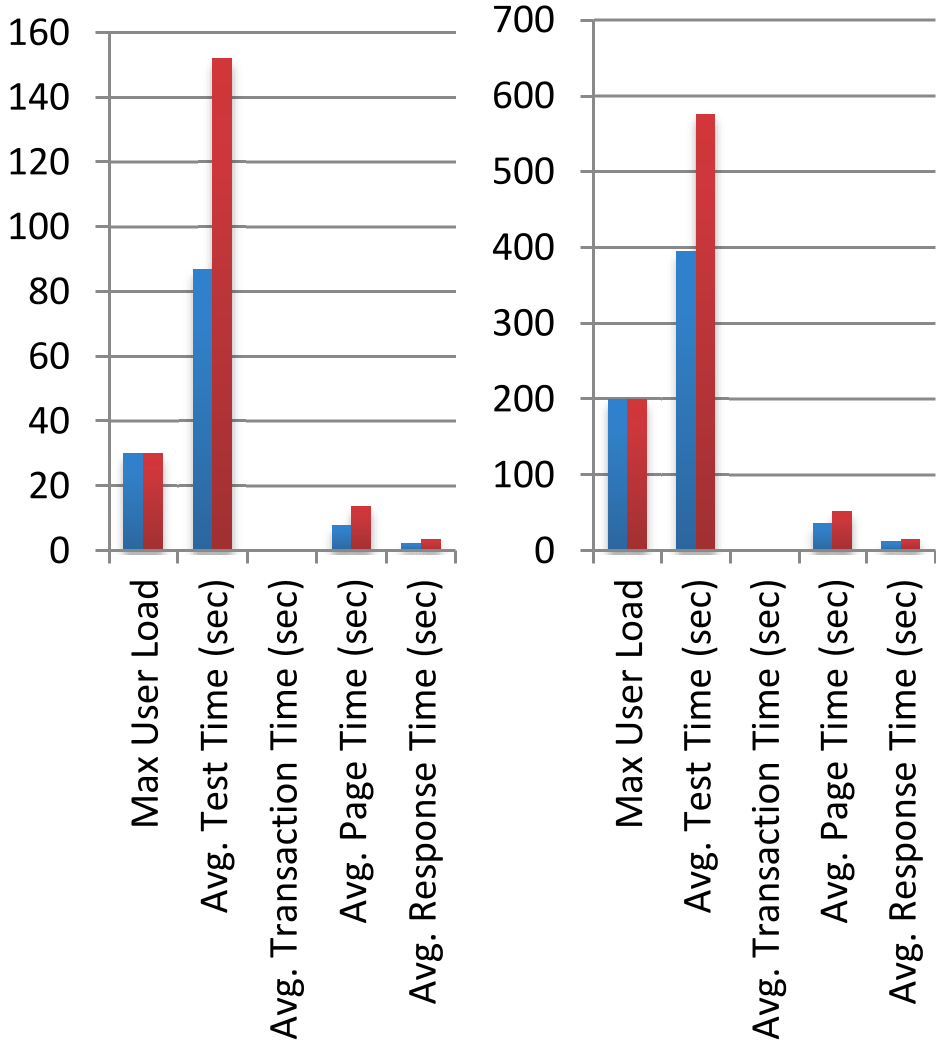 Figure 2: Performance metrics showing Azure Cloud (Blue) maintaining better stability than the Server (Red) under increased load.
Deep Insight & Conclusion
The study highlights that Scalability is not just about raw CPU cycles. While the local server had significantly more RAM (40GB vs 5GB), it couldn't match the throughput of the Cloud's 3-instance cluster. This is likely due to the architectural advantages of load balancing and the overhead of the IIS request queue on a single OS instance.
Limitations
The study focused on a web-based social network (I/O intensive). The authors acknowledge that for "Computational Intensive" tasks (like 3D simulations or heavy math), a dedicated high-clock-speed local server might still hold the advantage.
Final Takeaway
For any business growing beyond a static user base, the "Reliability" and "Horizontal Scaling" of the Cloud are not just buzzwords—they are measurable performance gains. If your application expects a large number of concurrent end-users, migrating to a multi-instance cloud environment is no longer optional; it is a technical necessity.