
Hybrid Intelligence: Boosting Stock Forecasts with CRO and Cloud Computing
Combining cloud computing, machine learning and heuristic optimization for investment opportunities forecasting
This paper proposes an integrative machine learning framework for stock market trend prediction, combining Support Vector Machines (SVM) with Chemical Reaction Optimization (CRO) and Grid Search (GS). The system incorporates Feature Noise Filter (FNF) and Principal Component Analysis (PCA) within a sliding window mechanism, deployed on the Microsoft Windows Azure cloud platform to forecast the Hang Seng Index (HSI).
TL;DR
Predicting stock market trends is notoriously difficult due to the "noise" in financial data. This paper introduces a sophisticated framework that optimizes Support Vector Machines (SVM) using a novel Chemical Reaction Optimization (CRO) algorithm. By integrating feature filtering and a sliding window mechanism on a cloud platform, the authors achieved an impressive 78.6% accuracy in predicting the Hang Seng Index, a significant leap over baseline models.
Context & Motivation: Why SVM is Not Enough
The Efficient Market Hypothesis (EMH) suggests that stock prices reflect all available information, making prediction impossible. However, modern Computational Intelligence (CI) challenges this. While Artificial Neural Networks (ANNs) are popular, they often fall into the trap of Local Optima and Overfitting.
SVMs offer a solution via Structural Risk Minimization, but they are "fussy" models. Their performance relies heavily on:
- The Penalty Factor (): Balancing error tolerance vs. margin width.
- Kernel Parameters (): Defining the reach of a single training example.
The authors argue that static parameters fail because markets are non-stationary—what worked last year won't work today.
Methodology: The "Secret Sauce"
The proposed framework isn't just one algorithm; it’s a pipeline designed to squeeze every bit of signal out of the noise.
1. Optimization via Chemical Reaction (CRO)
Instead of standard Grid Search, the authors employ Chemical Reaction Optimization. This metaheuristic transforms the optimization problem into a molecular simulation:
- Molecules represent potential pairs.
- Potential Energy (PE) represents the prediction error.
- Elementary Reactions (Collisions, Decomposition, Synthesis) allow the "molecules" to explore the solution space and escape local minima—an area where ANNs typically fail.
2. Feature Noise Filter (FNF) & PCA
Inputting 20+ technical indicators (MACD, RSI, etc.) creates redundancy. The framework uses:
- FNF: An iterative process that removes "noisy" features one by one, checking if accuracy improves.
- PCA: A linear transformation that reduces dimensionality while retaining 95% of the variance.
3. The Sliding Window Mechanism
This is the "engine" of adaptability. Rather than training a model once, the system uses a 50 or 100-day window that moves forward daily. This ensures the SVM is always tuned to the current market regime.
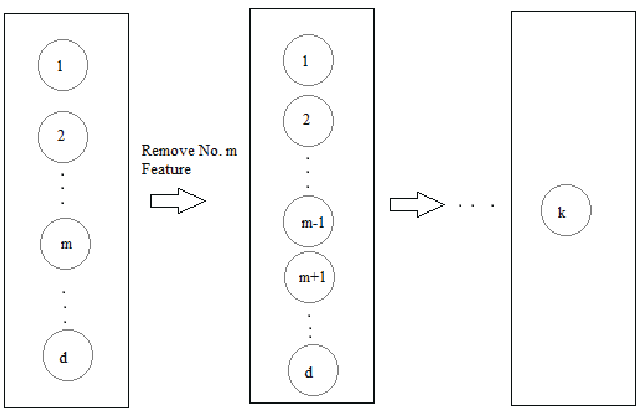 Figure: The iterative process of the Feature Noise Filter to refine input signals.
Experiments and Results
The researchers tested their framework on the Hang Seng Index (HSI) and major stocks like Tencent and HSBC.
Key Findings:
- Baseline SVM: Struggled with a meager ~40% accuracy.
- CRO-SVM: Jumped to 66.6% accuracy. The "chemical" search proved superior at finding global optima for SVM parameters.
- The Complete Pipeline (PCA-GS-SVM-SW): Reached a peak accuracy of 78.6%.
| Model Variant | Avg. Accuracy (HSI) | Key Advantage |
|---|---|---|
| Conventional SVM | 40.0% | Simple, but unstable |
| GS-SVM | 53.5% | Better parameters |
| CRO-SVM | 66.6% | Global optimization |
| Full PCA-GS-SW | 78.6% | Adaptability to trends |
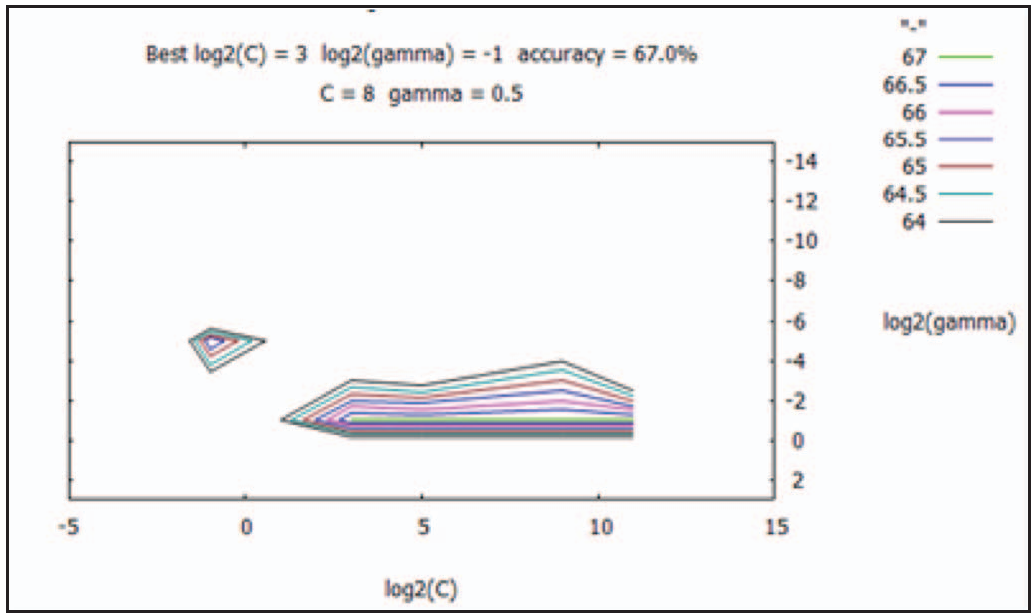 Figure: Grid Search contours showing the optimization landscape for SVM parameters.
Critical Insight & Conclusion
The true value of this paper lies in its holistic approach. While many researchers focus solely on the "learner" (SVM), this work highlights that pre-processing (PCA/FNF) and environment-awareness (Sliding Window) are just as vital.
Major Takeaways:
- Optimization Matters: Heuristic algorithms like CRO can prevent models from getting "stuck" in poor configurations.
- Cloud Power: Using Azure was essential to handle the heavy computational load of "Leave-one-out" cross-validation used in the sliding window.
- Dynamic > Static: A fixed model is a failing model in finance.
Limitations: The study assumes no short-selling and focused on daily trends. Future research could explore tick-by-tick high-frequency data where the noise-to-signal ratio is even more challenging.