
Breaking Borders in Liver Cancer Research: A Cloud-Based Transnational Data Mining Platform
A cloud computing based platform for sharing healthcare research information
This paper proposes a cloud-based medical data mining platform designed for collaborative liver cancer research involving institutions in Canada, Taiwan, and Mongolia. By leveraging a Service-Oriented Architecture (SOA) and virtualization technologies, it enables cross-border sharing of Electronic Health Records (EHR) and data mining results while maintaining privacy and cost-efficiency.
TL;DR
Biomedical research is often siloed by geographic and technical barriers. This paper introduces a transnational, cloud-based platform connecting Canada, Taiwan, and Mongolia to share liver cancer research data. By utilizing Service-Oriented Architecture (SOA) and virtualization, the researchers transformed fragmented Electronic Health Records (EHR) into a unified mining pool, significantly lowering infrastructure costs while addressing the "nightmare" of international data privacy laws.
The Motivation: Why Move to the Cloud?
Traditional research setups are plagued by the "Distributed Server Trap"—where each institution maintains its own hardware, leading to:
- Massive IT Overhead: Maintaining high-performance servers for sporadic data mining tasks is financially wasteful.
- Incompatible Environments: "Data lock-in" occurs when different sites use bespoke software that doesn't talk to others.
- Complexity Barriers: Processing millions of medical records for association rules (like the Apriori algorithm) requires elastic compute power that local labs often lack.
The authors realized that for early liver cancer detection to be effective, they needed a system that was on-demand, ubiquitous, and borderless.
Methodology: The SOA and Virtualization Core
The platform isn't just a database; it’s a sophisticated Community Cloud. The architecture relies on two technical pillars:
- Service-Oriented Architecture (SOA): By wrapping data and algorithms as Web Services, researchers can access remote resources via standardized programming grammars without worrying about the underlying OS.
- Virtualization (PaaS/SaaS): Using VMware, the platform provides a consistent execution environment. This allows site-specific researchers to run high-intensity data mining applications (SaaS) on virtualized hardware (PaaS).
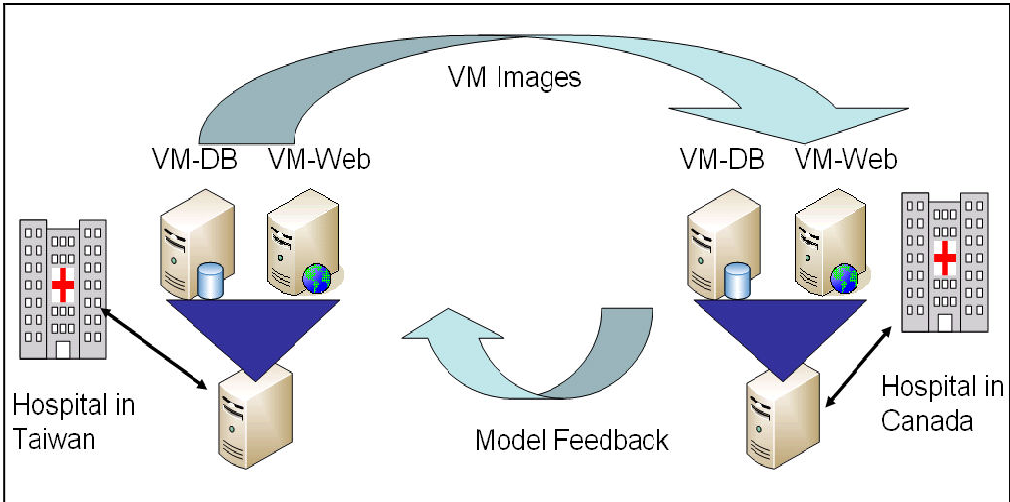 Figure: The SOA and virtualization servers forming the unified healthcare cloud.
Tackling the Privacy Elephant in the Room
Sharing medical data across borders triggers a legal minefield (e.g., Canada's PIPEDA vs. the US Patriot Act). The authors addressed this by:
- Ambiguity Technique: Implementing algorithms that obscure patient identities while preserving the statistical relationships necessary for data mining.
- Local Data Residence: Original patient data remains in local databases, while only transformed outcomes or virtualized views are shared via the cloud.
Implementation: The 5-Step Migration Strategy
The paper provides a roadmap for other researchers looking to leave the "Server Room" behind:
- Requirement Identification: Defining specific clinical pathways and indicators.
- Challenge Evaluation: Proactively addressing the "Loss of Governance" (the fear of not knowing where data physically resides).
- Provider Benchmarking: Comparing SLAs of major players like AWS, Google, and Microsoft.
- Unit & Integration Testing: Validating the platform with joint datasets from NTU (Taiwan) and MUST (Mongolia).
- Follow-up Plan: Measuring improvements against predefined performance targets.
Critical Analysis & Results
While the paper is a seminal look at cloud migration in the early 2010s, its value lies in its real-world feasibility study.
- Efficiency: Projects cited in the paper (like genome assembly at Harvard) saw cost reductions of up to 40% using cloud infrastructure.
- Speed: Clinical billing and documentation times were slashed from 7 days to less than 24 hours in similar cloud adoption cases.
Limitations
The primary challenge remains Data Jurisdiction. As the authors point out, if a cloud provider (like Amazon) moves data to a US-based server to balance load, it technically becomes subject to the Patriot Act, potentially violating Canadian privacy laws. This "legal latency" is often harder to solve than technical latency.
Conclusion
The shift from "Laboratory-Hosted" to "Cloud-Based" is no longer optional for high-impact biomedical research. This platform proves that a combination of SOA for flexibility and Virtualization for consistency can bridge the gap between three distinct healthcare systems, ultimately leading to better clinical guidelines for liver cancer treatment.
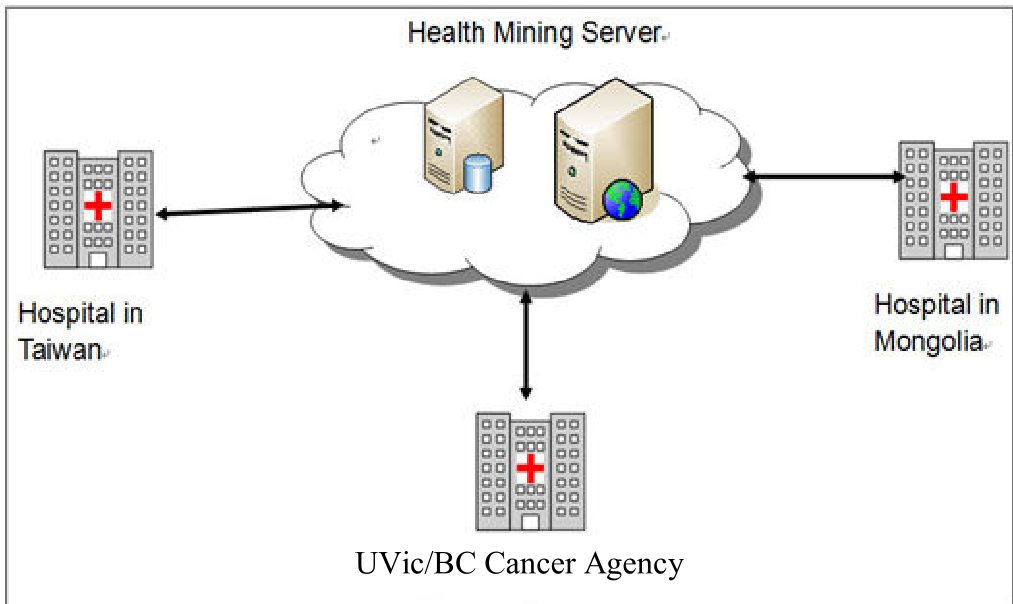 Figure: The structural flow for implementing the proposed platform.