
Hybrid Intelligence: Boosting Economic Statistics with Cloud Data and Neural Networks
Introducing Cloud Data Technology into Economic Statistics
This paper proposes a hybrid forecasting framework that integrates Cloud Computing and Big Data analysis into economic statistics. By combining Adaptive Lasso variable selection, Grey System Model GM(1,1), and BP Neural Networks, the study achieves high-precision prediction of local government fiscal revenue.
Executive Summary
TL;DR: This paper introduces a modernized approach to fiscal revenue forecasting by migrating traditional economic statistics to a Cloud-based Big Data framework. By synthesizing Adaptive Lasso variable selection, Grey Prediction, and BP Neural Networks, the researchers developed a system capable of predicting local government revenue with a stunning relative error of less than 1%.
Field Positioning: This work bridges the gap between traditional econometrics and modern data science, moving from simple linear regressions to a hybrid intelligent model that thrives on cloud-scale data.
The "Multicollinearity" Trap: Why Traditional Models Fail
In economic statistics, variables like GDP, tax revenue, and fixed asset investment are often highly correlated. This phenomenon, known as multicollinearity, creates "noise" that destabilizes traditional statistical models, leading to wild inaccuracies in fiscal planning.
The author identifies that government data is now "massive and aggregated," requiring more than just a spreadsheet; it requires a cloud infrastructure that can handle diverse data types and dynamic resource allocation.
Methodology: The GM-BP Hybrid Architecture
The core of this research is a three-stage pipeline designed to distill value from complex economic datasets.
1. Variable Selection via Adaptive Lasso
To solve the multicollinearity problem, the authors applied Adaptive Lasso (Least Absolute Shrinkage and Selection Operator). Unlike standard regression, Lasso can shrink the coefficients of less important variables to zero, effectively performing feature selection.

2. Grey System Modeling (GM 1,1)
The Grey Model is used to forecast the future values of the selected independent variables. It is particularly effective for "small data" series where the underlying law of development is consistent over time but the data is partially unknown.
3. BP Neural Network Integration
Finally, the predicted variables are fed into a Backpropagation (BP) Neural Network. This network acts as the "brain," learning the non-linear relationship between indicators (like tax and per capita income) and the target fiscal revenue.
 Table: Accuracy of independent variable predictions using the GM(1,1) model.
Experimental Breakthroughs
The researchers tested their model on city-level economic data. After filtering 12 initial factors down to 6 key drivers (X2, X8, X9, X10, X11, X12), the BP Neural Network was trained with a maximum of 5,000 learning iterations.
Key Results:
- Unprecedented Precision: The relative error remained below 1%.
- Visual Convergence: The "Real Value" and "Predictive Value" curves on the result graphs almost perfectly overlap, demonstrating the model's high fault tolerance and adaptive learning capacity.
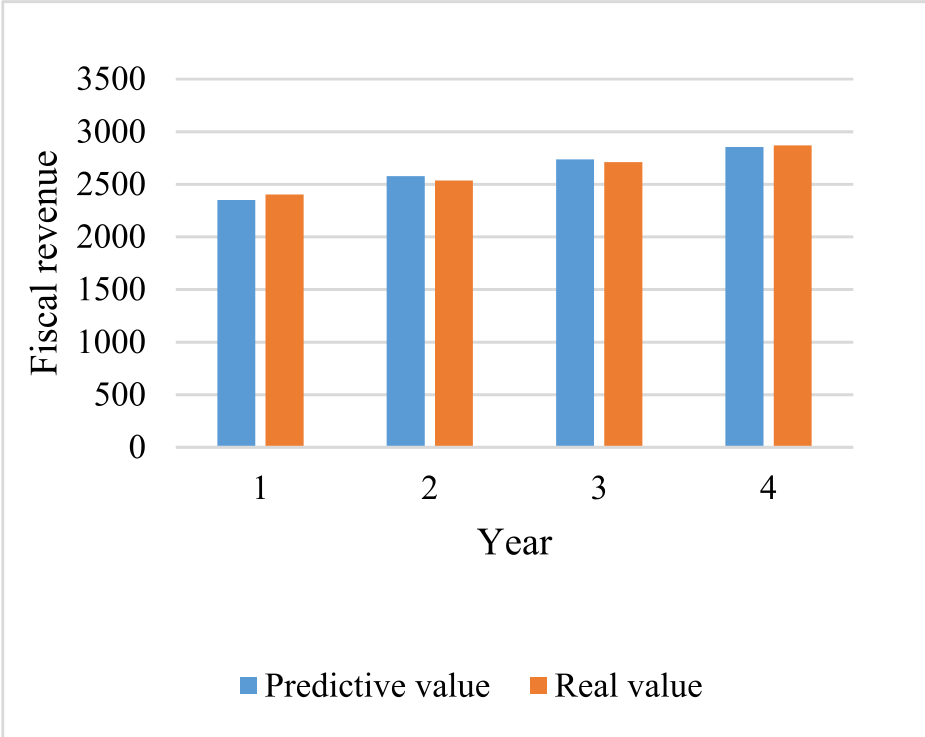 Figure: The convergence of real and predicted fiscal revenue over a 4-year period.
Critical Insight & Future Outlook
The success of this method lies in its modular design:
- Lasso handles the "cleanliness" of the data.
- Grey Models handle the "temporal" trend.
- Neural Networks handle the "complexity" of the relationships.
Limitations: While the model is highly accurate for short-term local planning, its reliance on a GM(1,1) model assumes a degree of regularity in economic growth. Sudden "Black Swan" events (like market crashes or policy shifts) might require more dynamic, real-time cloud data streams to adjust the BP weights.
Conclusion: This research proves that economic statistics are no longer a back-office manual task but a front-line application for cloud-based AI.