
CMSS: Bridging the Cloud-Social Divide for Efficient Multimedia Streaming
Pricing and resource allocation for multimedia social network in cloud environments
2015-08-29
Summary
Problem
Method
Results
Takeaways
Abstract
The paper introduces the Cloud-based Multimedia Service System (CMSS), a novel architecture that integrates cloud computing and multimedia social networks. It enables bandwidth-limited mobile users to acquire live streaming content directly from desktop users via social ties, achieving efficient distributed resource allocation and reducing content provider overhead.
## TL;DR
As mobile multimedia consumption skyrockets, content providers face a massive bandwidth bottleneck. This paper proposes **CMSS (Cloud-based Multimedia Service System)**, which turns social networks into a distributed delivery layer. By allowing mobile users to fetch streams from nearby desktop "friends" via a dynamic, market-driven pricing strategy, the system significantly reduces provider costs while maximizing user utility.
## The Motivation: Why Your Social Life Matters for Bandwidth
Traditional Multimedia Social Networks (MSNs) often treat all users as equals. However, in reality, your desktop computer and your smartphone have vastly different capabilities. The authors identify a missed opportunity: **the social context**. If a mobile user can watch a movie via a desktop friend’s local hotspot rather than the congested cloud server, the entire network benefits.
The challenge lies in **incentives**. Why should a desktop user share their bandwidth? And how do we ensure mobile users get the QoS they expect?
## Methodology: The Virtual Market and Dynamic Pricing
The paper introduces a third-party **Bandwidth Management System** that acts as a clearinghouse for supplies (desktop bandwidth) and demands (mobile requests).
### 1. The Architecture
The CMSS architecture splits the world into the **Cloud Side** (storage and scheduling) and the **Social Network Side** (delivery).

### 2. The Pricing Insight
The core of the paper is a mathematical pricing mechanism that considers two distinct user behaviors:
* **QoS-Sensitive Users**: Those who prioritize bandwidth quality and have inelastic demand.
* **Price-Sensitive Users**: Those who switch connections based on the best "deal."
The authors derive an optimal price ($p_i^m$) using the **Cardano formula** to solve the cubic equations representing the desktop user’s profit maximization. Unlike previous static models, this pricing is *dynamic*—adapting as mobile users switch between desktop "sellers."
### 3. The Iterative Algorithm
The researchers developed a three-part iterative algorithm to find the "Utility Equilibrium":
1. **Initialize**: Randomly connect mobile users to desktop nodes.
2. **Information Exchange**: Users in the same social group communicate utilities.
3. **Migration & Adjust**: Mobile users jump to better connections, and desktop users adjust prices until $p$ is stable.
## Experimental Insights
The simulation highlights the efficiency of this market-driven approach:
* **Rapid Convergence**: The system reaches a stable utility equilibrium in just a few iterations, even with 75+ mobile users competing for resources.
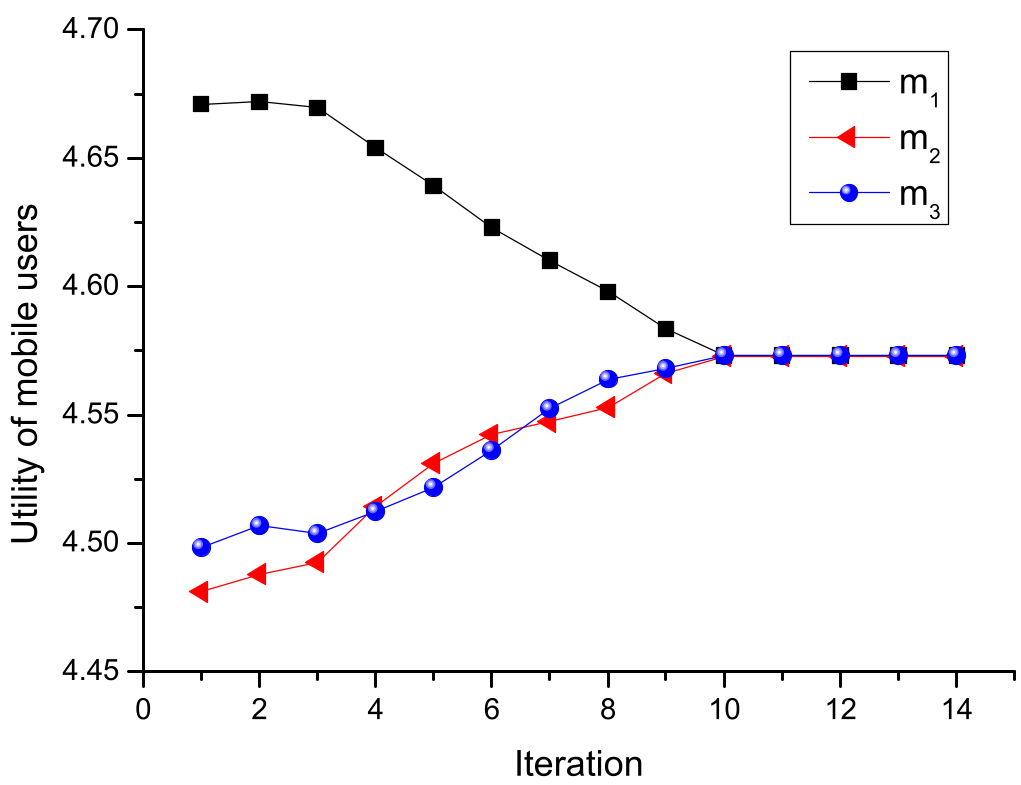
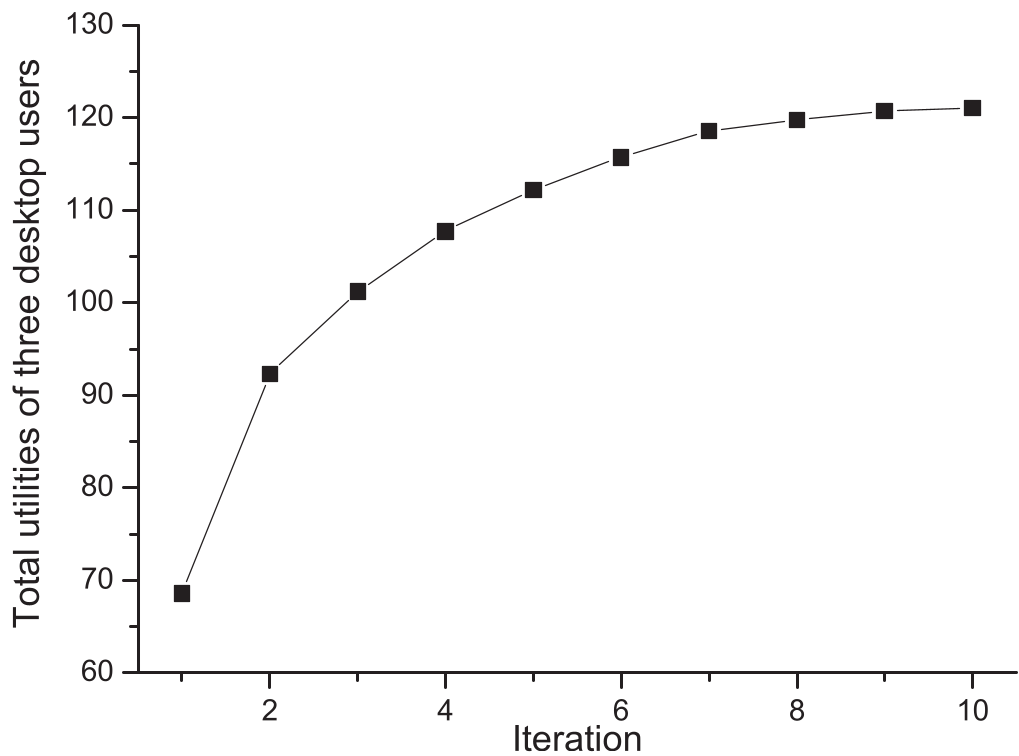
* **Utility Gains**: Desktop users see non-decreasing total utility as they refine their prices, proving that sharing bandwidth can be a profitable endeavor rather than just a altruistic social act.
## Critical Analysis & Future Outlook
**Contributions**: The integration of social properties into a rigorous mathematical pricing framework is a significant step forward from basic P2P models. It acknowledges the economic reality of resource sharing.
**Limitations**:
* **The Single-Link Constraint**: Currently, a mobile user can only connect to one desktop user. In a modern mesh environment, multi-path connections would be more robust.
* **Fairness to Desktops**: While the paper introduces "credits," the actual implementation of a secure payment or reputation system is left for future work.
**Conclusion**:
CMSS provides a blueprint for the future of decentralized content delivery. By turning interpersonal relationships into technical "links," we can build a more resilient and cost-effective internet.