
Cloud Federations: Leveraging Game Theory for a Sustainable Sharing Economy
Cloud Federations: Economics, Games and Benefits
The paper establishes a fundamental economic theory for Cloud Federations using Task Forwarding (TF) and Capacity Sharing (CS) approaches. It leverages M/M/1 queuing models and Game Theory to achieve SOTA performance in balancing Cloud Service Provider (CSP) profits with end-user Quality of Service (QoS).
TL;DR
Cloud capacity is expensive and volatile. This paper proposes a mathematical framework where Cloud Service Providers (CSPs) stop competing in isolation and start federating. By modeling CSPs as queuing systems and applying game-theoretic reward mechanisms (specifically the Shapley Value), the authors demonstrate that even "selfish" providers can be incentivized to cooperate, resulting in higher profits for providers and stable QoS for users.
Background: Why Standalone Clouds are Inefficient
The modern cloud landscape is plagued by two extremes: either a provider over-dimensions their hardware to handle peak loads (wasting money during idle times) or they under-dimension and suffer SLA violations when traffic spikes.
The authors argue that the "Sharing Economy"—already successful in transport (Uber) and lodging (Airbnb)—is the architectural solution for computational resources. The goal is to pool geographically dispersed resources to manage diverse, time-varying service requests efficiently.
The Core Approaches: TF vs. CS
The paper distinguishes between two primary ways a federation can function:
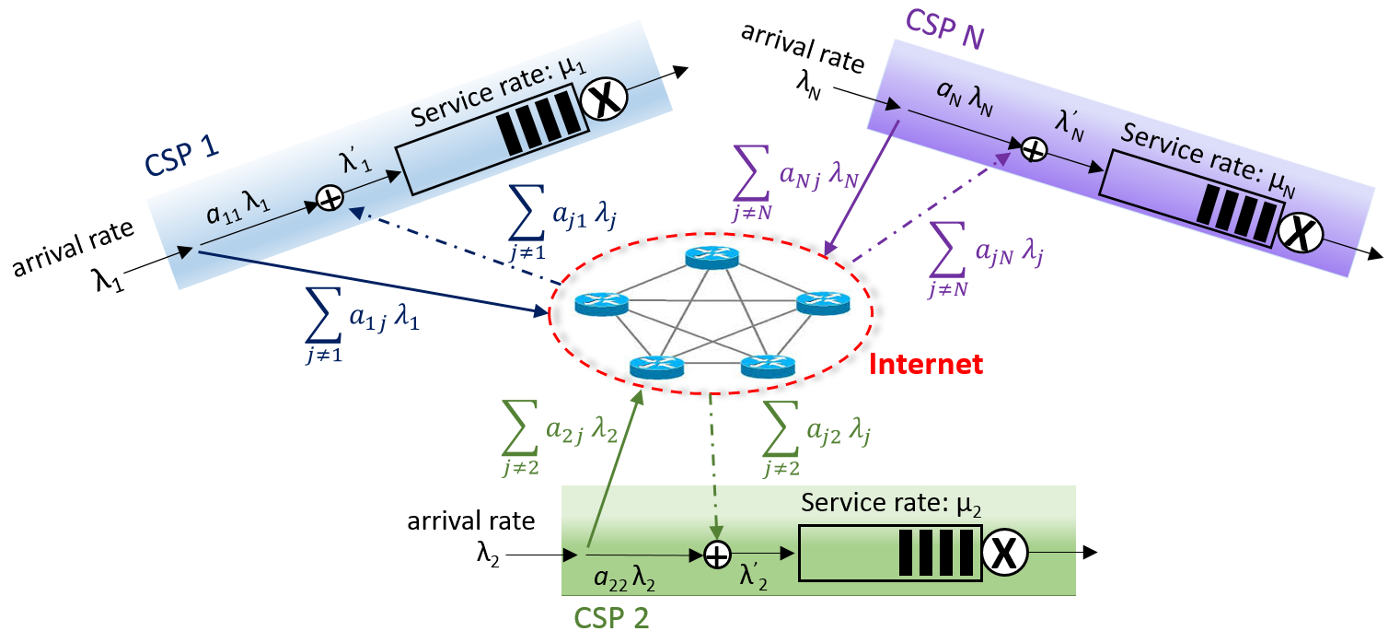
- Task Forwarding (TF): A CSP receives a request but forwards the workload to another member of the federation.
- Capacity Sharing (CS): A CSP grants a slice of its infrastructure (CPU cycles) to another provider, who then manages it as its own.
The M/M/1 Abstraction
To make this mathematically tractable, the authors abstract complex data centers into M/M/1 queuing systems. While real data centers have many servers (M/M/c), the paper proves that under heavy loads, the qualitative behavior—specifically the convexity of completion time relative to arrival rate—remains consistent, allowing for elegant optimization.
Methodology: Gaming the System for the Common Good
The paper's most innovative contribution is the Reward-Driven Federation.
In a typical non-cooperative game, selfish actors reach a Nash Equilibrium that is often "worse" than the social optimum (the Price of Anarchy). To solve this, the authors use the Shapley Value as the payoff function.
- The Logic: A CSP's reward is strictly tied to its marginal contribution to all possible sub-federations.
- The Result: The authors prove (Proposition I) that if each CSP maximizes its own Shapley-based payoff, the entire system converges to the global maximum profit.
Experimental Insights & Results
The researchers conducted extensive simulations comparing standalone, TF, and CS models.
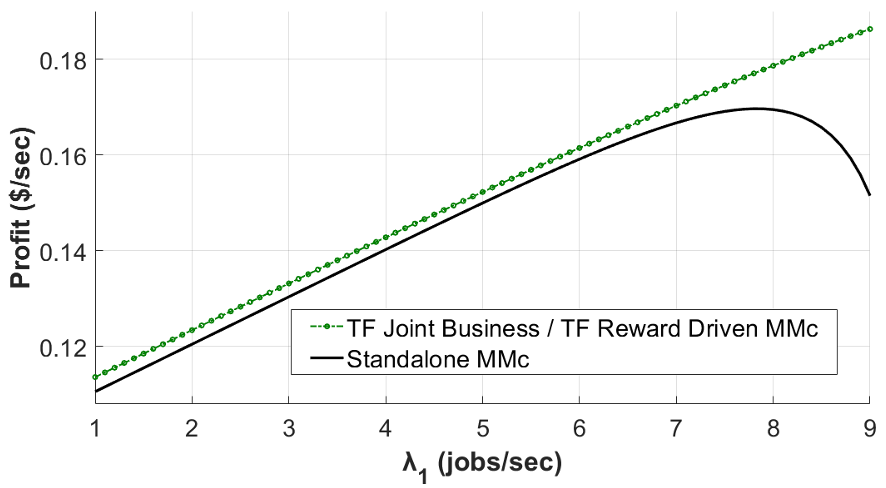
- Profit Gains: Both TF and CS showed massive profit improvements over standalone operations.
- QoS Alignment: In TF, profit and QoS are naturally aligned—higher efficiency leads to faster processing. In CS, however, the authors warn of "unfair" pricing where a federation might sacrifice the QoS of some users to maximize total revenue, requiring strict SLA thresholds.
- Convergence: The experiment confirms that the Reward-Driven mode (selfish) achieves exactly the same total profit as the Joint Business mode (fully cooperative).
Critical Insight & Future Outlook
This work provides the "economic bedrock" for Serverless Computing and Multi-Cloud environments. By proving that cooperation is mathematically the most profitable strategy for selfish giants, it paves the way for automated, market-driven resource exchanges.
Limitations: The model currently assumes a static electricity price and ignores the complex "data gravity" issues where moving large datasets between providers might cost more than the computational savings. Future work must integrate bandwidth costs and storage constraints into this queuing-game framework.
Conclusion
Cloud Federation isn't just a technical challenge; it's an economic one. By treating computational cycles as a fungible commodity and applying rigorous fair-sharing rules, we can build a cloud that is both more profitable for companies and more responsive for users.