
CTC-MSNS: Reimagining Social Networks as Cloud-Terminal Collaborative Ecosystems
Towards Cloud and Terminal Collaborative Mobile Social Network Service
The paper proposes CTC-MSNS (Cloud and Terminal Collaborative Mobile Social Network Service), a novel architectural framework for mobile social networking. It introduces a Widget/Server (W/S) model combined with RESTful APIs to enable seamless collaboration between mobile device capabilities and cloud-based social services.
Executive Summary
TL;DR: This paper argues that Mobile Social Network Service (MSNS) is not just a "small screen" version of Facebook. Instead, it defines MSNS as an Activity-Based, Context-Aware platform. The authors propose the CTC-MSNS architecture, which utilizes a Widget/Server (W/S) model and RESTful APIs to bridge the gap between local device power (GPS, sensors) and cloud-side social intelligence.
Positioning: This work serves as a foundational architectural blueprint that shifts the focus from centralized Browser/Server models to a decentralized, collaborative middleware-driven approach.
The "Mobile" in MSNS: Why Prior Approaches Failed
Most early attempts at mobile social networking treated the mobile phone as a passive viewer (B/S model). The authors identify a fundamental gap: SNS is person-centric, but MSNS is context-centric.
The pain point is simple: If you only use a mobile browser, you lose access to the "rich context" of the user—their precise location, their movement, and their local device data. The paper argues that for MSNS to be effective, it must be:
- Activity-based: Simple, high-frequency interactions.
- Mobility/Context-based: Leveraging dynamic data like GPS.
- Device-reliant: Using the phone's native hardware.
- Open: Allowing third-party mashups via APIs.
Methodology: The CTC-MSNS Framework
The core of the paper is the Cloud and Terminal Collaborative (CTC) model. Instead of a monolithic app, it breaks the system into three pillars:
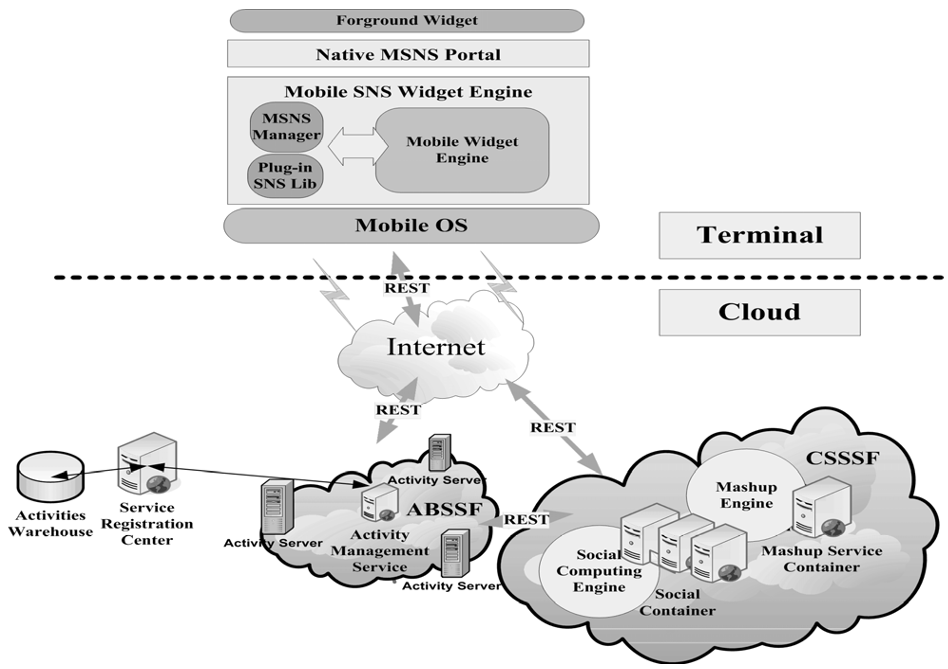
1. The Terminal: MSNSWE (Widget Engine)
The authors champion Mobile Widgets over native C/S apps. Why? Because widgets provide a cross-platform web environment that can still talk to the phone's hardware. The MSNSWE acts as middleware that gathers local context and provides a "Plug-in SNS Lib" for developers.
2. The Cloud Core: CSSSF
This cloud layer handles the heavy lifting:
- Social Computing: Context reasoning and relationship mining.
- Mashup Engine: Combining APIs from different sources (e.g., Google Maps + Facebook data).
3. The Service Layer: ABSSF
Following the Software as a Service (SaaS) model, this layer treats every social activity (a game, a check-in, a photo share) as a modular service with its own lifecycle.
Comparison & Experimental Feasibility
The authors distinguish their architectural choice (Widget/Server) against traditional B/S and C/S models.
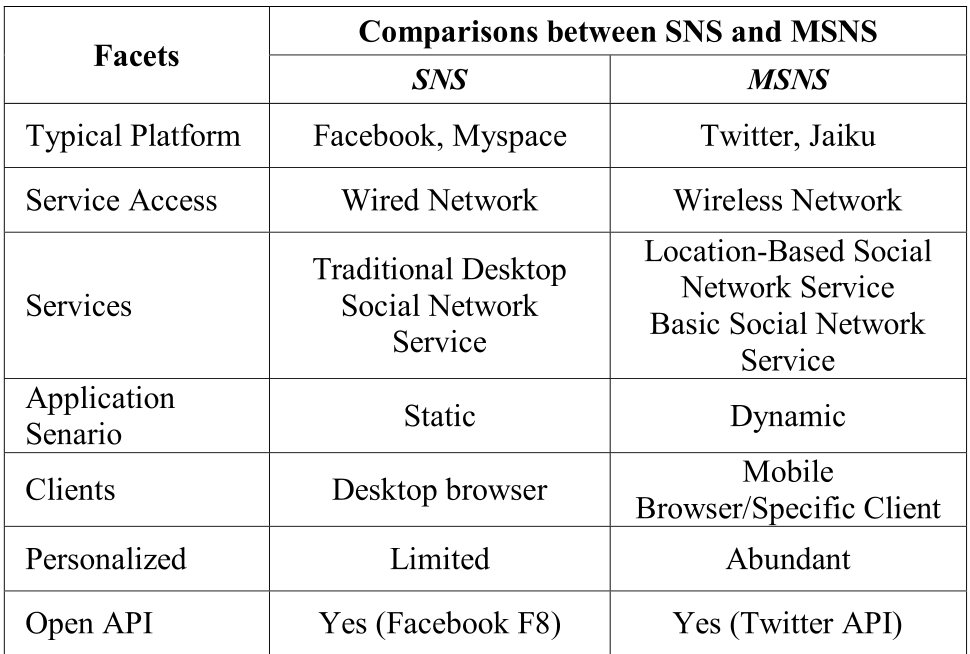
The critical advantage of W/S is its balance: it is as easy to develop as a web page (low cost) but as powerful as a native app (high device access).
To prove this isn't just theory, the authors map their architecture to existing projects:
- Terminal: Using BONDI (an OMTP project) to implement the Widget Engine.
- Cloud: Using Apache Shindig and OpenSocial APIs to manage social data across different platforms.
Critical Insight & Future Outlook
The beauty of CTC-MSNS lies in its loose coupling. By using RESTful patterns, the terminal doesn't need to know the complex logic of the cloud; it simply consumes APIs. Meanwhile, the cloud can "reason" about the user's context (where they are, who they are with) to provide intelligent recommendations.
Limitations: The paper acknowledges that Security and Ubiquitous Computing modeling remain open challenges. As we move into an era of privacy-preserving AI, how we share "rich context" without exposing sensitive data will be the next frontier for this architecture.
Conclusion: This research successfully moves MSNS from being a "subset of the web" to a "native extension of the user's physical life."