
Cloudworks: Transforming Teaching Design into a Social Experience
The design of Cloudworks: Applying social networking practice to foster the exchange of learning and teaching ideas and designs
This paper introduces Cloudworks, a social networking platform designed to facilitate the sharing, finding, and discussion of learning and teaching designs. Leveraging Web 2.0 practices and the concept of "social objects," the platform serves as a collaborative hub for educators to bridge the gap between technological potential and actual pedagogical practice.
TL;DR
The potential of educational technology often stays trapped in theory because teachers lack a way to share and deconstruct successful practices. Cloudworks addresses this by applying Web 2.0 social networking principles—think "Flickr for teaching ideas"—to create a space where pedagogy becomes a "social object" that can be discussed, modified, and reused.
Context: The Innovation Mismatch
For decades, technology in education has often merely replicated face-to-face practices online. The authors identify a "mismatch": while tools are powerful, teachers are often working in silos, lacking the time and specialized skills to design truly innovative learning activities. The problem isn't the lack of good ideas; it's that those ideas are rarely externalized or shareable.
Methodology: From Repository to Social Stream
The development of Cloudworks followed an Agile and Participatory Design approach, moving through three distinct phases:
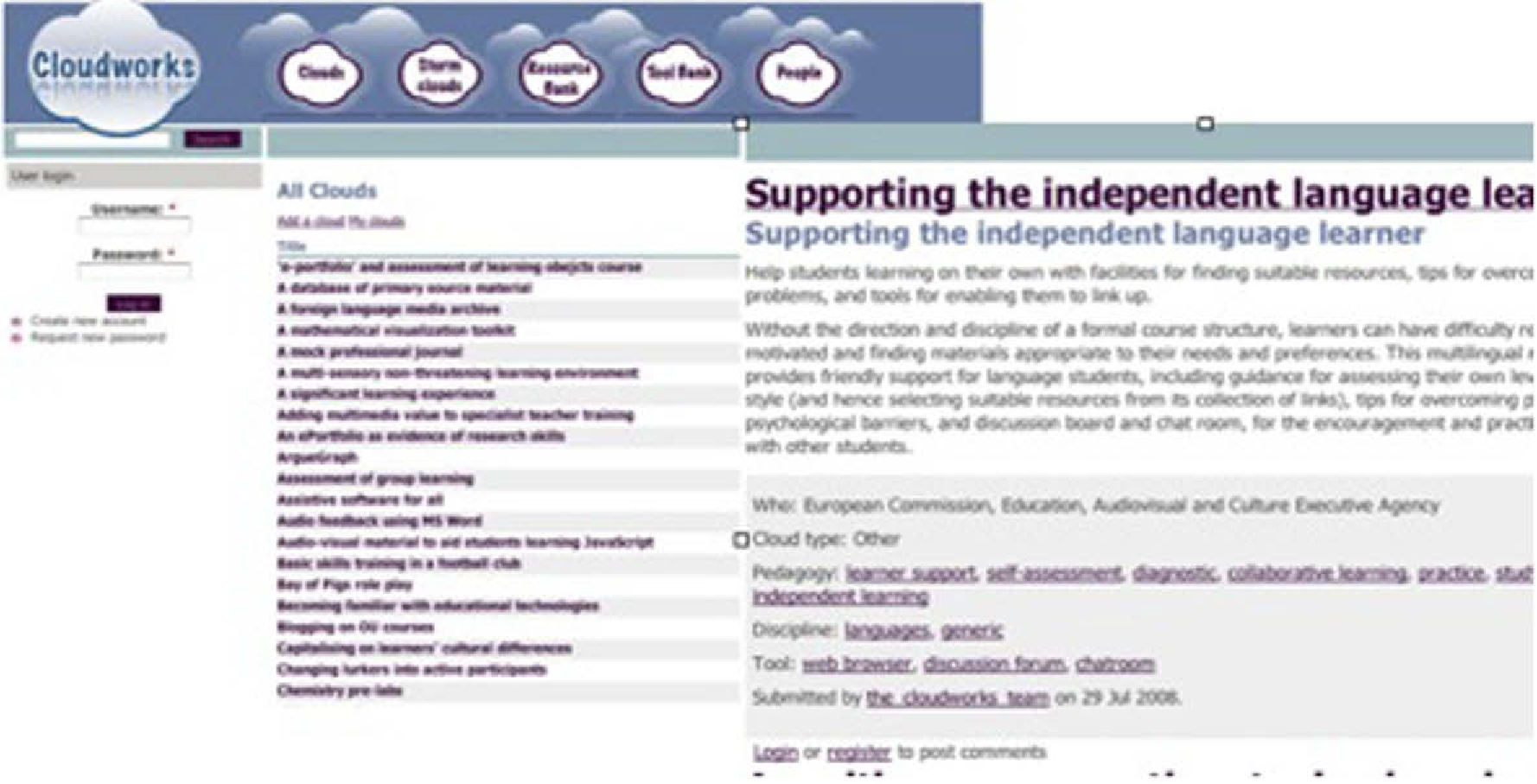
- Phase 1 (The Metaphor): Introduced the concept of "Clouds" (ideas/designs) to avoid dry technical jargon.
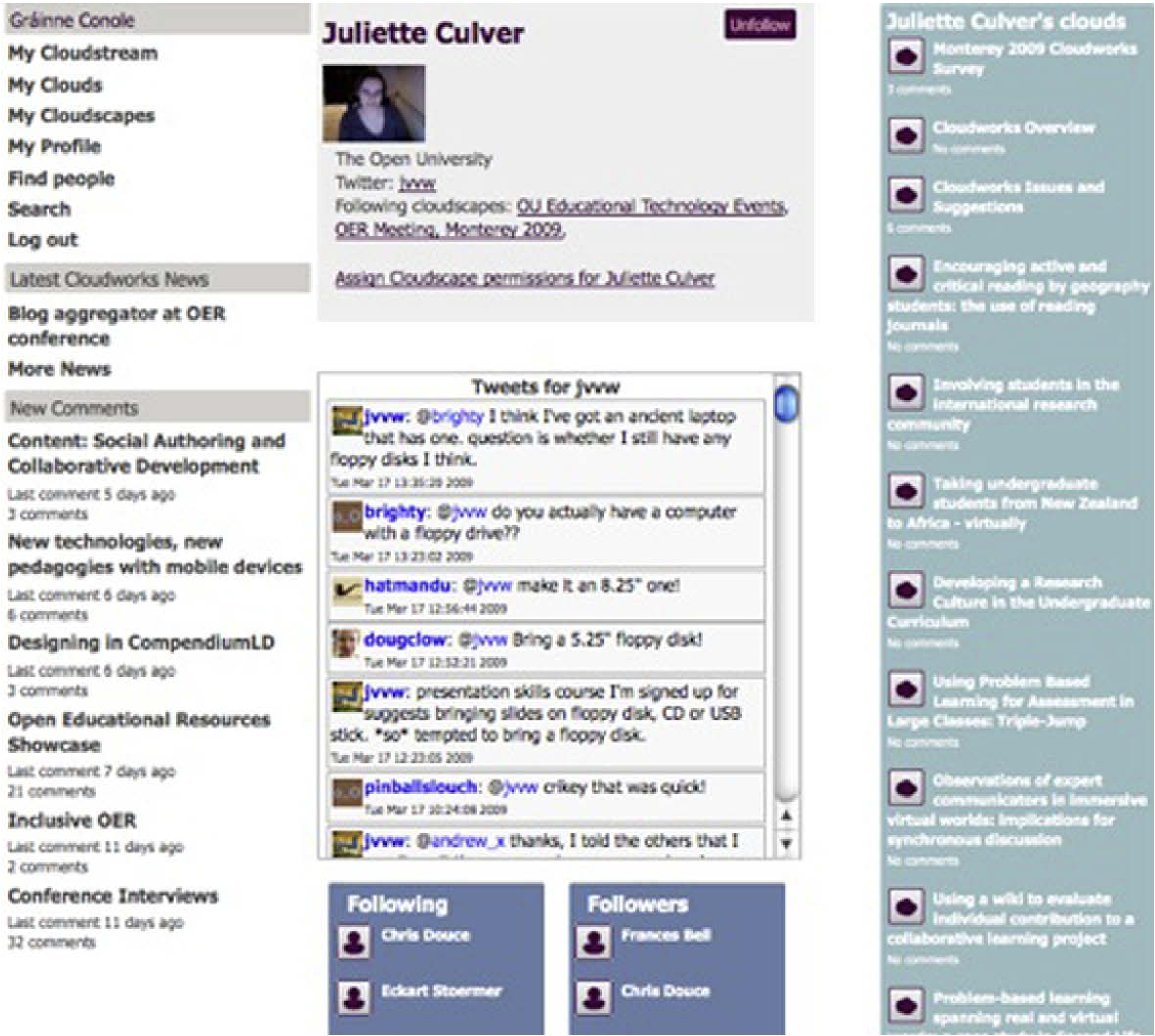
- Phase 2 (Community Engagement): Introduced "Cloudscapes" (groups) and "Cloudstreams" (activity feeds) to mimic the real-time interaction of platforms like Twitter.
- Phase 3 (Integration): Added RSS feeds and integrated external Web 2.0 streams like Flickr and Twitter hashtags.
The Core Concept: Social Objects
The paper leans heavily on the theory of Object-Oriented Sociality. In successful networks, people don't just connect to people; they connect to objects (photos on Flickr, videos on YouTube). In Cloudworks, the "Cloud" is the social object—the anchor for professional discourse.
Key Results & Evaluation
Cloudworks found its strongest "product-market fit" in Conference and Workshop support. During an OER conference in Monterey (2009), the platform acted as a "live blogging" space.
- User Engagement: 94.4% of participants read comments from others, and over 77% contributed content.
- Usability Insight: While participants loved the "unconference" feel and aggregation of Twitter/blogs, some struggled with the lack of traditional hierarchical forum structures—highlighting the learning curve of shifting from "static Web 1.0" to "dynamic Web 2.0" professional habits.
Deep Insight: Why This Matters
The real takeaway from the Cloudworks experiment is that designing for sociality is harder than designing for utility. Success in educational technology isn't just about building a better tool; it's about mirroring real-life practices (mimicking reality) while offering clear benefits for self-actualization.
Limitations & Future
Despite its success in structured events, getting teachers to spontaneously share content in their daily lives remains a challenge. Issues like copyright concerns, "imposter syndrome" (the fear that ideas aren't good enough), and technical barriers still exist. Future developments focused on building "champion communities" to sustain engagement beyond the honeymoon phase of a conference.
Conclusion
Cloudworks proved that when we treat teaching designs as open, social objects, we move away from "technologically deterministic" models of education and toward a collaborative, reflective community of practice.