
Unmasking Digital Identities: Linking Social Media Profiles via Smartphone Camera Fingerprints
A Cluster-based Approach of Smartphone Camera Fingerprint for User Profiles Resolution within Social Network
2018-01-01
Summary
Problem
Method
Results
Takeaways
Abstract
The paper introduces a cluster-based forensic method for user profile resolution on Social Networks (SNs) using Smartphone Camera Fingerprints (PRNU). By extracting unique sensor noise patterns from images, the authors utilize a K-medoids clustering approach to link multiple social media profiles (e.g., Facebook and WhatsApp) to a single physical device.
## TL;DR
Researchers from the University of Bologna have developed a forensic method to solve the "Profile Resolution" problem—identifying if different social media accounts belong to the same person. By analyzing the microscopic, unique "noise" created by a smartphone's camera sensor (PRNU), they can cluster images from Facebook and WhatsApp back to the original device with **98% accuracy**, even when images are compressed by the platforms.
## The Problem: The Mask of Social Media
On modern Social Networks (SNs), a single user often maintains multiple profiles. While some are legitimate, others are "fake profiles" used for impersonation or bypassing constraints. Traditional methods of linking these profiles—such as matching usernames, interests, or tagging patterns—are easily manipulated.
Furthermore, when users upload photos, SN platforms like Facebook and WhatsApp strip away metadata (EXIF) and compress the files, making traditional digital forensics extremely difficult. Identifying that two different accounts are uploading photos from the **same physical hardware** remains the "Holy Grail" of digital investigation.
## The Insight: Every Sensor has a "Fingerprint"
The authors rely on a physical phenomenon known as **Photo-Response Non-Uniformity (PRNU)**. Due to manufacturing imperfections, every pixel on a camera sensor has a slightly different light sensitivity. This creates a systematic, unique noise pattern—a "fingerprint"—that is embedded in every photo taken by that specific device.
### Methodology: From Pixels to Clusters
The proposed workflow consists of three main stages:
1. **Residual Noise Extraction**: Using the **BM3D (Block Matching 3D)** algorithm, the system filters the "content" of the image away to isolate the underlying sensor noise (Residual Noise).
2. **Pre-processing**: Images are normalized to a standard size (1024x1024) and orientation to ensure the geometric alignment of the noise patterns.
3. **K-medoids Clustering**: Unlike K-means, K-medoids is more robust to outliers. The system uses a **Correlation Distance** metric to group noise patterns. If images from "Profile A" and "Profile B" fall into the same cluster, they were almost certainly taken by the same phone.
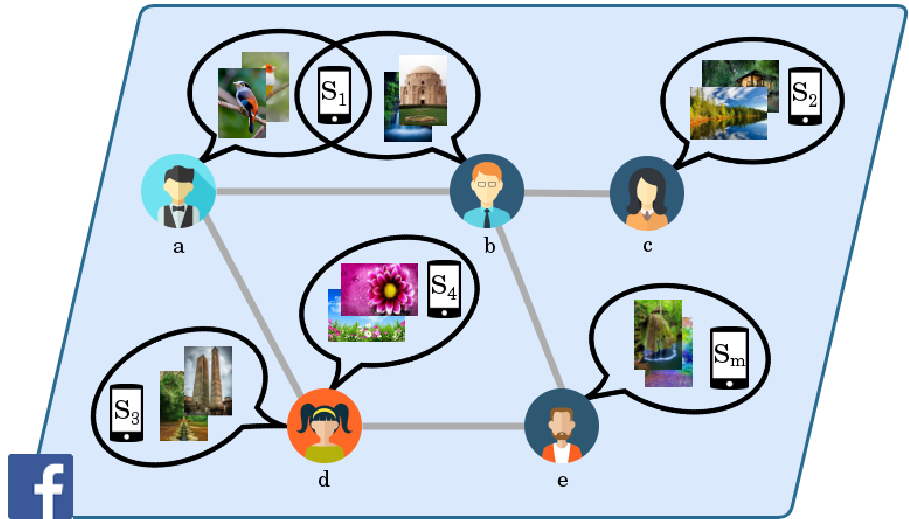
*Figure 1: How camera fingerprints map profiles to specific devices (Profiles a and b share a device, while profile d uses multiple devices).*
## Experiments & Results
The team tested their approach using 1,500 images from 10 devices, including multiple identical models (e.g., three different LG Nexus 5 phones). This is a crucial test: can the system distinguish between two phones made in the same factory?
* **Distinguishing Identical Models**: The system successfully separated noise patterns even for identical smartphone models, where other forensic methods often fail.
* **Resistance to Compression**:
* **Facebook**: Average Sensitivity ~97%.
* **WhatsApp**: Average Sensitivity ~96.2% (lower due to WhatsApp's more aggressive compression).
* **Clustering Performance**: K-medoids outperformed K-means significantly in handling the "messy" noise inherent in SN images.
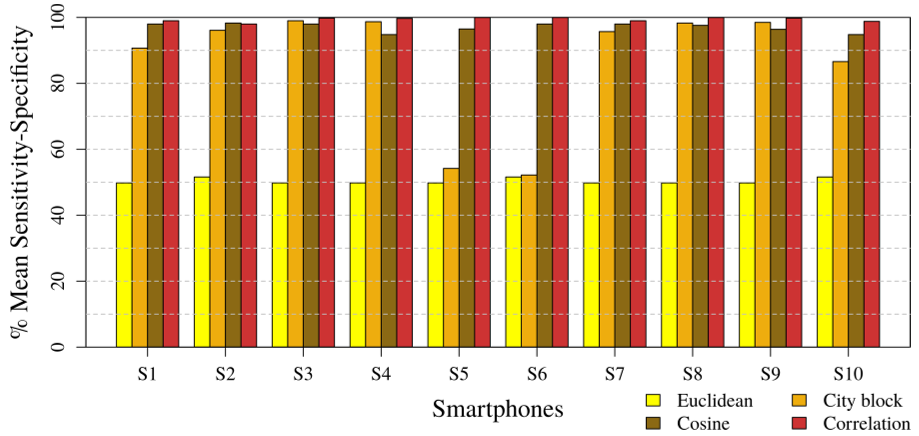
*Figure 2: Evaluation of different distance metrics, showing that Correlation distance consistently provides the best results for profile resolution.*
## Critical Analysis & Conclusion
**Takeaway**: This work demonstrates that the physical "imperfections" of hardware are more reliable for identity resolution than software-level metadata or behavioral data. It provides a powerful tool for digital investigators to link fake accounts to real-world devices.
**Limitations**:
* **Scale**: The current approach is computationally expensive. Clustering millions of images across an entire social network is currently infeasible; it is best used on a "candidate set" of suspected profiles.
* **Unknown Sources**: The paper notes that identifying images downloaded from the internet (which don't contain the user's sensor noise) remains a challenge for future work.
**Future Outlook**: As AI-generated images (Deepfakes) become common, techniques like PRNU clustering will be vital not just for identity resolution, but for verifying if an image was actually captured by a physical sensor or synthesized by an algorithm.