
Legal Intelligence: Moving Beyond Keywords with "Bag of Law References"
Clustering and Categorization of Brazilian Portuguese Legal Documents
This paper introduces a semi-supervised framework for the clustering and categorization of Brazilian Portuguese legal documents to improve case law retrieval. It proposes a modified TClus algorithm and a novel "Bag of Terms and Law References" representation, achieving significant dimensionality reduction and accurate document classification.
Executive Summary
TL;DR: This research addresses the inefficiency of Brazilian legal searches by proposing a semi-supervised clustering system that categorizes new petitions based on a "Bag of Terms and Law References" model. By evolving the TClus algorithm to preserve small document groups and focusing on statutory citations, the authors achieved a 50% improvement in cluster quality and high precision in automated categorization.
Context: This work sits at the intersection of Information Retrieval (IR) and Legal Tech, acting as a bridge between traditional keyword-based indexing and modern semantic categorization for civil law jurisdictions.
Problem & Motivation
The Brazilian legal system faced a paradox: while trials were being virtualized, search tools remained primitive. Existing systems restricted searches to abstracts—which are frequently incomplete or inaccurate—leaving vast amounts of case law inaccessible.
The authors identified two fatal flaws in previous machine learning applications to this domain:
- The Discard Problem: Standard clustering algorithms (like TClus) discard "outlier" documents. In law, an outlier might be a rare but crucial precedent.
- The Linguistic Problem: General "Bag of Words" approaches fail to capture the weight of law. A mention of "Article 34 of Decree-Law 8192" is infinitely more descriptive than the word "decree."
Methodology: The Core Architecture
The authors introduced a two-phase architecture (Phase A: Clustering, Phase B: Categorization) supported by a sophisticated preprocessing pipeline.
1. The "Bag of Terms and Law References"
Instead of treating all words equally, the system uses:
- Thesaurus-based Terms: Merging the VCB and TJF thesauri to identify multi-word legal concepts.
- Law Reference Normalization: Using regular expressions to turn complex legal citations into unique, weighted tokens (e.g.,
dl 8192/1972 art. 34). - Weighting Logic: Attributes near the "leaves" of the legal thesaurus receive higher weights, reflecting their specific semantic value.
2. Modified TClus Algorithm
The researchers modified the TClus algorithm to ensure Hard Clustering (one document, one category) while preventing the loss of information.
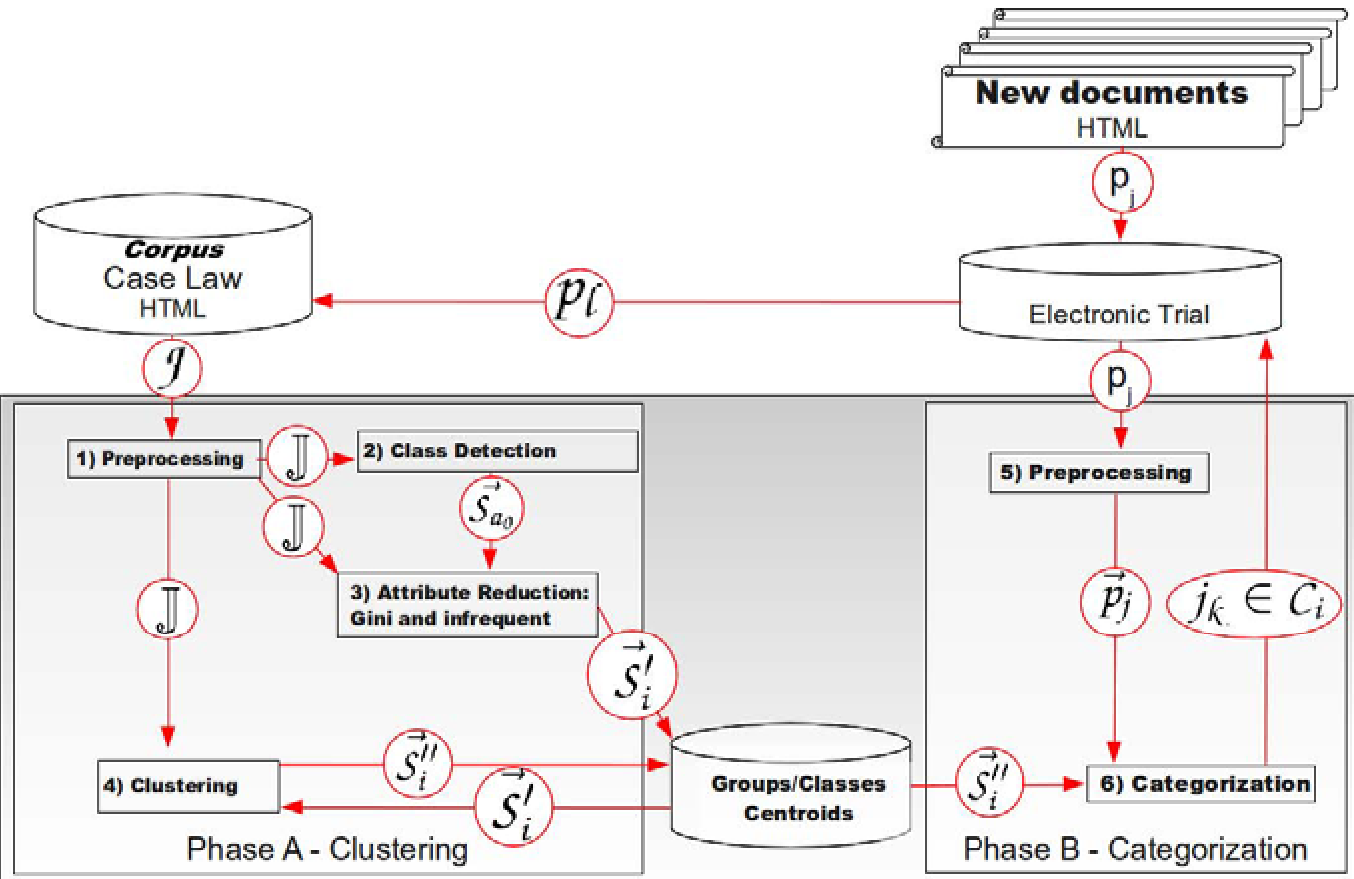 The dual-phase workflow: Clustering existing case law to build the taxonomy, then categorizing new petitions.
A key innovation is the Cluster Division feature. If a document is too distant from existing centroids, instead of being discarded, it triggers the creation of a new cluster, which can then attract other similar documents in subsequent iterations.
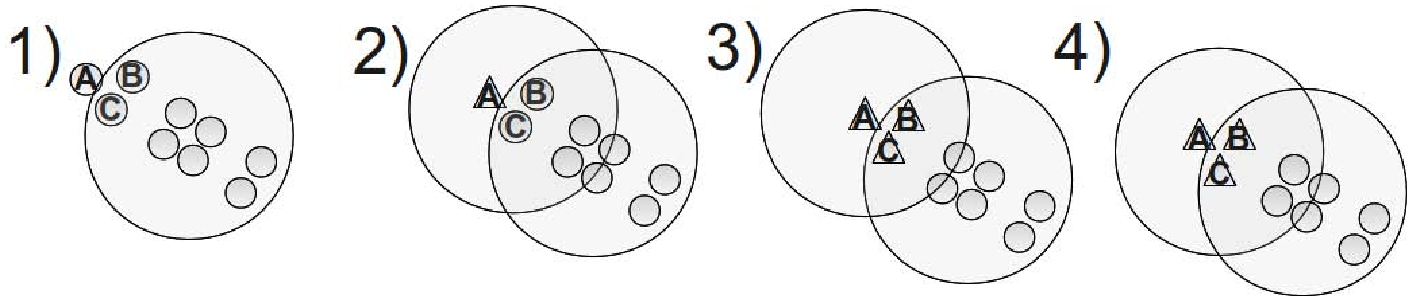 The visual representation of how new centroids are birthed from outliers to refine cluster granularity.
Experiments & Results
The system was tested on a corpus of 1,192 single-themed judicial documents from the 4th Region Brazilian Federal Tribunal.
Quantitative Success
The modified algorithm outperformed the baseline on the Relative Hardness (RH) Measure, dropping from 0.071 to 0.035 (a lower score indicates better cluster separation).
Qualitative Validation
Human specialists (lawyers) evaluated 105 documents. The results were striking:
- High Precision: Documents with >30% similarity to the centroid had a 100% True Positive rate.
- Value of the "Outliers": Nearly 50% of the True Positives occurred in clusters with fewer than 4 documents. This proves that disabling the "discard" feature of TClus was vital for legal accuracy.
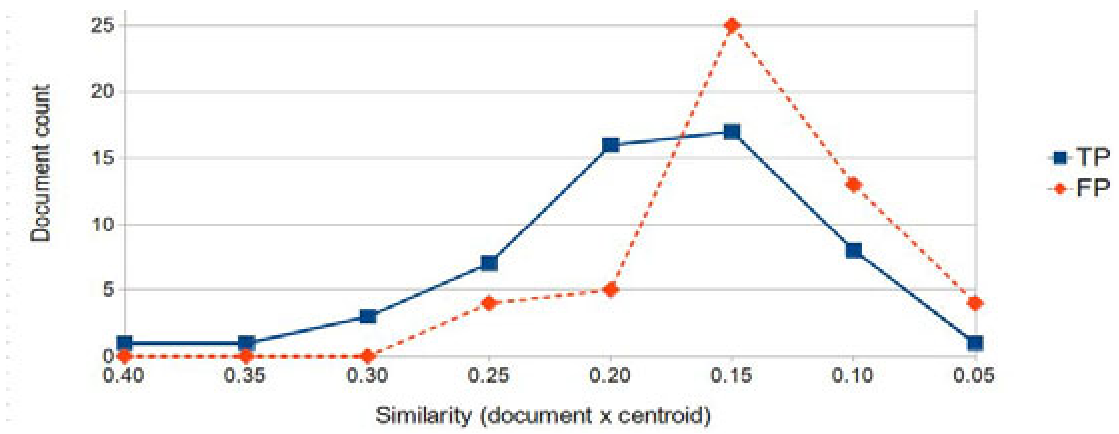 Experimental results showing the correlation between centroid similarity and classification success.
Critical Analysis & Conclusion
Takeaway: The "Bag of Law References" is the standout contribution. The authors found that law references represented only 4.9% of initial attributes but rose to 15.17% in final centroids, indicating their high discriminative power.
Limitations: The system currently struggles when documents have a balanced mix of general terms and law references; the highest accuracy occurs when one type predominates. Additionally, the manual effort required to merge thesauri poses a scalability challenge for other legal domains.
Future Outlook: The next step for this technology is focusing exclusively on statutory citations for the initial clustering phase, while using descriptive terms only to refine the categorization—essentially letting the "Code of Law" define the structure and the "Language of Law" populate it.