
Efficient Community Detection: Leveraging Clustering Coefficients for Linear-Time Network Analysis
An approach based on the clustering coefficient for the community detection in social networks KHAWLA ASMI LRIT, Associated Unit to CNRST (URAC No 29)-Faculty of sciences
This paper introduces a community detection algorithm for social networks based on the clustering coefficient and common neighbors similarity. By identifying and removing "inter-community" edges characterized by high neighborhood external relations and low local overlap, the method achieves SOTA modularity and precision on benchmark datasets.
TL;DR
This research presents a novel community detection framework that identifies "weak links" between communities using a combination of Clustering Coefficients and Common Neighbor Similarity. By systematically removing edges that act as bridges between dense clusters, the algorithm achieves higher modularity and precision than standard baselines like CNM and WalkTrap, all while maintaining a highly efficient linear-time complexity.
Problem & Motivation: The Scalability Wall
Detecting communities—dense subgraphs with sparse external connections—is central to social network analysis. However, we face a persistent trade-off:
- Spectral Methods: Superior accuracy but O(n³) complexity.
- Betweenness-based Methods: Effective at finding "brokers" but restricted by the cost of calculating all-pairs shortest paths.
- Louvain/Modularity Methods: Fast, but often suffer from resolution limits (merging small communities) and high memory usage.
The authors observed a fundamental structural truth: members of the same "friendship circle" share many mutual friends, whereas acquaintances connecting two different circles rarely do. The goal was to translate this intuition into a formal mathematical weight that can pinpoint inter-community edges for removal.
Methodology: The Logic of Geometric Connectivity
The core of the paper lies in the weight formula. It balances two specific properties:
- Property A (Dissimilarity): Nodes in different communities share few common neighbors.
- Property B (Local Density): Nodes within a high-quality community should belong to many triangles (high clustering coefficient).
The Formula
The authors define a weight for an edge as: Where represents the number of relations between a node's neighbors. A high value indicates an edge that is likely a bridge between two communities because it has low overlap (denominator) but incident nodes with high internal connectivity (numerator).

Algorithm Steps
- Edge Weighting: Calculate for all edges.
- Filtering: Focus on edges with less than 20% common neighbor similarity.
- Iterative Removal: Sort edges by in descending order and remove them, provided the removal doesn't isolate a node completely.
- Refinement: Merge subgraphs smaller than 4 nodes into their parent communities to ensure meaningful clusters.
Experiments & Results
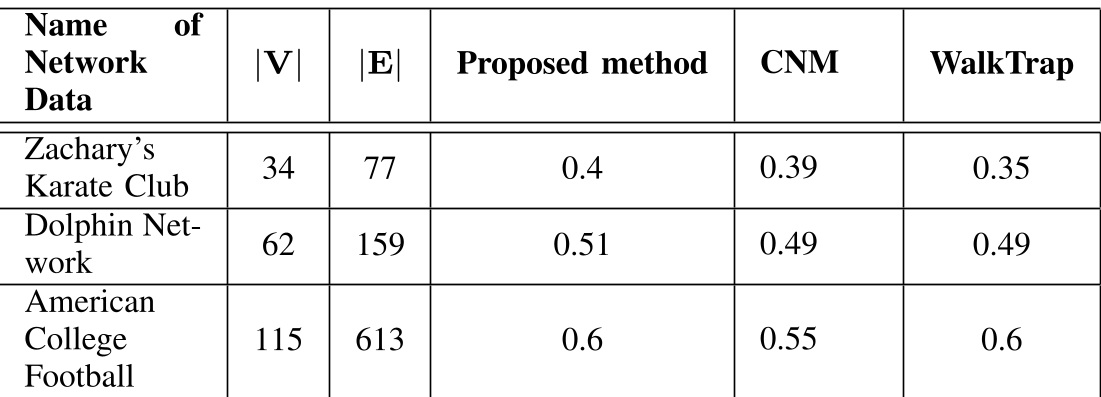
The authors validated their approach on three classic benchmarks: Zachary’s Karate Club, the Dolphin Social Network, and the American College Football network.
Performance Metrics
Compared to CNM (Clauset-Newman-Moore) and WalkTrap, the proposed method consistently yielded higher Modularity, indicating better-defined community structures.
- Precision: Reached 0.97 in the Football network, outperforming CNM (0.67) significantly.
- Modularity: Improved from 0.49 to 0.51 in the Dolphin network.
Visualizing the Clusters
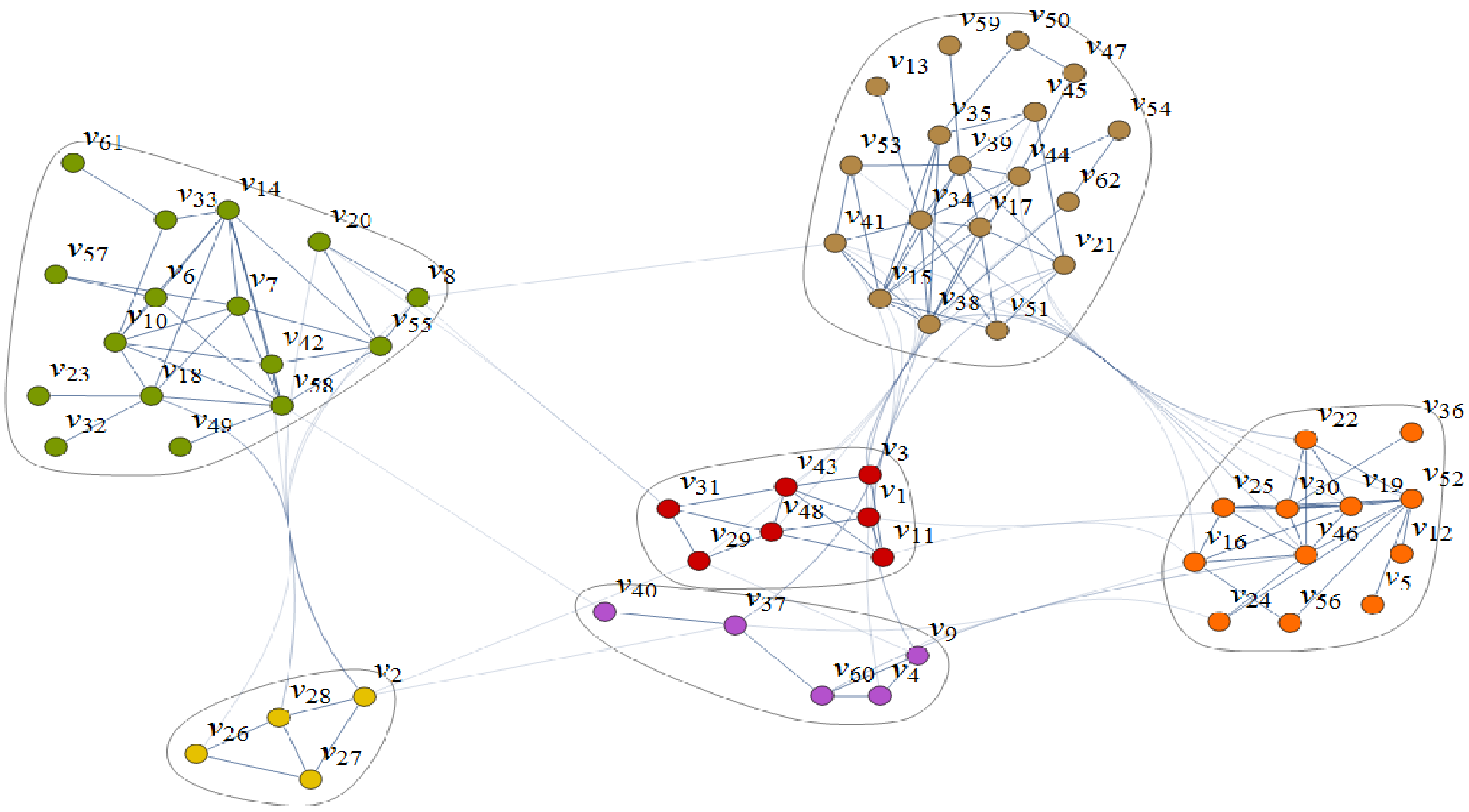
In the Dolphin network, the algorithm successfully separated the associations into distinct biological social units, as shown in the visualization below:
Critical Analysis & Conclusion
Takeaways
The method's most impressive feat is its linear complexity. By only sorting a small subset of "potential bridge edges" (those with <20% common neighbors), the algorithm sidesteps the computational overhead that plagues traditional hierarchical clustering.
Limitations
- Static Threshold: The 20% similarity threshold and the minimum community size of 4 are heuristic-based. While they work for the provided datasets, they may require tuning for different graph densities.
- Unweighted focus: Current methodology is strictly for unweighted graphs; social networks often have edge weights representing interaction frequency, which are not yet utilized.
Future Work
The next logical step for this research is adapting the clustering coefficient weight for directed networks and exploring its application in dynamic networks where community boundaries shift over time.