
Modeling the Architecture of Friendship: Analytical Clustering in Duplication Models
Analysis of clustering coefficients of online social networks by duplication models
This paper proposes a mathematical duplication model to simulate the growth and structural properties of Online Social Networks (OSNs). By utilizing differential equations, the authors derive analytical expressions for the clustering coefficient, mean degree, and second moment of degrees in these evolving networks.
TL;DR
How do massive online social networks like Facebook and Flickr maintain their "tight-knit" feel despite having millions of users? This paper provides a mathematical backbone to this phenomenon using a Duplication Model. The authors derive a closed-form expression for the clustering coefficient, providing a formal bridge between simple local growth rules and global network topology.
Background: The Triadic Closure Intuition
In social science, "triadic closure" is the idea that if Alice is friends with Bob and Charlie, there is a high probability that Bob and Charlie will eventually become friends. Online, this is automated by "People You May Know" algorithms.
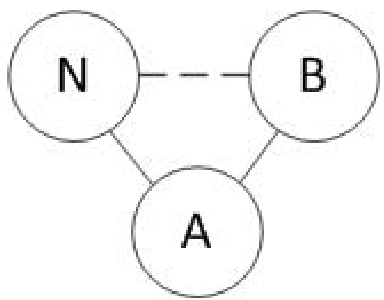
The authors argue that the formation of online social networks (OSNs) is essentially a duplication process. When a new user joins, they connect to an "anchor" friend and are then introduced to that friend's circle.
Methodology: From Difference to Differential Equations
The core of the paper lies in deriving the Clustering Coefficient (), defined as:
The Growth Mechanism
- Selection: A new vertex joins and connects to a random existing vertex .
- Duplication: For each neighbor of , establish an edge with probability .
Analytical Derivation
The authors define (mean degree), (second moment), and (expected triangles). By analyzing how these quantities change when a single vertex is added (), they construct difference equations like: These are then transformed into differential equations to find long-term steady-state behaviors.
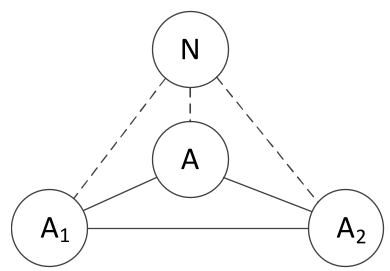 Fig 2: A visual breakdown of how new triangles are formed during the addition of vertex N.
Experiments & Real-World Validation
The authors validated their formulas against datasets from Facebook, Flickr, Orkut, and Livejournal. By tuning the arrival probability and the initial clique size , the model successfully replicated the specific metrics of these platforms.
| Site | Actual | Model |
|---|---|---|
| Facebook I | 0.148 | 0.148 |
| Flickr | 0.112 | 0.112 |
| Orkut | 0.107 | 0.107 |
Key Insights from Results
- Parameter Sensitivity: The mean degree and clustering are highly sensitive to . A higher leads to a more "densely packed" community.
- Regular Network Behavior: The paper proves a fascinating proposition: the duplication model behaves similarly to a regular network (where all vertices have the same degree) in terms of its local connectivity properties.
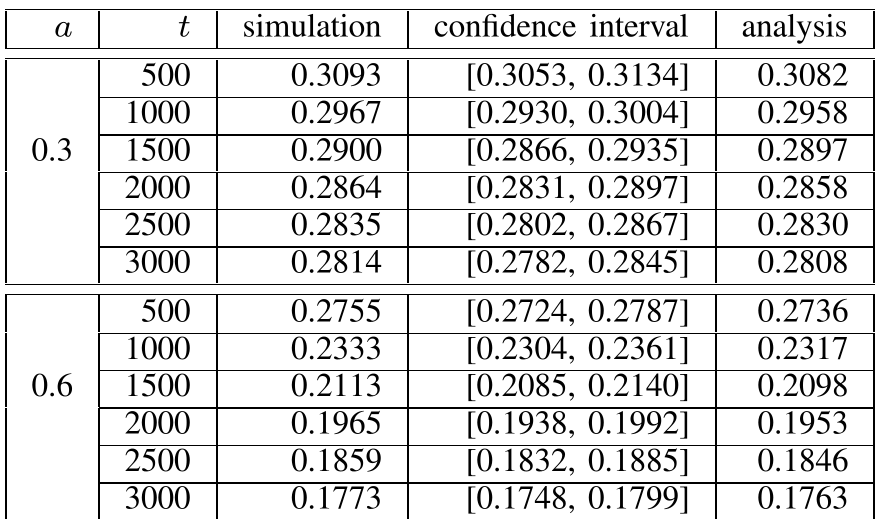 The table shows high alignment between analytical predictions and stochastic simulations.
Critical Insight & Conclusion
This work moves beyond empirical observation into the realm of predictive modeling. By providing a closed-form solution for the clustering coefficient, researchers can now predict how an OSN's "tightness" will scale as it grows, without needing to run computationally expensive simulations.
Limitations: The model assumes a purely additive process. Real networks involve "churn"—users leaving or deleting edges. Future iterations of this duplication model would need to incorporate vertex/edge removal to capture the full lifecycle of a social platform.
Final Takeaway: The success of "People You May Know" isn't just a UI feature; it is the fundamental mechanism that generates the mathematical structure of our digital social lives.