
Monitoring Corporate Reputation on Twitter: A Specificity-Driven Clustering Approach
Clustering with Error-Estimation for Monitoring Reputation of Companies on Twitter
The paper introduces a hybrid monitoring strategy for Online Reputation Management (ORM) on Twitter, utilizing unsupervised clustering and supervised priority assessment. The proposed method organizes tweets into topical clusters and assigns them priority levels (e.g., Alert, Low, Irrelevant) without relying on external knowledge bases.
TL;DR
Social media monitoring is a critical task for modern brands, yet the brevity and noise of tweets make it a "hard nut to crack." This paper presents a specialized framework for Online Reputation Management (ORM) that segments tweets into topical clusters and ranks them by priority levels. By leveraging Core Term Expansion and a unique Global Error-Estimation loop, the authors achieved the highest precision in topical clustering at the RepLab2012 competition without using any external knowledge like Wikipedia.
The "Sentiment Gap" in Reputation Management
Why can't we just use sentiment analysis to monitor a company's reputation? The authors point out a crucial insight: Reputation is not always about sentiment.
For instance, a tweet stating "Steve Jobs used patents to pressure Bill Gates" doesn't contain obvious negative sentiment (subjectivity), yet it is highly critical for Apple’s PR team to monitor. Standard event detection also fails because reputation threats often start as niche topics rather than "trending" global events.
Methodology: The Core Term & Specificity Engine
The methodology is divided into two distinct phases: Unsupervised Clustering and Supervised Priority Assessment.
1. Core Term Extraction
To handle the "noisy" nature of 140-character tweets, the system filters out technical noise (RT, mentions, URLs) and uses POS tagging to isolate "Core Terms" (Nouns and Adjectives).
2. Multi-Stage Clustering Architecture
The clustering process isn't a single pass; it's a refined three-step iteration:
- Content Similarity: Initial clusters are formed using Cosine Similarity.
- Specificity Ratios: This is the "secret sauce." The system calculates how much more frequent a term is inside a cluster compared to the rest of the corpus. If a tweet outside the cluster contains high-specificity terms, it is pulled into that cluster.
- URL Homogeneity: Since tweets often share shortened links, the system identifies "home clusters" for specific URLs to refine groupings.
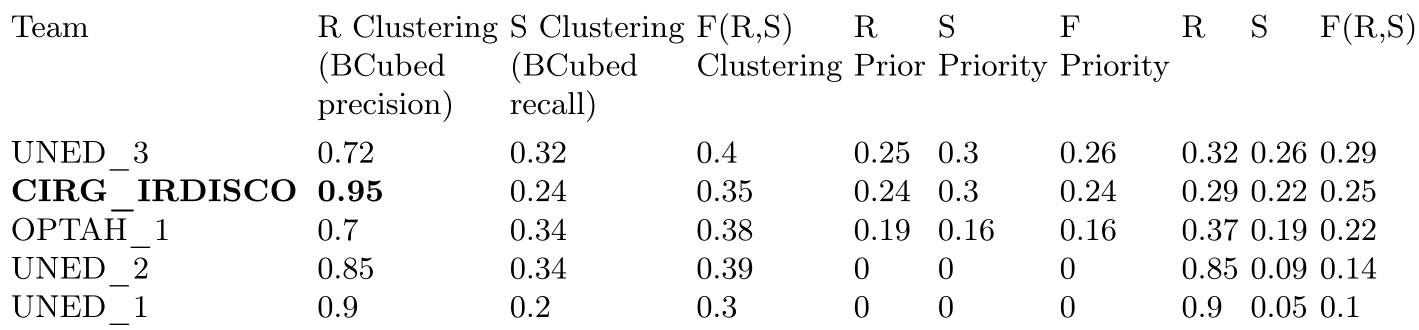 Table 2: Comparison of the CIRG_IRDISCO team against other RepLab participants, showing superior Reliability (Precision).
Global Error Estimation: Self-Optimizing Thresholds
A standout feature of this research is how it learns. Instead of using a one-size-fits-all threshold (like similarity > 0.5), the algorithm calculates a Global Error Estimate by measuring the "non-uniformity" of priority levels within a cluster. It then iterates through different thresholds to find the configuration that minimizes this error for each specific company.
Experimental Insights & Results
The model was tested on 31 companies. While the system excelled at Clustering Precision (0.95), it faced challenges in Priority Assignment (ranking clusters from 'Alert' to 'Irrelevant').
Key Findings:
- Translation Sensitivity: Performance dropped when tweets required translation from Spanish to English, highlighting the dependency on linguistic accuracy.
- Cross-Entity Learning: The system performed best when the test company was similar to those in the training set (e.g., using "Apple" training data to analyze "Yahoo!").
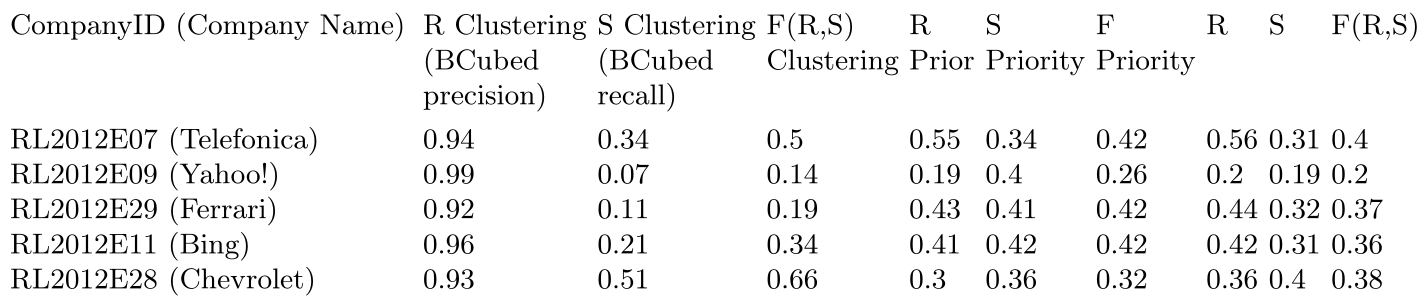 Table 3: Results for specific companies like Telefonica and Ferrari, showing high Reliability in clustering.
Critical Analysis & Future Outlook
The beauty of this approach lies in its independence from external data. By purely analyzing the statistical specificity of terms within a local stream, it bypasses the need for massive knowledge graphs.
Limitations:
- Context Cold-Start: The priority assessment relies on seeing similar core terms in training data.
- Short-Text Noise: While Core Term Expansion helps, the method remains sensitive to the quality of POS tagging on highly informal text.
Takeaway: This work proves that for highly specialized domains like corporate reputation, "less is more." Specificity ratios often provide a clearer signal than complex latent topic models (like LDA) when dealing with the fragmented, real-time nature of Twitter.