
Beyond "Local", "Categories" and "Friends": Decoding Urban Behavior with Latent Topics
Beyond “Local”, “Categories ” and “Friends”: Clustering foursquare Users with Latent “Topics”
This paper applies Latent Dirichlet Allocation (LDA) to Foursquare check-in data to cluster users based on latent "topics" that represent behavioral drivers. By treating individual venues as "words" and users as "documents," the authors successfully identify distinct groups characterized by specific interests, geographic communities, and user categories like "tourists" or "students."
TL;DR
Researchers from Carnegie Mellon University have applied Latent Dirichlet Allocation (LDA) to Foursquare check-in data to uncover the hidden "themes" of human mobility. By stripping away explicit metadata like GPS coordinates and venue categories, they discovered that users naturally cluster into "Interest Factors," "Communities," and "User Types" (like tourists or Stanford students), providing a more nuanced map of urban life than simple geography ever could.
Problem & Motivation: The Limits of the "Local"
Why do we go where we go? Most mobility models focus on the "What" (Venue Categories), the "Where" (GPS coordinates), or the "Who" (Social Circles). However, these explicit features are often too rigid. For instance:
- Spatial models ignore people with shared interests spread across a city (e.g., sports fans).
- Category models fail to distinguish between different types of users visiting the same location (e.g., a local at a museum vs. a tourist).
The authors' insight was to treat check-ins like words in a document. Just as words like "spaghetti" and "pizza" hint at an "Italian Food" theme, checking in at "Yankee Stadium" and "MetLife Stadium" hints at a "Sports Enthusiast" latent driver.
Methodology: LDA for Human Mobility
The core of this work is the application of LDA, a generative probabilistic model.
- Data Representation: A User is treated as a Document; a Venue ID (the specific Starbucks on 5th Ave) is a Word.
- Latent Topics: The model assumes users have a distribution over various "topics" (behavioral drivers).
- Mechanism: It identifies which venues "belong" together because the same users frequent them, even if those venues are miles apart or have different category tags.
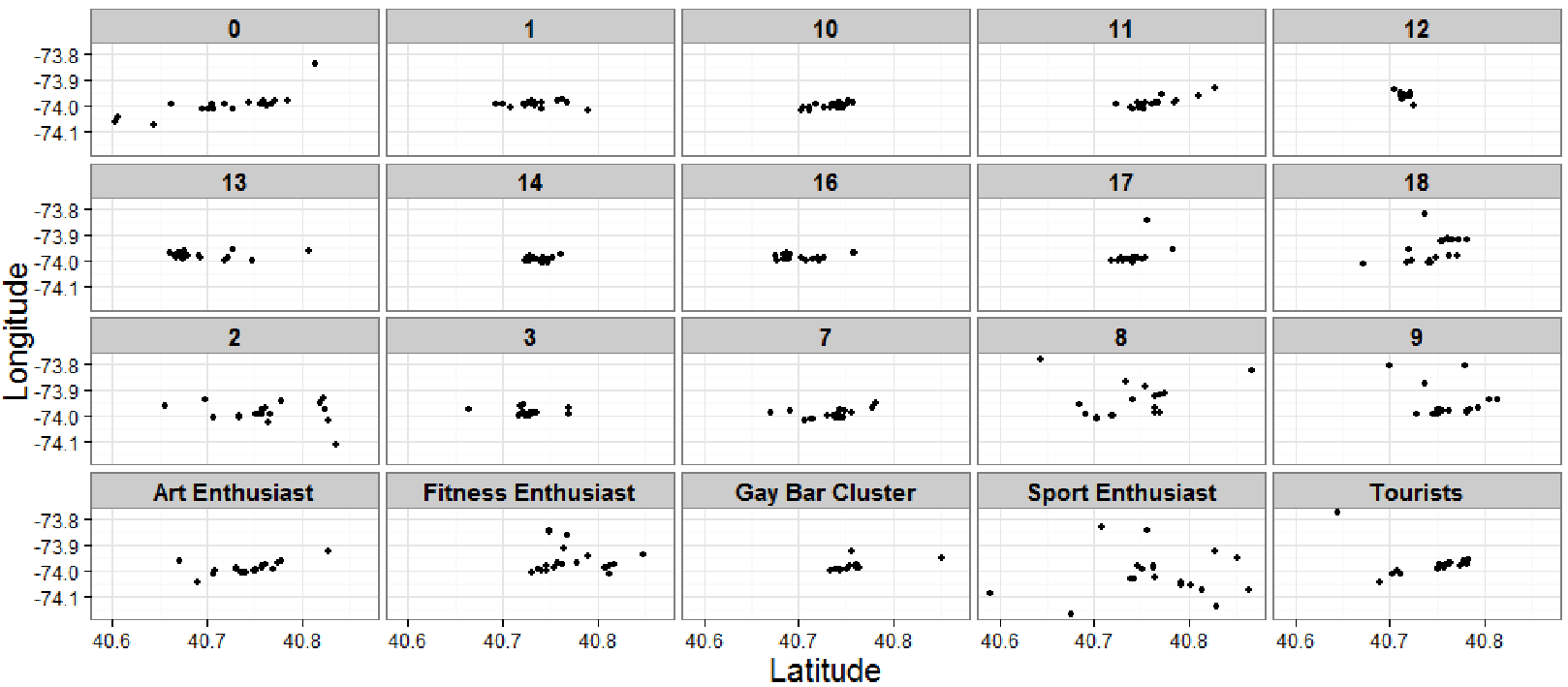 Figure 1: Geo-spatial distribution of clusters in New York City. While some clusters are geographically tight (Neighborhoods), others like "Sports Enthusiasts" are scattered across the boroughs.
Key Findings: Three Faces of Urban Movement
The authors categorized the discovered latent factors into three distinct types:
1. Interest Factors
These clusters are defined by shared activities. For example, the "Art Enthusiast" cluster includes the MoMA and the Metropolitan Museum of Art. These users are bound by what they do, not where they live.
2. Community Factors
Despite being location-agnostic, the model naturally found "Communities." In both NYC and San Francisco, a distinct "Gay Bar" cluster emerged. Interestingly, in San Francisco, this cluster was geographically concentrated in "The Castro," reflecting how marginalized groups often coalesce into tight-knit urban neighborhoods.
3. User Type Factors
This is where the model transcends simple classification. It identified a "Tourist" cluster in NYC (Airports, Central Park, Statue of Liberty) and a "Stanford Student" cluster in the Bay Area (University buildings, local movie theaters, and transit stations).
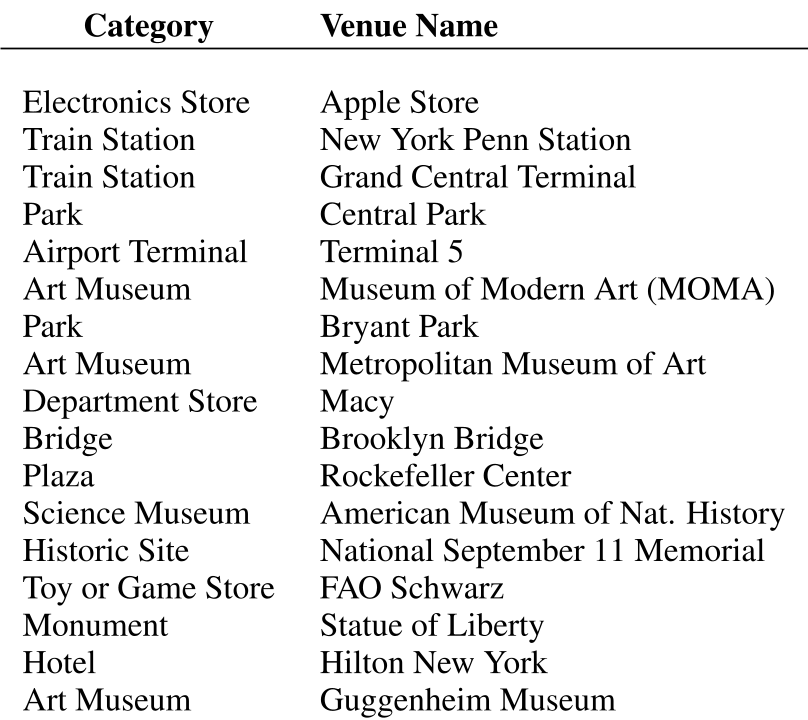 Table 4: Representative venues for the "Tourist" cluster in New York, featuring major transit hubs and landmarks.
Critical Analysis & Future Outlook
Takeaway
This research confirms that latent semantical structures exist in physical movement data. It suggests that recommendation engines shouldn't just look at "people who like pizza" but at the "latent drivers" (e.g., "Fitness Enthusiasts" who visit both gyms and athletic apparel stores like NikeTown).
Limitations
- Static Nature: The model ignores temporal sequences (the order of check-ins) and time of day, which are crucial for dynamic urban sensing.
- Interpretability: Like many unsupervised models, some clusters remain "noise" or require deep local knowledge to interpret.
- Data Sparsity: The model performs significantly better in high-density cities like NYC compared to smaller cities with fewer check-ins.
Conclusion
By moving beyond the "local," this work provides a framework for understanding the invisible threads—interests, identities, and communities—that weave through the fabric of a city. It opens the door for more "human-centric" recommendation systems that understand the why behind our footsteps.