
Decoding the Life Course: How Career and Family Paths Sculpt Our Travel Habits
Clustering Life Course to Understand the Heterogeneous Effects of Life Events, Gender, and Generation on Habitual Travel Modes
This study utilizes Joint Social Sequence Clustering to analyze longitudinal life history data from the San Francisco Bay Area, identifying five distinct life course cohorts based on family and career trajectories. The research quantifies how major life events (e.g., childbirth, employment) heterogeneously impact habitual travel mode choices across different demographic segments.
TL;DR
Daily travel choices—whether we drive, bike, or take the bus—are rarely isolated decisions. This research demonstrates that our "Mobility Biography" is carved by the timing and order of life events. By clustering individuals into five archetypal life trajectories, the study reveals that the most significant shifts toward car dependency occur when career and family events collide early in life.
The "Static" Blind Spot in Urban Planning
Most transportation models look at a "snapshot" of a person: 30 years old, one child, living in the suburbs. This static view masks the truth. A 30-year-old who has been working for a decade and just had a child behaves differently than one who just finished a PhD. Existing literature failed to account for these long-term life trajectory contexts, treating all "parents" or "employees" as a monolith.
Methodology: Mapping the Life Sequence
The researchers moved beyond simple regressions by adopting Joint Social Sequence Clustering. They treated an individual's life between ages 20 and 35 as a multi-channel sequence of states:
- Family Channel: Partnered/Unpartnered, Children/No Children.
- Career Channel: In School/Working/Other.
By calculating the "distance" between these sequences (using Optimal Matching), they identified five distinct cohorts:
- Singles (40%): Early career, delayed family.
- Couples (27%): Early partnership, delayed/no children.
- Have-it-alls (18%): Fast-track everything—early school, work, partner, and kids.
- Late Bloomers (8%): Delayed transitions across all domains.
- Family First (7%): Early children/partner, delayed career.
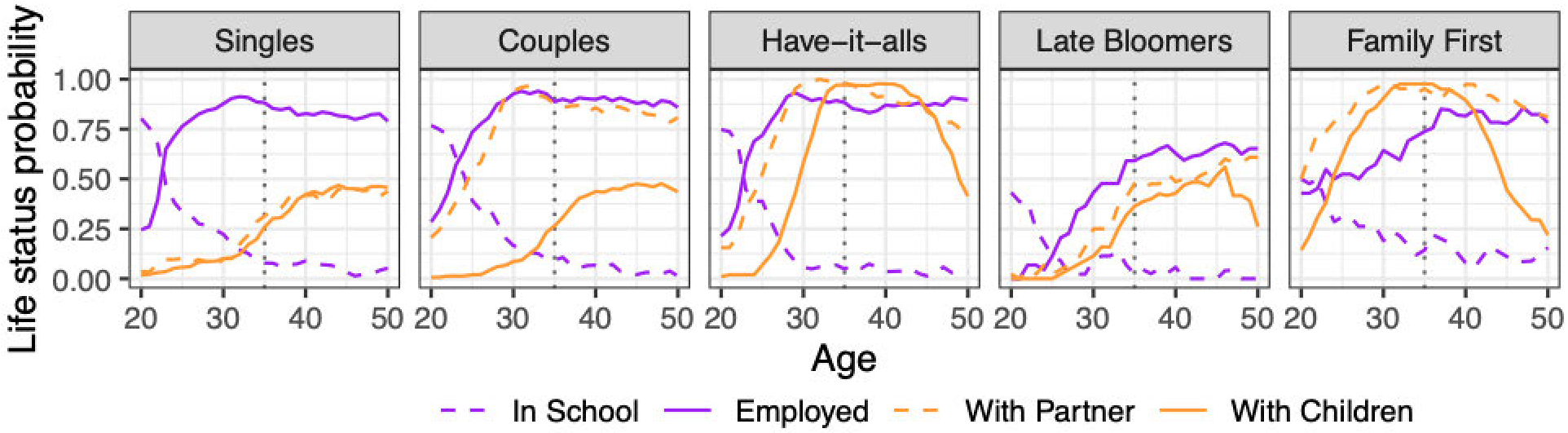 Figure: The divergent life course patterns of family and career status across the five identified cohorts.
Key Insights: Why "Timing" is Everything
The study’s regression analysis yielded a "Heuristic of Timing": Events that occur early in life are more likely to cause permanent shifts in habits.
The "Have-it-alls" Acceleration
Members of the "Have-it-alls" cohort experience a "compounding effect" on car use. Because they transition through school, work, partnership, and parenthood in rapid succession before age 35, their car usage ramps up at every stage. They reach peak car dependency (80% regular use) by age 30, whereas the general population doesn't reach 70% until age 33.
The Gender & Generation Gap
- The Time-Poor Mother: In the "Have-it-alls" cohort, women drive significantly more than men upon having children. This isn't just "parenthood"—it's the stress of simultaneous early-career development and family formation.
- Generational Shifts: Younger generations (GenX) show a higher probability of switching to cars during familial events than Baby Boomers, likely due to decades of suburbanization and the decline of transit-oriented neighborhood designs.
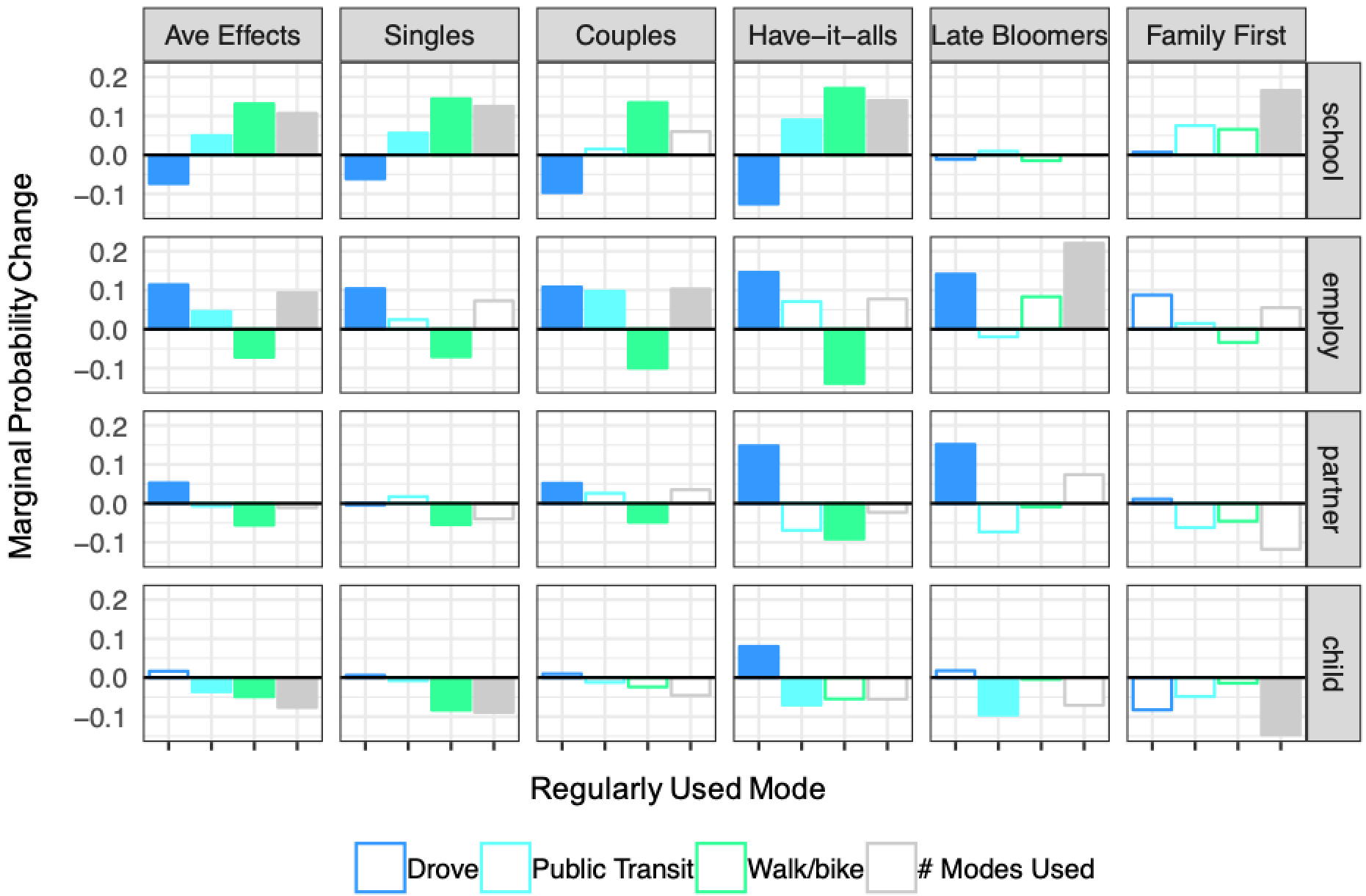 Figure: The marginal effects of life events on mode choice, showing how the same event (e.g., child-rearing) has vastly different impacts depending on the cohort.
Conclusion & Policy Impact
The takeaway for urban planners is clear: Context is king.
- Targeted Intervention: For "Have-it-alls," transit subsidies or car-sharing programs are most effective during the "nesting" period (2 years before the first child).
- Life-Stage Marketing: Policies aimed at reducing car use must recognize that a "Single" professional who already has a low-car habit is a very different target than a "Family First" individual who has already cemented a driving routine.
While the study is limited to the San Francisco Bay Area, it provides a robust machine-learning framework for any city to analyze its citizens' "Mobility Biographies" and design a more sustainable future.