
Beyond Keywords: Scaling Meme Detection through Protomemes and Heterogeneous Clustering
Clustering memes in social media
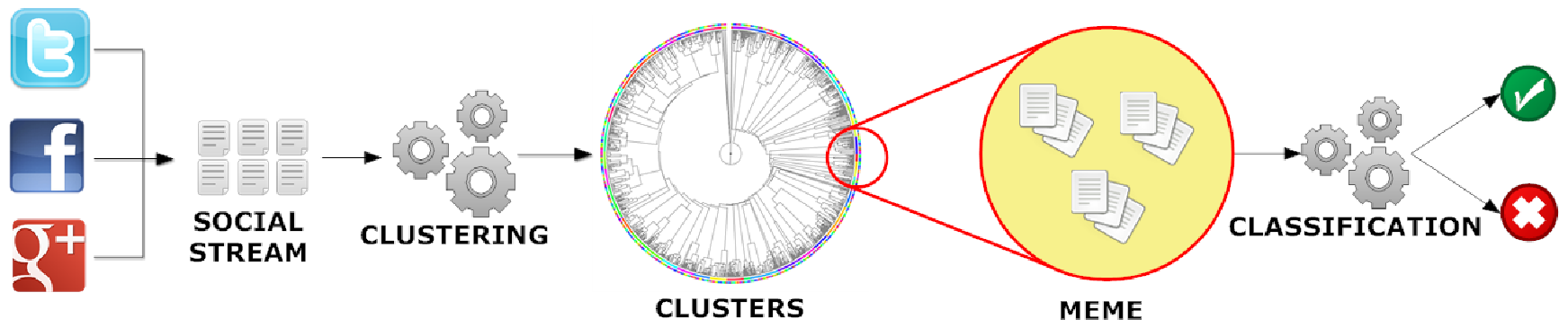
This paper introduces a scalable, unsupervised framework for clustering social media messages into "memes" (units of information). By proposing "protomemes"—clusters based on hashtags, mentions, URLs, or phrases—and applying hierarchical clustering with heterogeneous similarity measures, it achieves state-of-the-art results in identifying misinformation campaigns versus spontaneous communication.
TL;DR
Social media is an ocean of noise where engineered misinformation campaigns often hide within spontaneous chatter. This paper presents DESPIC, a framework that revolutionizes how we identify "memes"—the basic units of information transmission. By moving away from simple keyword matching to a sophisticated "protomeme" pre-clustering approach, the authors achieve high-accuracy, real-time detection without needing the full (and often private) social follower graph.
The Granularity Gap: Why Clustering Tweets is Hard
In the world of microblogging, a single tweet is too sparse to provide sufficient context for NLP. Traditional Lexical analysis (TF-IDF) struggles because:
- Text Sparsity: 140 characters don't provide enough signal for reliable clustering.
- Context Shifts: The same hashtag might be used in wildly different contexts, or different hashtags might refer to the same event.
- Network Invisibility: Most real-time systems cannot afford the "cost" of crawling the entire follower network to see who is talking to whom.
The authors argue that the unit of classification shouldn't be the tweet, but the Meme—a set of tweets carrying the same information concept.
Methodology: The Power of Protomemes
The core innovation is the Protomeme. Instead of treating every tweet as an isolated point, the system automatically groups tweets into "primitive memes" based on shared entities:
- Hashtags: Explicit topic markers.
- Mentions: Indicators of specific conversations.
- URLs: Links to the same external evidence.
- Phrases: Processed textual snippets.
Multi-Dimensional Similarity
To merge these protomemes into broader, meaningful memes, the authors utilize four distinct projections:
- (User Similarity): Do the same group of people post these protomemes?
- (Tweet Similarity): How much do the tweet sets overlap?
- (Content Similarity): Lexical TF-IDF similarity.
- (Diffusion Similarity): This is the "secret sauce"—it uses Mentions and Retweets as a proxy for the social network, bypassing the need for a full follower graph.
Hierarchical Clustering vs. K-means
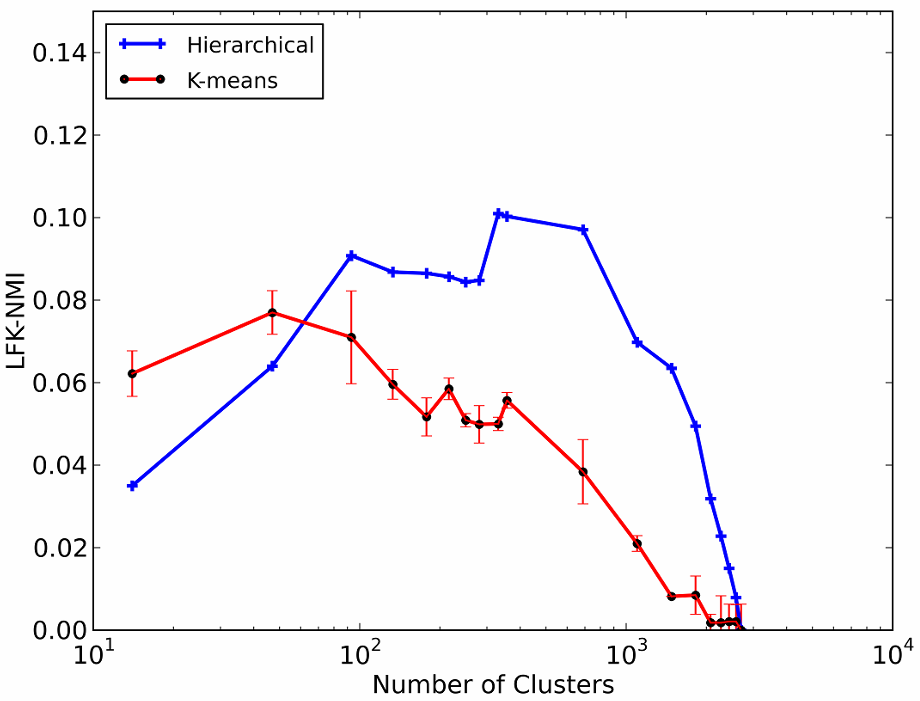
The paper makes a strong case for Hierarchical Clustering over K-means. In a dynamic social stream, we don't know the number of clusters () in advance. Hierarchical clustering allows for a "dendrogram cut," letting researchers tune the granularity of memes from broad topics to specific sub-discussions.
Key Results & Insights
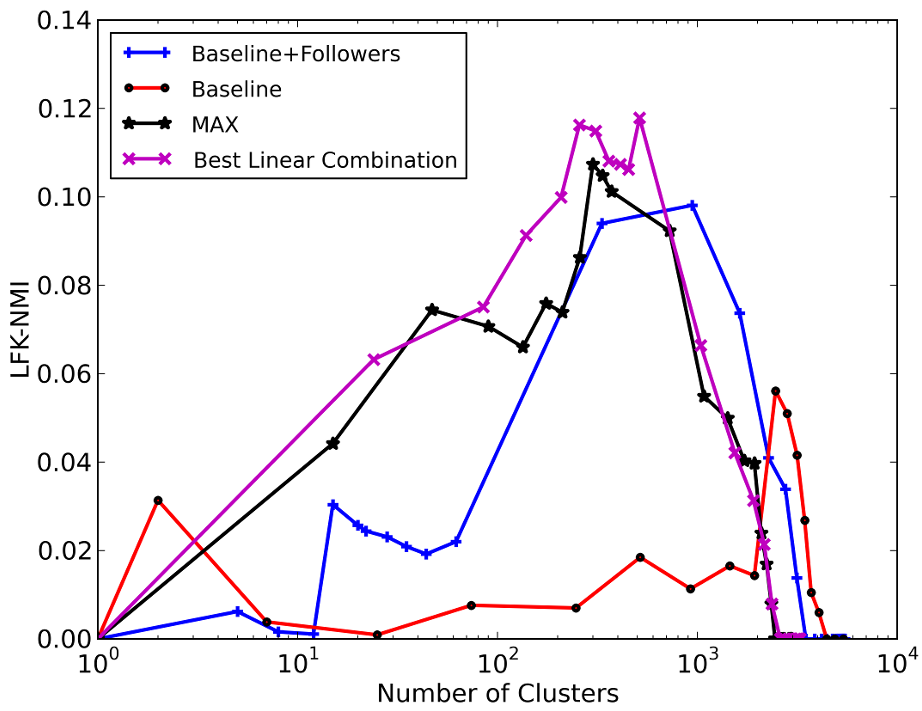
- MAX beats Complexity: One of the most surprising findings was the effectiveness of the MAX strategy. Simply taking the maximum of the four similarity scores (Content, User, Tweet, Diffusion) was nearly as effective as a complex, ground-truth-optimized linear combination. This suggests that for any given meme, one specific feature usually shines as the definitive signal.
- Context over Network: The
Baseline+Followersmethod (which uses the full social graph) was actually outperformed by theMAXstrategy in many scenarios. This proves that Diffusion Similarity (mentions/retweets) is a more relevant "active" signal than the "static" follower network.
Critical Analysis & Conclusion
This work provides a robust blueprint for real-time social sensing. It moves "Meme Tracking" from a retrospective academic exercise into a real-time defense mechanism.
Takeaway: To understand information flow, look at the entities (hashtags, URLs) and the active diffusion (retweets) rather than just the words.
Limitations: The current model struggles with cross-platform memes (e.g., a meme moving from Twitter to Instagram) and does not yet incorporate image-based similarity, which is increasingly vital in modern "visual" meme culture.
Future Outlook: Integrating these clusters with supervised classifiers could allow platforms to flag "Astroturfing" (fake grassroots movements) in minutes rather than days.