
Decrypting Regional Economic Structures: A Hierarchical Clustering Approach
Application of clustering in regional economy
This paper explores the application of data mining in regional economics by employing the Agglomerative Nesting (AGNES) hierarchical clustering algorithm. The study categorizes nine districts in Beijing based on four industrial income indicators to provide a scientific basis for regional economic policy-making.
TL;DR
This study demonstrates how the AGNES (Agglomerative Nesting) hierarchical clustering algorithm can be applied to categorize regional economies. By analyzing nine districts in Beijing through the lens of four key industrial income metrics, the researchers provide a data-driven method for policy-makers to group regions with similar industrial profiles and tailor supportive economic strategies.
Background & Motivation
In the realm of regional economics, understanding the "DNA" of a district—its industrial composition—is crucial for effective governance. However, economic data is often noisy and multi-dimensional. The authors argue that Data Mining, specifically clustering, is the key to discovering "connotative and unknown" knowledge within large datasets. The motivation is to move beyond qualitative descriptions and provide a mathematical basis for industrial layout and regional differentiation.
Methodology: The AGNES Architecture
The core of this research is the AGNES algorithm, a "bottom-up" hierarchical approach.
1. The Clustering Logic
The process begins by treating every district as an independent cluster. Through an iterative process, the algorithm:
- Calculates a Differentiation Matrix using Euclidean distance.
- Identifies the two clusters with the shortest average distance.
- Merges them into a new cluster.
- Repeats until the desired number of clusters () is reached.
2. Mathematics of Economic Distance
To calculate the similarity between two districts ( and ), the authors use the multi-dimensional Euclidean distance formula:
A significant insight provided is the Weighted Distance formula, which allows researchers to assign importance coefficients () to specific sectors:

Experiments and Results
The study analyzed 1996 data from nine Beijing districts, including Chaoyang, Fengtai, and Haidian. Four attributes were used: Industrial income, Agricultural/Forestry income, Planting income, and Total rural economic income.
Key Findings:
- Initial Merge: Fengtai and Fangshan were the first to be clustered, indicating they share the most similar industrial proportions.
- Final Classification: The nine districts were grouped into three distinct categories:
- Class 1: Chaoyang, Fengtai, Fangshan.
- Class 2: Shi Jingshan, Men Tougou, Changping.
- Class 3: Haidian, Shunyi, Tongxian.
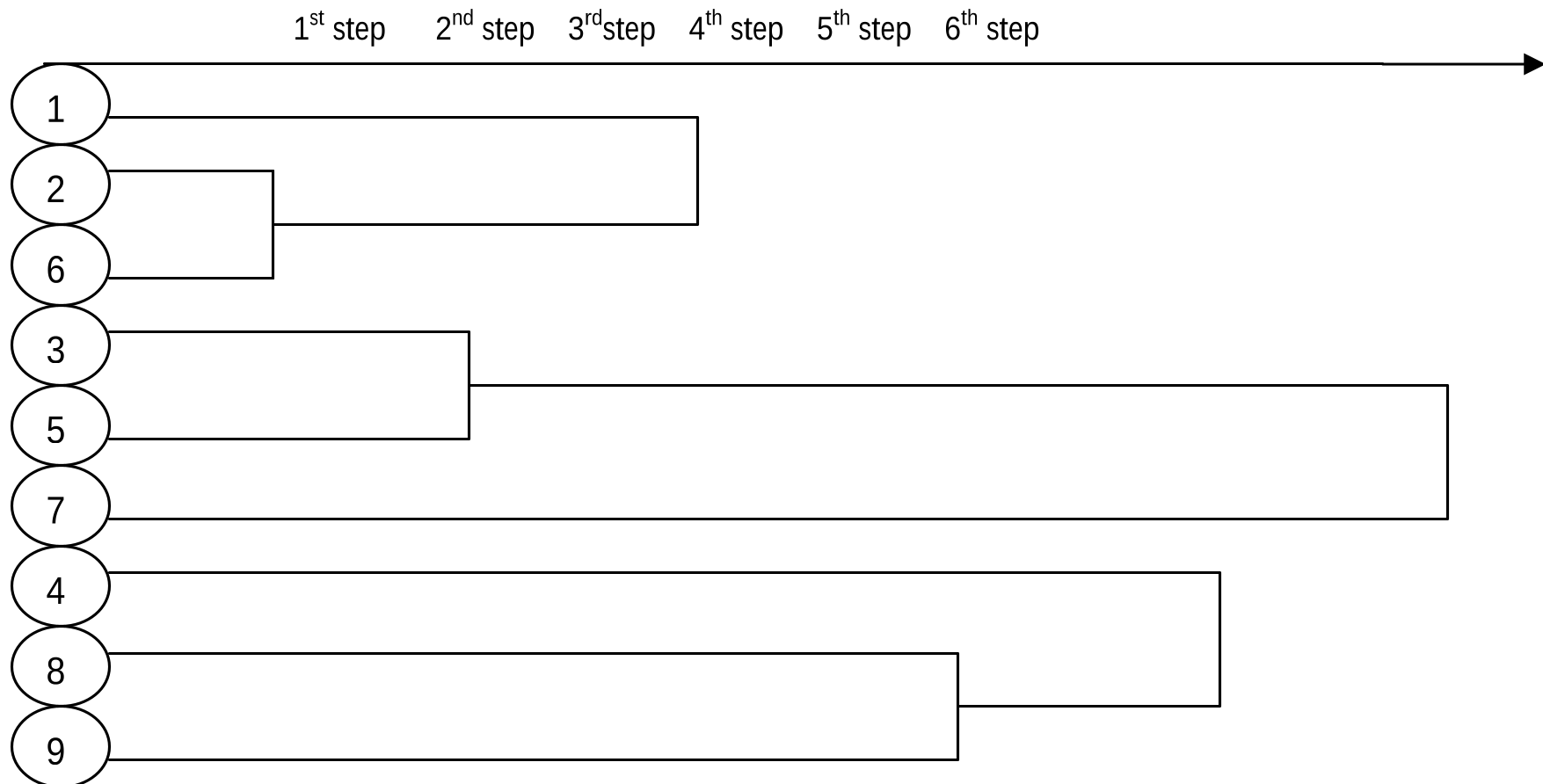 Figure 1: The hierarchical tree structure showing the merging process of the Beijing regional economy.
Critical Analysis & Conclusion
Takeaway
The primary value of this work lies in its flexibility. By adjusting the weights of different industrial sectors, a policy-maker can refocus the clustering results on specific priorities (e.g., focusing solely on high-tech vs. traditional agriculture).
Limitations
The authors honestly note a critical flaw in traditional hierarchical methods: irreversibility. Once a cluster is formed, it cannot be split. If an early step is influenced by an outlier, the error propagates throughout the hierarchy, potentially skewing the final grouping.
Future Outlook
To address these limitations, the authors suggest moving toward more sophisticated algorithms like CURE or BIRCH, which offer more flexibility and can handle larger, noisier datasets. This work serves as a foundational bridge between raw data mining theory and its practical, "on-the-ground" application in regional governance.