
Beyond the Glass Ceiling: Decoding the "Social Gestalt" of Gendered Collaborations
Co-authorship pair distribution patterns by gender
This paper presents a comprehensive study on gender-based co-authorship patterns in Turkish social sciences using bibliographic data from 7,835 papers. By integrating the Social Gestalt model with Lotka’s law, the authors identify significant regularities in how male and female scientists collaborate and sustain research partnerships.
TL;DR
This research investigates the hidden architecture of scientific collaboration in Turkey's social sciences through a gendered lens. By moving beyond simple productivity counts, the study applies the Social Gestalt model to reveal that females are naturally more collaborative, yet male-dominated networks are more active in dissemination. It uncovers a striking "asymmetry" in how senior and junior researchers of different genders pair up.
Contextualizing the Collaboration Gap
Turkey presents a unique case study; it boasts a higher-than-average proportion of female full professors (28%) compared to the EU average (19%). However, institutional presence does not always equate to collaborative symmetry. The authors move beyond the "What" of productivity to the "How" and "Why" of scientific partnership, using a dataset of over 6,000 scientists to map the social psychology of academic ties.
Methodology: The Yin and Yang of Research
The core of this paper lies in the application of the Social Gestalt model. This model views collaboration as a tension between two forces:
- Yang (Homophily): "Birds of a feather flock together"—scientists with similar productivity levels collaborating.
- Yin (Complementarity): "Opposites attract"—the master-apprentice relationship where a high-output seminal author pairs with a newcomer.

The researchers don't just count papers; they calculate the persistence of ties—how often the same pair works together again—and fit these to power-law distributions.
Empirical Findings: Productivity vs. Persistence
The study reveals four critical insights into the Turkish social science community:
1. The Productivity Paradox
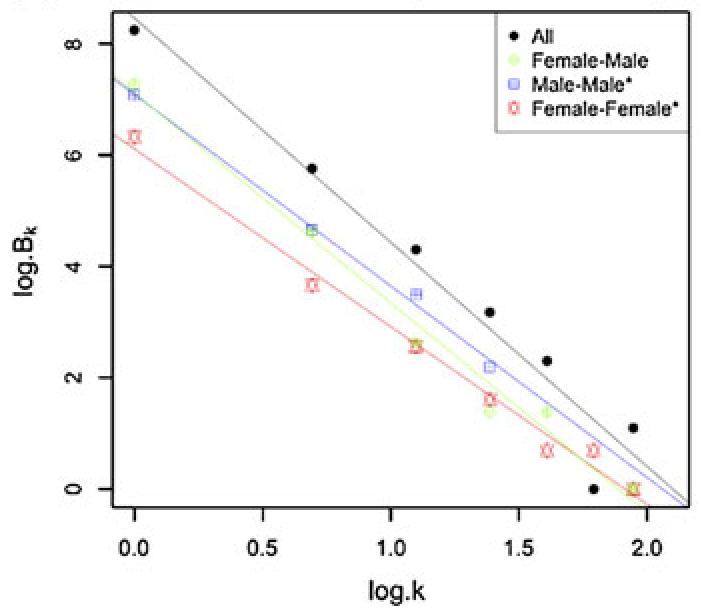
While women are more likely to participate in at least one collaboration (62% vs. 55% for men), men still dominate the total contribution and presence metrics. The data confirms a statistically significant gender difference in publication output, aligning with Lotka’s Law but with steeper decay rates.
2. The Persistence of Female Ties
One of the most salient findings is that female-female (FF) dyads are more persistent. When women find a collaborative partner of the same gender, they are more likely to repeat that partnership compared to male-male (MM) pairs.
3. Asymmetric "Master-Apprentice" Relationships
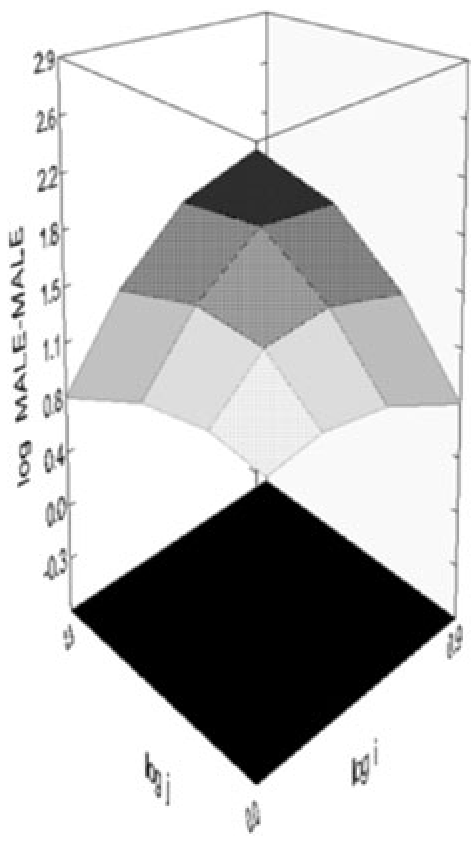
The Social Gestalt surfaces (the 3D plots below) reveal that for the whole community, the "Yang" (colleagues at the same level) dominates the entry phase, while "Yin" (master-apprentice) takes over for senior authors. However, this is asymmetric: productive males are more likely to mentor/pair with less productive females than vice versa.
Critical Insight & Conclusion
The study’s strength lies in its integrated parametric approach. It treats co-authorship not as a series of isolated events, but as a dynamic network influenced by "interpersonal attraction."
Takeaway: The research suggests that to improve female productivity in academia, policy should focus not just on "individual support," but on fostering the types of persistent intra-gender networks that women already utilize effectively. The "asymmetry" in inter-gender mentoring suggests that senior female scholars might face different barriers or choices in building apprentice-based "laboratories" compared to their male counterparts.
Limitations: The study is confined to a 5-year window and a specific geography (Turkey), and it relies on manual gender coding which, while thorough, may overlook nuances in non-binary gender identities or changing surnames.