
Bridging Social Silos: A Co-training Approach to Cross-Network User Identification
A co-training method for identifying the same person across social networks
The paper introduces a Co-training method to identify the same user across different social networks (e.g., Zhihu and Guokr). It leverages a collaborative strategy that iteratively synchronizes profile matching (via SVM) and relation matching (via graph propagation) to improve cross-network alignment with minimal labeled data.
TL;DR
In an era of fragmented digital identities, linking accounts across platforms like Twitter, LinkedIn, and Facebook is essential for accurate user profiling. This paper proposes a Co-training framework that allows profile-based matching and relationship-based matching to "teach" each other. By iteratively exchanging high-confidence labels, the model achieves a significant 10% F1-score improvement over traditional static fusion methods, even with very few initial "seed" users.
Problem & Motivation: The Asymmetry Trap
Most of us exist in multiple digital worlds: we use LinkedIn for career growth, Twitter for real-time news, and Facebook for family. However, these accounts remain isolated.
Previous attempts at "User Identity Linkage" (UIL) faced two major hurdles:
- Asymmetric Data: A user might have a detailed profile on one site but be nearly anonymous on another.
- Feature Dissonance: Sometimes a person’s username matches perfectly, but their social circles are entirely different (e.g., a professional vs. a personal network). Simply averaging these similarities often leads to poor results.
The authors' insight is rooted in the Co-training paradigm: if we have two independent views of the same data (Profiles and Relations), we don't need to force them into a single score. Instead, we can let them collaborate dynamically.
Methodology: The Power of Collaborative Learning
The proposed system breaks the problem into two distinct pipelines that feed into a feedback loop.
1. The Profile Pipeline
The model first measures Username Similarity using the Jaro-Winkler distance. Crucially, it doesn't treat all names equally; it uses a Markov Chain-based language model trained on 200,000 users to estimate the "uniqueness" of a name. A match on a rare name like "ZhengFang123" is worth much more than a match on "JohnSmith."
2. The Relation Pipeline
Social circles are the "fingerprints" of our digital lives. The authors use a relative similarity metric: Where is the number of common neighbors (already matched pairs). To prioritize influential nodes, they incorporate GlobalRank to identify core users who act as "anchors" in the network structure.
3. The Co-training Loop
This is where the magic happens. Instead of a one-pass match, the algorithm runs iteratively:
- Profile Matcher identifies the top most confident pairs and hands them to the Relation Matcher.
- Relation Matcher uses these new "seeds" to re-calculate social similarities and hands its top successes back to the Profile Matcher.
 Equation showing the calculation of common neighbors based on identified seeds.
Experiments & Results: SOTA Performance
The authors tested their model on two real-world Chinese social networks: Zhihu (Q&A) and Guokr (Science-focused).
| Method | Precision | Recall | F1-score |
|---|---|---|---|
| Username Match | 38.8% | 52.8% | 44.7% |
| SVM (Profile only) | 56.2% | 52.2% | 59.7% |
| Static Fusion | 63.6% | 69.3% | 66.3% |
| Co-training (Ours) | 72.2% | 75.5% | 73.8% |
Key Insights from Results:
- The "Seed" Efficiency: Unlike deep learning models that require massive datasets, this Co-training method matures rapidly. With just 150 seeds (known pairs), the F1-score jumps significantly, proving its utility in "cold-start" scenarios.
- Beyond Text: While username matching is fast, its 38.8% precision is abysmal. Adding avatar (image) matching and social relations is the only way to reach professional-grade accuracy.
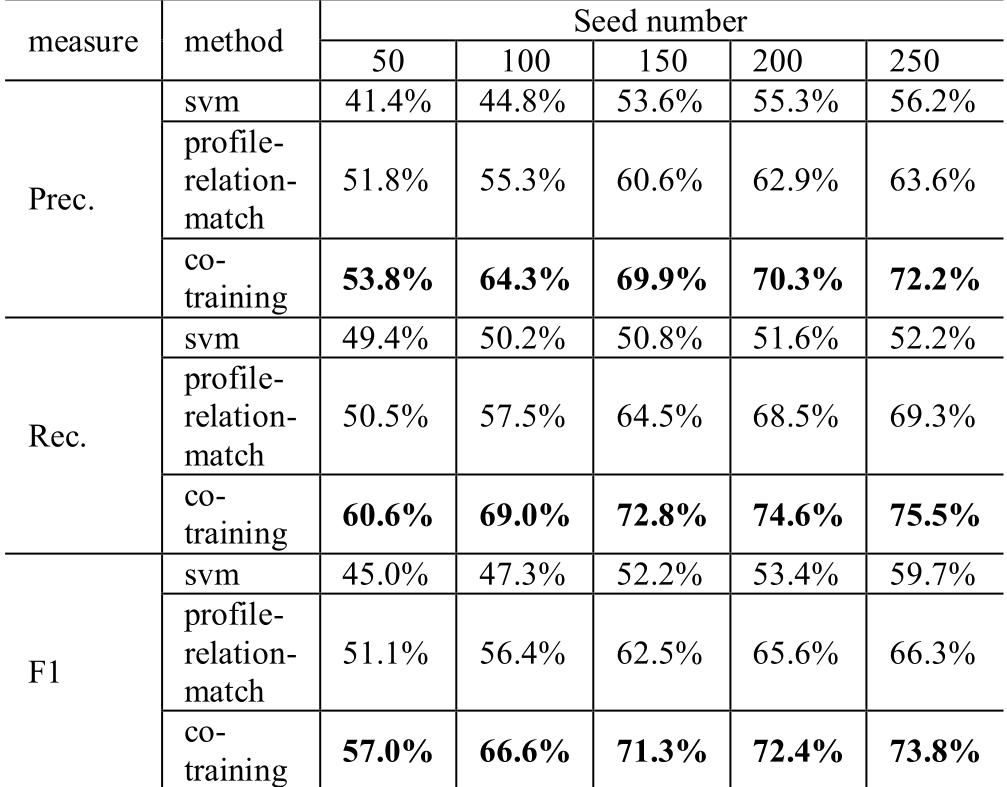 The chart shows that Co-training consistently outperforms SVM and static methods across all seed counts.
Critical Analysis & Conclusion
Takeaway: This paper successfully demonstrates that the "wisdom of two perspectives" is better than one. By treating profile attributes and network topology as independent but collaborative learners, the system bypasses the "averaging" problem that plagues static models.
Limitations:
- Behavioral Gap: The model ignores when and how users post (temporal and behavioral patterns).
- Privacy Concerns: Such efficient identification tools raise significant privacy questions regarding "de-anonymization" across the web.
Future Outlook: Integrating behavioral dynamics (e.g., posting frequency or sentiment) could be the next frontier to reach >90% accuracy in cross-network linkage. As social platforms become more restrictive with data, the ability to work with sparse "seeds" becomes a vital technical advantage.