
Predicting Cooperation: Bridging Cooperative Game Theory and Deep Learning via Crowdsourcing
Analysis of Coalition Formation in Cooperative Games Using Crowdsourcing and Machine Learning
This paper introduces a novel framework for analyzing coalition formation in cooperative games by combining large-scale crowdsourcing with Deep Neural Networks (DNNs). Using data from the Japan-based platform Lancers, the authors predict player behavior regarding coalition choice and payoff distribution, achieving results consistent with traditional laboratory experiments.
TL;DR
Researchers have successfully moved game theory experiments from the costly lab to the "crowd." By using crowdsourcing to collect large-scale data on how humans form coalitions and split profits, they trained Deep Neural Networks that predict strategic behavior with high accuracy. The key finding? Humans love fairness, and AI can learn to predict that "human touch" better than traditional formulas.
The Scalability Bottleneck in Behavioral Economics
For decades, understanding how people cooperate has relied on Laboratory Experiments. While effective, they are the "artisan" approach to science: small-scale, expensive, and slow. In cooperative games—where players form groups (coalitions) and sign binding agreements—predicting the outcome is notoriously difficult because human logic often defies the "perfect rationality" assumed by classical concepts like the Core or Shapley Value.
The authors identify a critical gap: To apply modern Machine Learning (ML) to game theory, we need "Big Data" of human decisions. Their solution? Crowdsourcing.
Methodology: From Human Input to Neural Weights
The study utilizes a two-step pipeline: Data Acquisition and Deep Modeling.
1. Data Collection via Lancers
The researchers assigned roles (Agent A, B, C, or a Third Party) to 166 workers and asked them to play 10 different games. These workers had to decide:
- Which coalition to join? (e.g., A+B, or the "Grand Coalition" A+B+C).
- How to split the pot? (e.g., If A+B get 120, does A get 60 and B get 60?).
2. The Deep Learning Architecture
The authors didn't just use simple linear regression. They built two distinct DNNs to handle the complexity:
- Coalition Prediction Model: A 4-layer fully connected network using Target Softmax to predict the probability of choosing among 5 possible coalition structures.
- Division Prediction Model: A similar architecture using Kullback-Leibler (KL) Divergence as a loss function to measure the difference between the predicted and actual percentage of the "split."
 Figure 1: Conceptual overview of strategic interaction in multi-agent systems.
Key Insights: Fairness Over Formula
The results revealed a fascinating disconnect between theory and practice:
- The "Equal Division" Bias: Standard theory (Shapley Value) assigns values based on marginal contribution. However, the study found that 48.1% of participants chose an exactly equal split, regardless of their "power" in the game.
- Stability vs. Fairness: Even when the "Core" (the set of stable outcomes) was empty, players still found ways to cooperate, often defaulting to proportional or equal splits.
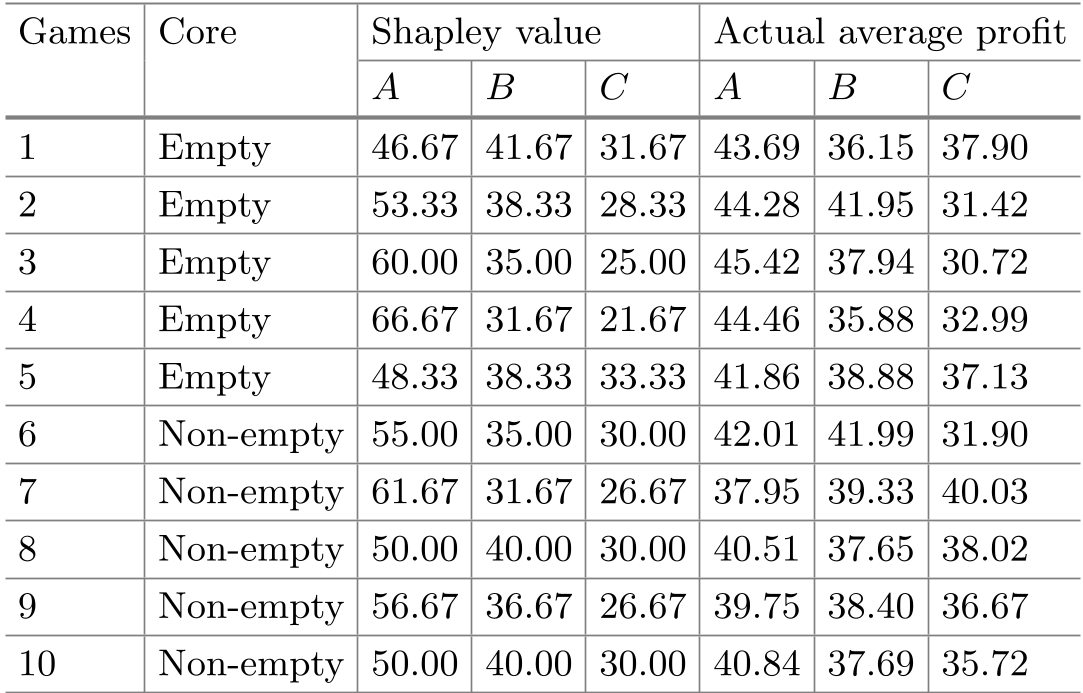 Table 2: Comparison of the Core, Shapley Value, and Actual Average Profit. Note how the actual profits deviate from theoretical Shapley values.
Performance on Unseen Games
To test the model's robustness, the authors introduced 3 entirely new games (N1, N2, N3). The ML models were able to generalize the "human-like" behavior, predicting that even in new scenarios, the Grand Coalition would likely form if the incentives were right, and that the split would gravitate toward fairness rather than just marginal contribution.
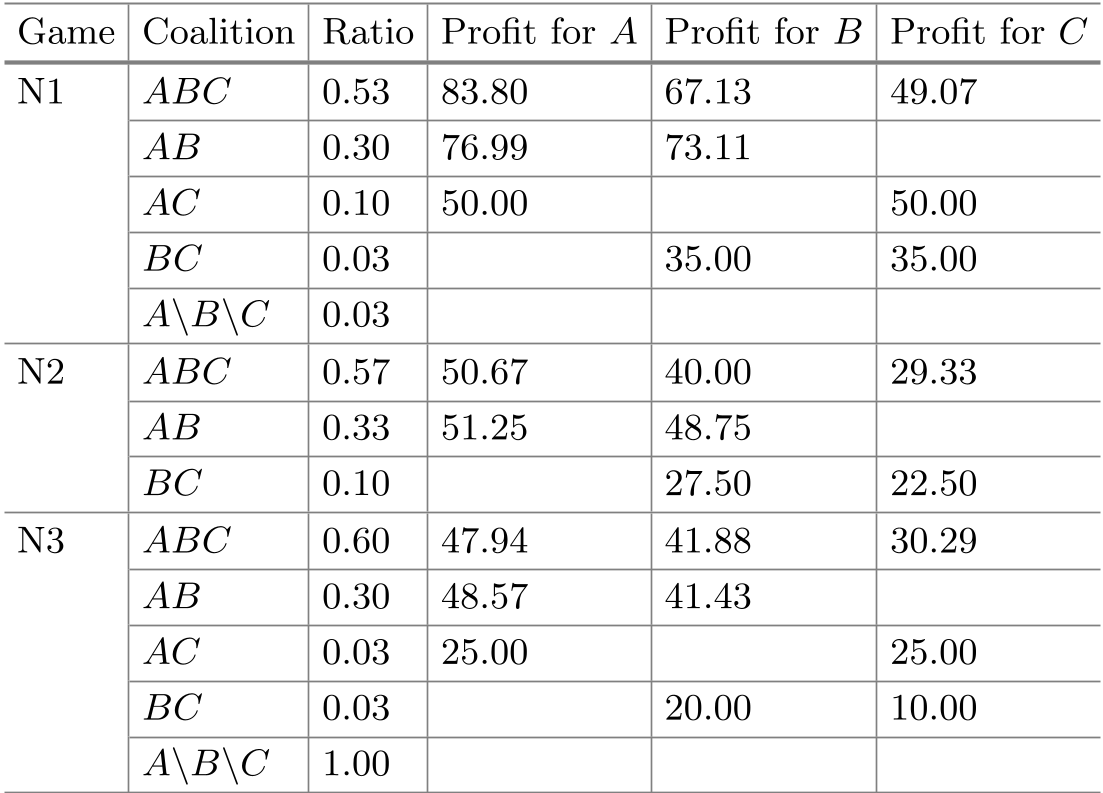 Table 10: Model predictions for new game scenarios, demonstrating the generalization capability of the DNN.
Critical Analysis & Future Outlook
Takeaway: This research successfully validates crowdsourcing as a high-fidelity data source for game theory. It proves that Deep Learning can capture the "Inductive Bias" of human fairness.
Limitations:
- Complexity: The study was limited to 3-player games. As the number of players () grows, the number of possible coalitions () grows exponentially, which would require more complex neural architectures (like Graph Neural Networks).
- Demographics: The data was collected from a Japanese platform (Lancers); cultural attitudes toward "fairness" might vary globally.
Future Work: The next frontier is applying this to Multi-Modal Game Theory, where agents interact via text or voice, and using these ML models to design better Incentive Mechanisms for decentralized autonomous organizations (DAOs) and AI-human collaboration.