
Coalition Formation of Mobile Agents: A New Frontier in Social Task Allocation
Coalition Formation Game for Task Allocation in the Social Network
This paper introduces a distributed coalition formation game for complex task allocation in social networks, where subtasks are assigned to "mobile agents" that migrate to suitable workers. The core method utilizes a graph-constrained coalition formation algorithm combined with a system operation cost minimization strategy to optimize task distribution.
TL;DR
This research transforms the traditional "worker-centric" task allocation problem into a "subtask-centric" mobile agent game. By allowing agents to form coalitions and move across a social network, the system minimizes both the execution delay and the communication costs of complex, interdependent tasks.
Contextual Positioning
In the multi-agent system (MAS) landscape, task allocation is a classic problem. However, as tasks become "complex" (decomposable and interdependent) and environments become "social" (network-constrained), static allocation fails. This paper is a methodological refinement, introducing the concept of mobile agents to represent subtasks, allowing for a more flexible and distributed optimization compared to traditional SOTA methods.
The Core Motivation: Beyond Static Partitions
Existing models usually try to divide workers into groups. The author identifies two massive inefficiencies here:
- Resource Waste: Not all workers need to be in a coalition at all times.
- Skill Redundancy: A single worker might possess multiple skills and could contribute to multiple tasks if managed correctly.
The insight is simple yet profound: don't move the workers; move the "representation" of the task. By assigning a mobile agent to each subtask, the problem becomes a distributed game of finding the best host (worker) for these agents to minimize the overall "System Operation Cost" ().
Methodology: The Coalitional Game
The paper models the process as a coalition formation game , where is the set of mobile agents.
1. The Cost Function (The "Why")
The game is driven by a two-part cost function:
- Total Delay Cost: Reflects the waiting time within a coalition. If multiple agents join the same worker, they must queue.
- Communication Cost: Reflects the distance between workers hosting interdependent agents.
2. Graph Constraints and Feasibility
Not all agents can form a coalition. A coalition is only feasible if the subtasks it represents are connected in the relationship graph and the target worker possesses all required skills.
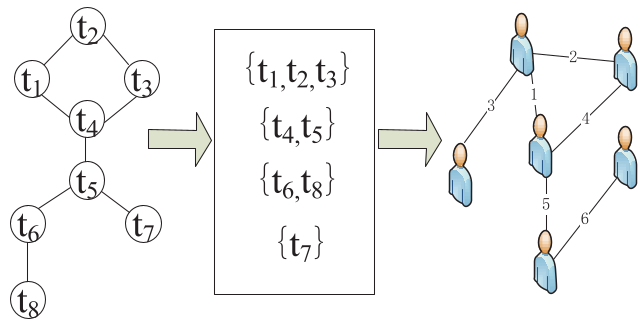 Above: The mapping from complex task decomposition to worker allocation in the social network.
3. The Algorithm (The "How")
The paper proposes a distributed algorithm where agents perform feasible transitions. An agent will leave its current coalition to join another only if the total system cost decreases. This ensures the system moves toward a Nash-stable partition.
Experimental Validation
The authors tested their approach against different scenarios ( and variations) and different selection strategies (Random, Greedy, and Best Response).
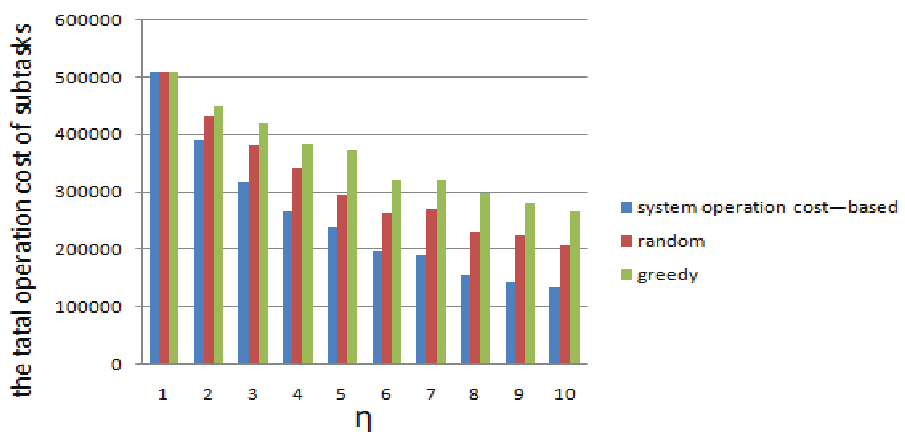 Experimental result: The System Operation Cost-based strategy (Best Response) significantly outperforms random and greedy approaches.
Key Findings:
- Cost Sensitivity: As the delay coefficient increases, agents spread out across more workers to avoid queuing time.
- Skill Density: When more workers have the same skill (), the total cost drops because agents have more options to find "closer" neighbors, reducing communication overhead.
Critical Insight & Future Outlook
The primary contribution is the proof of convergence for distributed mobile agent coalitions. While traditional models struggle with the computational explosion of social network partitions, this agent-centric move simplifies the search space.
Limitations: The model assumes "complete information"—every agent knows the status of all workers. In massive, real-world social networks, a partially observable model or a hierarchical gossip protocol would be necessary to maintain scalability.
Takeaway: For developers of decentralized AI systems or distributed cloud computing, this paper provides a robust mathematical framework for balancing processing speed against data transfer costs in a networked environment.