
Forming Coalitions in Social Networks: Balancing Team-Building Costs and Stability
Forming coalitions and facilitating relationships for completing tasks in social networks
The paper introduces a framework for establishing k-coalition structures in social networks where the organizer can facilitate new relationships at a cost. It addresses the challenges of maximizing social welfare and achieving "k-coalitions-core" stability using algorithms tailored for "nearly positive" graphs.
TL;DR
How do you form the perfect team when some people work well together, others clash, and you have a limited budget to introduce strangers? This paper addresses this by combining Cooperative Game Theory with Social Network Analysis. The authors provide a roadmap for central organizers to build optimal k-coalition structures, proving that even though these problems are usually computationally "heavy," they become solvable (polynomial time) when the number of negative relationships is limited.
Problem & Motivation: The Reality of Cooperation
In traditional multi-agent systems (MAS), researchers often assume any group of agents can just "form a coalition." In reality, humans (and agents) are bound by a social fabric.
- Fixed Tasks: Organizations usually have a fixed number of tasks (), meaning we must partition agents into exactly groups.
- Relationships Matter: Utilities aren't just about skills; they are about affinities. Weighted edges represent these relationships; negative weights mean cooperation is impossible or detrimental.
- The Intervention Aspect: A central organizer (like a manager) can "pay" to create new relationships (e.g., via team-building), but is it worth the cost?
Methodology: The "Nearly Positive" Insight
The paper treats the problem as a Symmetric Additively Separable Hedonic Game (ASHG). The core innovation lies in dealing with the complexity of negative edges.
1. Social Welfare Maximization
To maximize total utility, the authors show this is equivalent to finding a Minimum K-Cut. Since MIN-K-CUT is NP-hard, they restrict the search to "Nearly Positive Graphs"—graphs where the negative edges can be "covered" by a small (logarithmic) number of nodes.

2. The SN-max-SW Algorithm
The authors propose a clever strategy:
- Create a temporary graph where new potential edges have a weight of .
- Find the optimal partition in this graph.
- Only actually "build" the relationships that fall within the resulting coalitions.
Experimental & Theoretical Results
The authors distinguish between Social Welfare (what's best for the group) and Stability (what keeps agents from leaving).
Key Findings:
- Group Stability: Any coalition structure that maximizes social welfare is automatically "group stable," meaning no subgroup can benefit by jumping as a unit to another existing coalition.
- Complexity Benchmarks: While Membership testing in the "k-coalitions-core" is Co-NP-complete in general, it drops to Polynomial time for fixed on nearly positive graphs.
- Real-world Impact: Using a subgraph from Slashdot, the authors demonstrated that when the cost of adding relationships () is low, the organizer can boost total social welfare by massive margins (up to 150%).
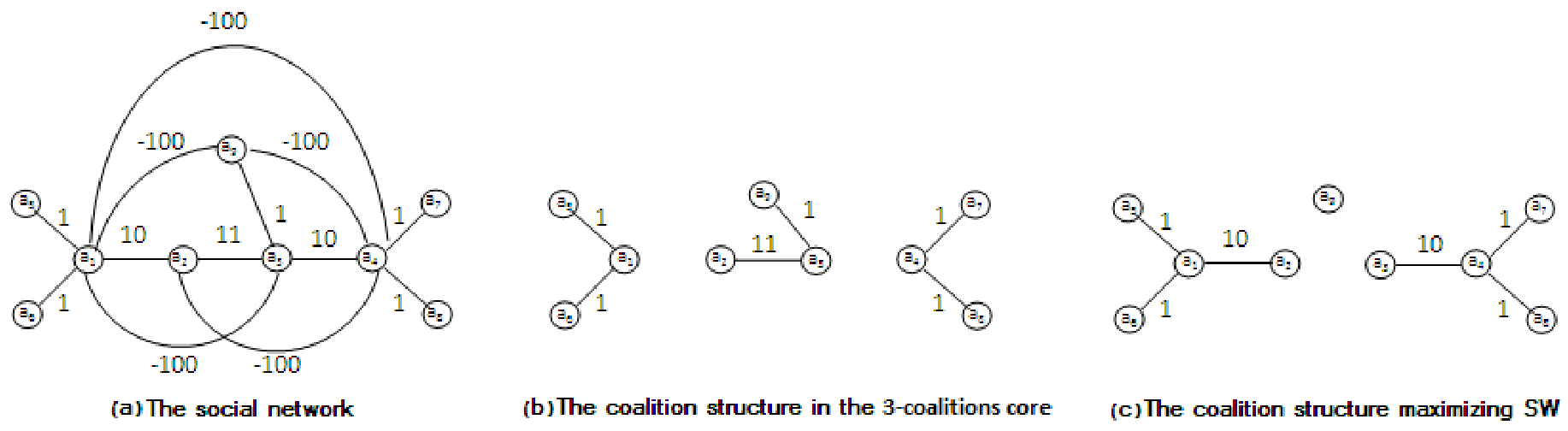 Figure 1 above illustrates a crucial distinction: the structure that is best for the group (max welfare) is not always the most stable (core).
Critical Analysis & Conclusion
This paper bridges the gap between abstract game theory and practical organizational management.
Takeaway: If you are managing a network with mostly positive or neutral relationships, finding the most efficient team structure is computationally feasible. However, the presence of even a few "toxic" or negative nodes (those requiring a vertex cover) drastically changes the landscape of stability.
Limitations: The model assumes relationship building has a fixed cost. In reality, connecting two high-profile specialized agents might be much more expensive than connecting two entry-level ones. Furthermore, it assumes weights are symmetric, ignoring "one-sided" professional admirations or rivalries.
Future Outlook: The next logical step is integrating Agent Skills. High affinity is useless if the team lacks the specific skills to complete the task—a multi-dimensional optimization problem that remains a frontier in MAS research.