
The Birth of Symbols: How Cooperation Shapes Culture and Social Networks
Modeling the Co-evolution of Culture, Signs and Network Structure
The paper introduces an agent-based model (ABM) to study the co-evolution of cultural traits, social network structures, and arbitrary observable tags. It demonstrates that when cooperation is mediated by "indirectly biased interaction," social networks evolve into small-world structures where tags function as meaningful signs of community membership and shared cultural strategies.
TL;DR
This study uses agent-based simulations to show that when social ties are expensive and people’s true strategies are hidden, "tags" (arbitrary markers like dress or accent) naturally evolve into meaningful symbols. Through a process of co-evolution, populations self-organize into Small-World networks where shared culture and visible signs reinforce one another, allowing cooperation to flourish in local clusters.
The "Invisible Hand" of Culture
In human society, we often use external markers—accents, fashion, or even technical jargon—to identify "our own." But where do these signs come from? Academically, this is the problem of Indirectly Biased Interaction.
The researchers point out a critical flaw in traditional models: they often assume we know who to cooperate with, or that tags already have meaning. In reality, maintaining social connections is costly, and we cannot read minds. This paper asks: can meaningful signs emerge from purely neutral markers through evolution alone?
Methodology: The Coordination Game
The model places agents in a social network where they must play an coordination game. Success depends on matching a hidden "cultural trait."
The Cognitive Engine
Agents don't just react; they learn. Using the ACT-R model of cognition, agents track the "salience" of their experiences with specific tags. The formula for updating tag salience () accounts for a decay rate (), meaning recent interactions weigh more heavily than old ones:
If a tag is associated with successful cooperation, the agent seeks out more partners with that tag. If it leads to failure, the link is cut.
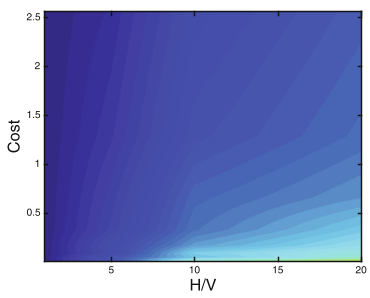 Figure: The visual evolution of the network. Note the transition from a random initial state (a) to specialized, modular clusters (j) in the Lamarckian model.
Key Findings: The Small-World Emergence
The study compared three configurations: Lamarckian (inherited learning), Genetic (inherited but static preferences), and Unbiased (random link-cutting).
- Small-World Structure: The Lamarckian model produced networks with high Clustering Coefficients and low Path Lengths. This is the hallmark of a functional society—tight-knit communities connected by occasional shortcuts.
- Tag Entropy: In biased models, the "entropy" of tags decreased, meaning a tag became a highly reliable predictor of a cultural trait. An arbitrary marker became a sign.
- Modularity: High maintenance costs () forced agents to be elitist. Under low costs, however, the biased interaction created clear "cultural silos" (High Modularity ).
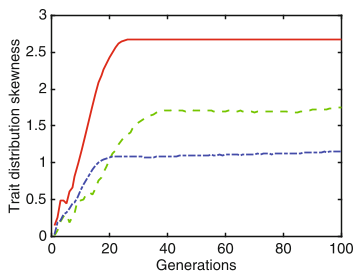 Figure: Comparison of Tag Distribution, Trait Distribution, and Entropy across the three models.
Critical Insight: Drift vs. Selection
A fascinating finding is the role of Kin Selection. Because offspring are born near parents and inherit their tag-trait combinations and their preferences, a "feedback loop of familiarity" begins. In the unbiased model, a single trait eventually takes over the whole population due to Genetic Drift. In the biased model, "meaning" is local: a red hat might mean "engineer" in one cluster and "artist" in another, yet both clusters thrive internally.
Conclusion and Future Outlook
This work provides a rigorous framework for understanding how symbolic culture acts as a shortcut for social optimization. While powerful, the model currently assumes a static environment. The next frontier in this research would be "mixed populations"—testing if these tag-biased agents can survive an invasion by "cheaters" who mimic tags without possessing the corresponding cultural trait.
For modern platforms like GitHub or AirBnB, this research suggests that our digital "tags" (badges, stars, reviews) are not just metadata—they are the evolutionary glue preventing network collapse under the weight of interaction costs.