
Cognition or Affect? Why You "Like" What You Don't Understand on Facebook
Cognition or Affect? - Exploring Information Processing on Facebook
This study investigates user information processing on Facebook using a custom-built real-time application and Structural Equation Modeling (SEM). It reveals that affective attitude primarily drives behavioral intentions (commenting, liking, etc.), significantly outweighing cognitive utility in the social networking context.
TL;DR
Why do we interact with some Facebook posts while ignoring others? This study reveals that our behavior on social networks is driven almost entirely by affect (feelings) rather than cognition (usefulness). By analyzing real-time user data, the researchers found that we use "communication intensity" as a mental shortcut—we tend to like posts from people we talk to often, even if the post itself is incomprehensible or useless.
Contextual Positioning
Positioned at the intersection of Information Systems (IS) and Social Psychology, this paper challenges the traditional "Technology Acceptance Model" (TAM) which emphasizes perceived usefulness. Instead, it positions Facebook as a Hedonic Information System, where social heuristics override rational information processing.
The Problem: The 30-Billion Piece Haystack
With over 30 billion pieces of content shared monthly, Facebook users face a massive Information Overload. Current algorithms filter content based on time and post type, but they fail to account for how humans actually process information under pressure. Users report stress and anxiety because they can't find the "needle" of interesting content in the "haystack" of social noise.
Methodology: Capturing Attitudes in the Wild
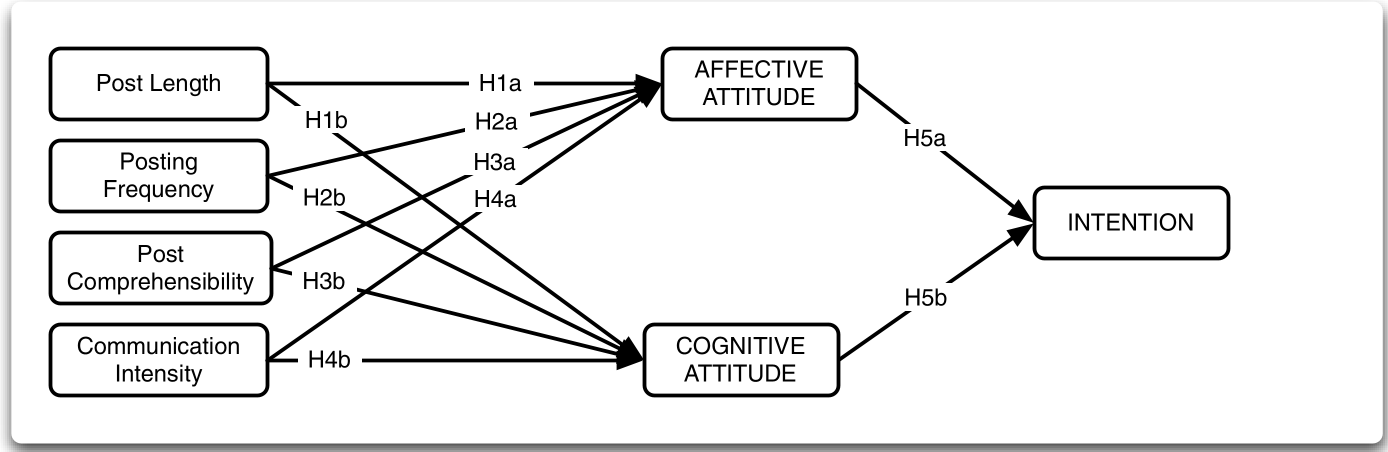
The researchers developed a custom Facebook application that pulled 6 random posts (status updates, links, pictures) from a user's actual Newsfeed and asked for immediate evaluation.
The Dual-Attitude Model
The study split "Attitude" into two distinct dimensions:
- Affective: Is it likable? Is it interesting?
- Cognitive: Is it useful? Is it relevant?
Core Findings: Heuristics Over Logic
Using Partial Least Squares (PLS) modeling, the authors tested several hypotheses with surprising results:
- The Power of Closeness: Communication intensity was the strongest predictor of both affective and cognitive attitudes. We essentially "hallucinate" value into posts made by our close friends.
- Comprehensibility vs. Relationship: Interestingly, high communication intensity can make a user overlook an unclear post. We are more likely to enjoy a confusing post from a best friend than a crystal-clear post from a stranger.
- The Post Length Paradox: Contrary to expectations that long posts cause overload (H1), post length actually had a small positive impact on attitude. It seems that on Facebook, "longer" might imply "more effort/value" until it reaches an extreme limit.
Performance Comparison: Affective vs. Cognitive
The study found a stark contrast in how these two attitudes translate to actual clicks.

As shown in the data, while 70% of posts were "liked," only 37% were deemed "useful." The path coefficient for Affective Attitude to Behavioral Intention (0.574) was significantly higher than the Cognitive path (0.228), proving that Facebook is a playground for the heart, not a library for the mind.
Critical Insights & Conclusion
Why does this work? (The "Why")
The study concludes that users apply Heuristic Processing. Because we are cognitively "lazy" (or overtaxed) when scrolling, we don't read for content; we read for the "source." Communication intensity acts as a "Social Heuristic"—if I talk to them often, their post must be worth my time.
Takeaway for Platform Designers
- Relationship First: Filtering algorithms should weight "interaction frequency" much higher than "keyword relevance."
- Hedonic Focus: Features should focus on engagement (fun, interest) rather than utility, as utility is not the primary driver of SNS retention.
Limitations
The study's reliance on subjective self-reporting and a relatively small sample (857 observations from 158 users) means the findings are snapshots of a specific era of Facebook. However, the underlying psychological truth—that social bonds act as filters for information—remains highly relevant for modern algorithmic feed design.