
Cognition and Statistics: A New Shield for Data Integrity in Contact Centers
Cognition and Statistical-Based Crowd Evaluation Framework for ER-in-House Crowdsourcing System: Inbound Contact Center
The paper introduces a dual-phase evaluation framework for an ER-In-house crowdsourcing system designed specifically for Inbound Contact Centers (ICC). It combines a cognitive filtering approach using the Analytic Hierarchy Process (AHP) with a novel statistical Heuristic Estimation algorithm to refine worker selection and estimate error rates in entity resolution tasks.
TL;DR
In the battle against "dirty data" within Inbound Contact Centers (ICC), human intelligence is the strongest yet most fragile link. This paper presents a framework that filters "in-house" crowd workers (Customer Service Representatives) based on their cognitive styles and employs a heuristic statistical algorithm to predict their accuracy without knowing the actual answers. The result? A significant leap in the reliability of Entity Resolution (ER).
The Motivation: Why Machines Fail and Humans Falter
Inbound Contact Centers are flooded with data from emails, calls, and voice recordings. This "channel richness" ironically creates data debris—duplicate records that prevent agents from identifying customers quickly.
While Entity Resolution (ER) algorithms exist, they struggle with ambiguity. Crowdsourcing (using humans to label data) is the standard fix, but it introduces a new problem: Who can we trust? Most systems ignore the psychological makeup of the worker, and statistical checks usually require "Gold Standard" data (answers we already know), which is expensive and rare in real-world ICC databases.
Methodology: The Two-Phase Filter
The authors argue that quality control must happen both before and during the work.
Phase 1: Cognitive Filtering (Before-Hand)
Not everyone is mentally suited for the repetitive, high-pressure task of comparing records. Using the Analytic Hierarchy Process (AHP), the researchers evaluated four cognitive styles: Decisive, Flexible, Hierarchic, and Integrative.
- The Winners: The "Decisive" and "Flexible" styles.
- The Logic: These styles handle time pressure and task uncertainty better than the "Integrative" style, which tends to over-analyze and stall under pressure.
Phase 2: Heuristic Error Estimation (In-Process)
Once the workers are in the system, how do we track their error rate? The authors adapted the 3-Worker Difference Algorithm.
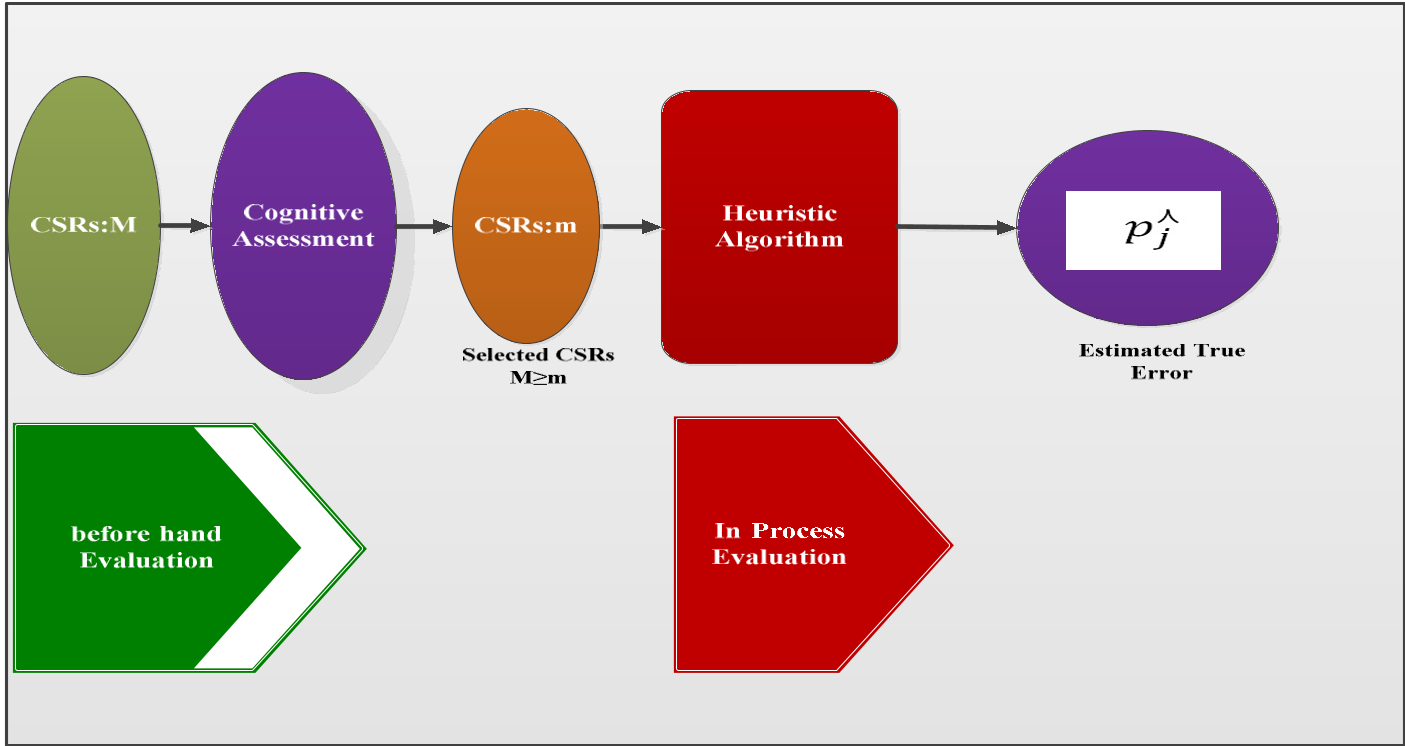
The core innovation is the Heuristic Estimation algorithm. Instead of an exhaustive search through every possible combination of workers to find a baseline (which is computationally heavy and often less accurate), the heuristic approach estimates the "True Error" () by analyzing the agreement rates between disjoint sets of workers and .
Experiments: Proving the Superiority
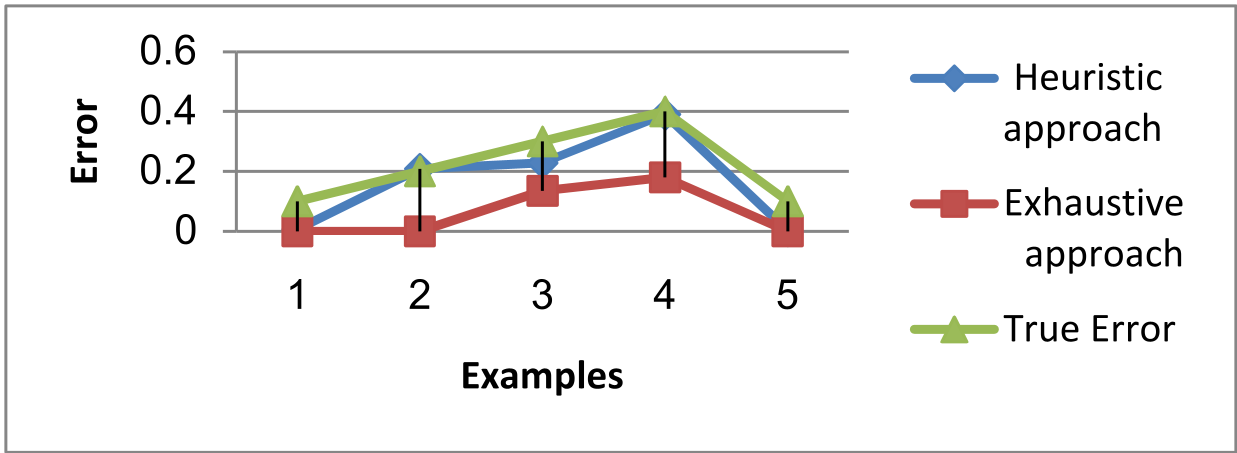
The team tested their framework using synthetic datasets representing different error profiles for CSRs.
Key Findings:
- High Accuracy: For a worker with a true error of 30%, the Heuristic approach estimated a 22.9% error rate, far closer than the 13.5% predicted by previous exhaustive methods.
- Scalability: The heuristic approach showed that as the true error increases (making the worker less reliable), the algorithm becomes even more effective at spotting the discrepancy compared to older strategies.
Takeaways and Future Outlook
This research shifts the focus from Incentives (paying people more) to Alignment (finding the right minds) and Advanced Inference (smarter math).
Future Impact:
- In-House Power: Companies don't need external crowds like Amazon Mechanical Turk; their own employees (CSRs) are a high-quality "in-house crowd" if managed correctly.
- Limitations: The study currently relies on synthetic data. Real-world validation with live CSRs using the Driver’s Decision Style Exercise (DDSE) is the next logical step.
By treating crowd evaluation as a psychological and statistical problem simultaneously, this framework provides a robust blueprint for any organization looking to clean their data at scale.