
Cognitive Fingerprinting: The Secret to High-Precision Crowdsourcing
Effect of Cognitive Abilities on Crowdsourcing Task Performance
The paper introduces a method to predict crowd worker suitability and performance by measuring three core executive functions—Inhibition Control, Working Memory, and Cognitive Flexibility—using brief (6.2 min) online cognitive tests. The study demonstrates that these quick assessments can significantly improve task accuracy across five common crowdsourcing domains: Classification, Counting, Proofreading, Sentiment Analysis, and Transcription.
TL;DR
Researchers have developed a way to predict how well a crowd worker will perform a task by putting them through a 6-minute "brain workout." By measuring core executive functions like working memory and inhibition control, they can match workers to tasks (like transcription or sentiment analysis) with significantly higher accuracy than traditional random assignment or history-based methods.
Context: Beyond the "Master Worker" Badge
In the world of crowdsourcing, quality is the ultimate currency. Requesters usually look at a worker's "Approval Rate" or "Number of HITS completed" to gauge quality. But these are lagging indicators—they don't tell you if a worker is actually suited for a specific, complex task like medical cell counting or subtle sentiment analysis.
The core insight of this paper is that Cognitive Ability is a better, more immediate predictor. While previous attempts to use cognitive tests were too slow (taking up to 2 hours), this work slashes the time to just 6 minutes, making it a viable "gatekeeper" for online platforms.
Methodology: Mapping the Mind to the Task
The authors focused on three "Executive Functions" that govern how we process information:
- Inhibition Control: Filtering out distractions (measured by the Stroop and Flanker tests).
- Working Memory: Holding and manipulating info (measured by N-Back and Pointing tests).
- Cognitive Flexibility: Switching between different rules or concepts (measured by Task Switching).
The Cognitive Experiment Workflow
Workers first completed the 5 fast-paced tests and then tackled 5 representative crowd tasks.

The researchers used Random Forest models to find the "fingerprint" of each task. For example, they found that Proofreading depends heavily on Working Memory and Cognitive Flexibility, whereas Counting tasks rely more on Inhibition Control (the ability to maintain focus without getting distracted by noise).
Results: Better Accuracy, Lower Costs
The results were striking. There was a clear, statistically significant correlation between how workers performed on the 6-minute "games" and how accurately they labeled data.
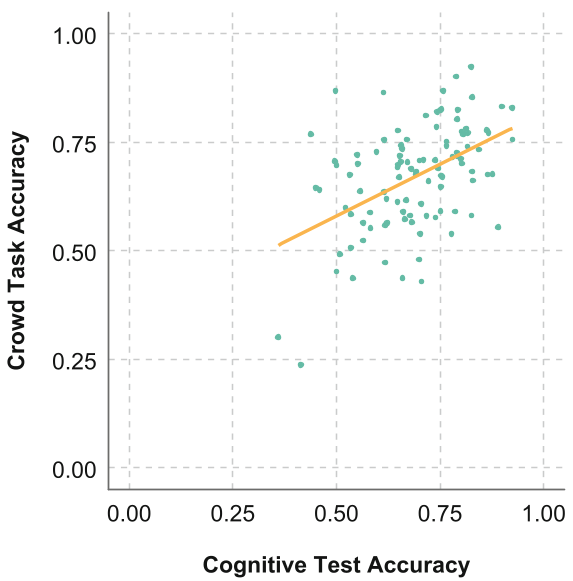
Key findings include:
- Predictive Power: Using even a 6-minute test allowed the team to predict task accuracy with high reliability (R-squared ~0.30 via Random Forest).
- Selective Improvement: By routing tasks to the top 40% of cognitively matched workers, the overall accuracy of the results increased significantly.
- Fairness: Unlike "Master Worker" systems that create a "rich get richer" scenario, this method identified different experts for different tasks. A worker who failed at Proofreading might be an elite performer at Counting.
Critical Analysis & Conclusion
This work sits at the intersection of Psychology and Human-Computer Interaction (HCI). It proves that the "Person-Job Fit" theorem, long used in corporate HR, is highly applicable to the micro-task economy.
The Takeaway
For platforms like Amazon Mechanical Turk or Prolific, the implication is clear: Don't just track what workers have done; measure what they are capable of. Implementing a suite of "Micro-Cognitive Tests" could serve as a universal qualification system that is fairer to new workers and more effective for requesters.
Limitations & Future Work
The study notes that cognitive performance fluctuates during the day (circadian rhythms) and that workers might eventually "game" the tests if they are repeated too often. Future research will likely look at "rolling" cognitive tests—subtle variations of these tasks that prevent memorization while still capturing the worker's current mental state.