
Mimicking the Social Brain: Decentralized Ego Network Detection for the Mobile Era
A Cognitive-Based Ego Network Detection System for Mobile Social Networking
This paper introduces a decentralized, cognitive-based algorithm for detecting "ego networks"—hierarchical social structures surrounding an individual—on mobile devices. By mimicking human cognitive heuristics for memory activation and similarity grouping, the system enables local, privacy-preserving identification of social circles (e.g., support cliques, sympathy groups) across both physical encounters and online interactions.
TL;DR
Researchers have developed a decentralized algorithm that allows your smartphone to understand your social world just like your brain does. By utilizing Cognitive Heuristics, the system identifies your "inner circles" (best friends vs. acquaintances) locally and privately. Testing on real-world physical and Twitter data proves that this "frugal" approach accurately mirrors human social structures defined by the "Rule of Three."
The "Why": Beyond Centralized Clones
In our "Cyber-Physical World," our devices act as our digital proxies. However, most apps currently understand "social" only through centralized, privacy-invasive cloud graphs. This paper argues for a shift: What if your device could autonomously detect your Ego Network—the concentric circles of relationships centered on you—using only local interaction data?
The motivation is clear:
- Privacy: No social graphs need to leave the device.
- Scalability: Processing is fully distributed at the edge.
- Human-Centricity: By using cognitive models, the device's behavior aligns with human intuition, making it more effective for social-aware services like smart tourism or health apps.
Methodology: The Core Heuristics
The authors didn't just use standard K-means clustering. Instead, they adapted two powerful models from cognitive science:
1. Estimating Tie Strength (Activation)
Tie strength is modeled as Memory Activation (). It’s not just about how many times you talk to someone; it’s about:
- Frequency: How often do you interact?
- Recency: How long since the last contact?
- Spacing: Are your interactions spread out or "bursty"?
2. Grouping via the Similarity Heuristic
Once activation is calculated, the system uses the Similarity Heuristic to categorize the peer. It compares the current activation against "exemplars" (prototypes) of existing circles. If the "distance" is too large, the system creates a new circle—mimicking how the brain creates new categories for novel stimuli.
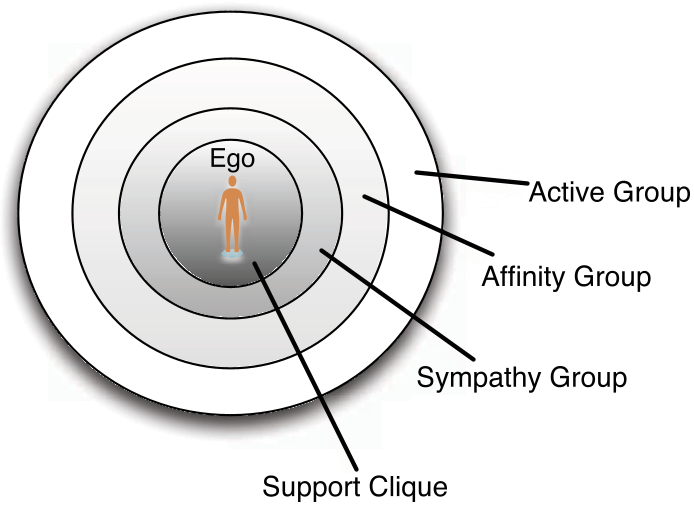 Fig 1: The hierarchical structure of an ego network, from the intimate Support Clique to the broad Active Group.
Experiments: Validating with "Dunbar's Number"
The researchers tested their algorithm on two distinct datasets: Physical face-to-face meetings and Twitter interactions.
Key Findings:
- The Power of 4: In both physical and digital worlds, the algorithm most frequently identified 4 concentric circles, perfectly aligning with the findings of evolutionary psychologist Robin Dunbar.
- The Scaling Factor: The circle sizes followed the famous ~3x scaling factor (e.g., ~5, 15, 45, 135).
- Self-Adaptation: The algorithm isn't static. It tracks how people move between circles as interaction patterns change.
 Fig 2: Comparison of the algorithm's results on Twitter data vs. standard human social network models.
Deep Insight: The Dynamics of "Bonding"
One of the most fascinating takeaways is the stabilization time. The authors used the Jaccard index to see how long it takes for the circles to "settle."
- Outer circles (acquaintances) stabilize first.
- Inner circles (best friends) take much longer to form.
This highlights a profound social reality: It takes very little data to know someone isn't a close friend, but it takes a long history of sustained, high-quality interaction for the "Social Brain" (and this algorithm) to promote someone to your support clique.
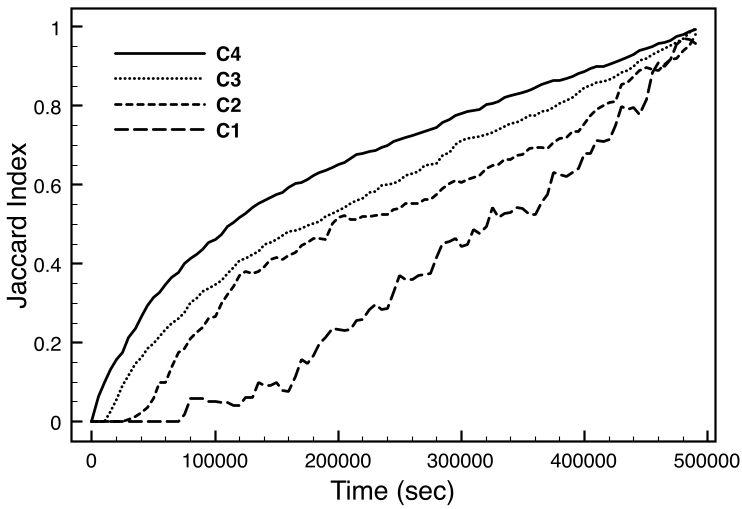 Fig 3: The Jaccard similarity over time, showing inner circles (C1) taking longer to reach stability.
Conclusion & Future Impact
By grounding technical algorithms in Cognitive Science, we can build systems that are more efficient and respectful of human social norms. This ego network detection system provides a robust foundation for a new generation of "Socially-Aware" mobile services—from opportunistic data sharing to personalized privacy settings—that operate entirely at the edge.
Future work could involve extending this to multi-modal interactions (combining voice, text, and proximity) to create an even more holistic digital "memory" of our social lives.