
OCC-OR: Cracking the Cognitive Code of Emotions in Chinese Online Reviews
Cognitive Detection of Multiple Discrete Emotions from Chinese Online Reviews
This paper introduces OCC-OR, a cognitive-based emotion detection model tailored for Chinese online reviews, grounded in the psychological OCC (Ortony, Clore, and Collins) theory. It transitions sentiment analysis from binary polarity to six discrete emotional dimensions (satisfaction, disappointment, admiration, reproach, love, hate) and validates this approach using a large-scale JD.com dataset with machine learning classifiers.
TL;DR
Moving beyond the "Thumbs Up/Down" binary, researchers have developed OCC-OR—a cognitive appraisal model that identifies six distinct emotions in Chinese e-commerce reviews. By mapping consumer thoughts to specific categories like "Reproach" for bad service or "Hate" for poor product features, this framework achieves high-precision emotional detection (F1 up to 0.92) and offers a much deeper look into the consumer psyche than traditional sentiment analysis.
Background: Why Polarity Isn't Enough
In the current era of User-Generated Content (UGC), a simple "negative" label on a review tells a brand very little. Is the customer angry at the delivery speed? Disappointed by a missing feature? Or do they simply dislike the aesthetic?
Most existing sentiment analysis tools focus on Polarity (Positive vs. Negative). However, emotions are the result of complex human cognitive processes. The authors argue that to truly understand a consumer, we must look at the Cognitive Appraisal—the "Why" and "How" behind the feeling.
Methodology: The OCC-OR Framework
The researchers adapted the classic OCC Theory (named after Ortony, Clore, and Collins) into a specialized version for the digital marketplace: OCC-OR (OCC in Online Review).
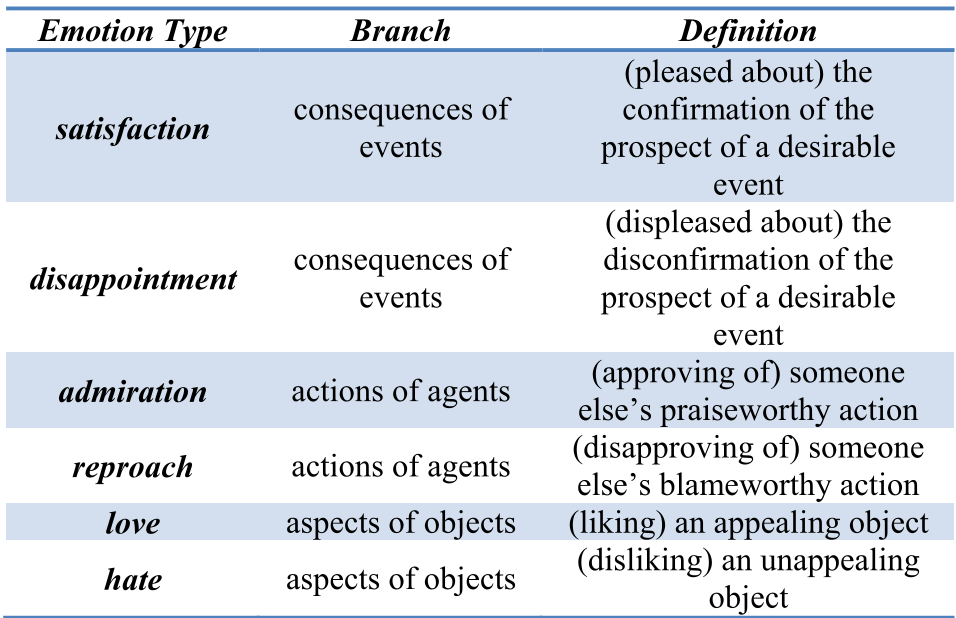
The core logic splits human cognition into three branches, each eliciting specific discrete emotions:
- Consequences of Events: Relates to goals (e.g., buying a phone for oneself).
- Emotions: Satisfaction (met expectations) vs. Disappointment (unmet expectations).
- Actions of Agents: Relates to the behavior of the platform or logistics.
- Emotions: Admiration (praising the seller/courier) vs. Reproach (blaming the seller/courier).
- Aspects of Objects: Relates to the product's specific properties (screen, battery, etc.).
- Emotions: Love (liking features) vs. Hate (disliking features).
Table I: Mapping the OCC-OR Dimensions
Experimental Evidence
The study analyzed over 679,000 reviews from JD.com, specifically targeting the mobile phone market.
Key Findings from Human Annotation:
- The "Hate" Peak: In the object-focused branch, "Hate" (disliking specific product attributes) was the most frequent emotion.
- Compound Emotions: Consumers rarely feel just one thing. Many reviews expressed up to five different discrete emotions simultaneously (e.g., Satisfaction with the price but Reproach for the slow shipping).
Machine Learning Validation:
The team tested five classifiers (SVM, LR, KNN, NB, DT) to see if machines could learn these cognitive categories.
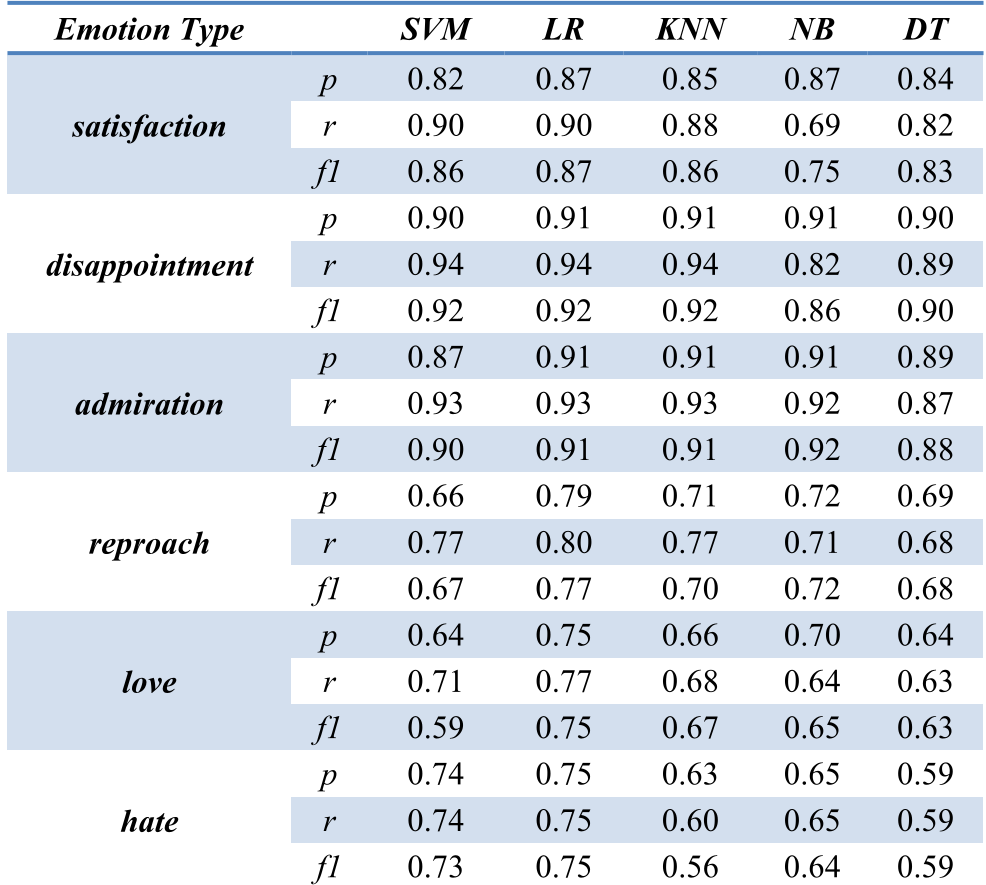
Linear Regression (LR) emerged as a top performer, consistently achieving high F1-scores across all categories. This proves that the OCC-OR model isn't just a theoretical psychological exercise—it is highly computable and reliable for automated systems.
Analysis of Temporal Trends
One of the most insightful parts of the study is the tracking of emotions across a full year (2015).
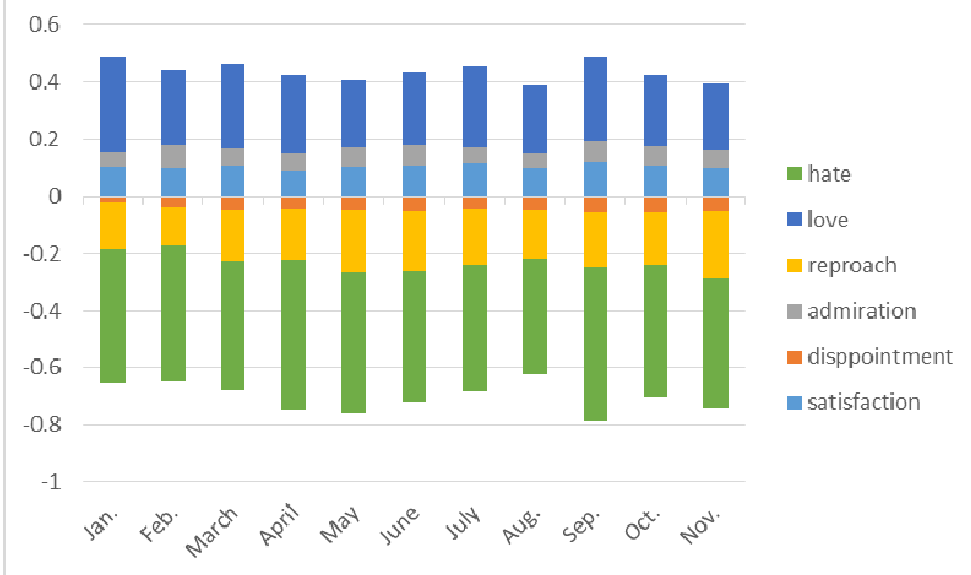
The researchers noticed that negative emotions like "Hate" and "Reproach" spiked in May and September. Their insight? This likely correlates with periods where no new products were launched, leading to a "mental gap" where consumer expectations were not being refreshed by new innovations, causing existing flaws in current products to feel more frustrating.
Critical Insight & Conclusion
The value of OCC-OR lies in its diagnostic power. If a company sees a spike in "Negative Sentiment," they might panic. But if they see a spike in "Reproach," they know the problem is with the agent (logistics/customer service), not the product. If the spike is in "Disappointment," the marketing team likely oversold the product's capabilities.
While the study is limited to the mobile phone sector and uses traditional ML (rather than current Large Language Models like GPT-4), it provides a robust theoretical foundation for the next generation of AI-driven sentiment analysis. It reminds us that behind every text review is a complex human mind making structured evaluations of the world.
Takeaway for Future Research
Integration of the OCC-OR hierarchy into LLM prompt engineering or fine-tuning could potentially revolutionize how brand-monitoring bots interpret customer feedback, allowing for automated, highly specific strategic recommendations.