
Programmer Psychology through the Lens of Ant Colonies: A New Paradigm for Collective Intelligence
Exploring the Cognitive Psychology Paradigm of a Programming Language and Identification of Emotion under Collective Intelligence: An Experience with an Ant Colony Metaphor
This paper introduces a novel simulation framework that leverages the Ant Colony Metaphor to model the cognitive psychology and emotional states of software programmers. By mapping programming tasks and knowledge exchange to pheromone trails, the study quantifies the impact of collective intelligence on tool acceptability and emotional transitions in both development teams and social networks.
TL;DR
Programming is rarely a solitary act; it is a complex, collective intellectual journey. This paper explores the "Psychology of Programming" by treating developers as agents in an Ant Colony. By using Pheromone Representation to model knowledge transfer and emotional "syntonicity," the researchers provide a mathematical framework to predict how programmers identify with tools and how collective intelligence matures in social networks.
Background: Tuning into the Programmer's Mind
In the modern SDLC (Software Development Life Cycle), we often obsess over metrics like velocity and code coverage, forgetting that the programmer is the basic building block. The authors argue that a programmer's performance is a function of their emotional state and their "affection" for specific tools—a concept they call Syntonicity.
The core insight is that traditional software engineering is too rigid. To understand why a team succeeds or why a specific language (like Rust or Python) gains "acceptability," we must look at the stigmergic coordination—the way individuals influence each other through the environment, much like ants laying pheromone trails.
Methodology: The Ant Colony Metaphor
The researchers define the Emotional-Reactive (E-R) state of a programmer as a 5-tuple: . This state isn't static; it changes based on the distance to the goal (project completion) and the "looping structures" of the environment.
The Pheromone Logic
The model translates abstract human behaviors into localized mathematical rules:
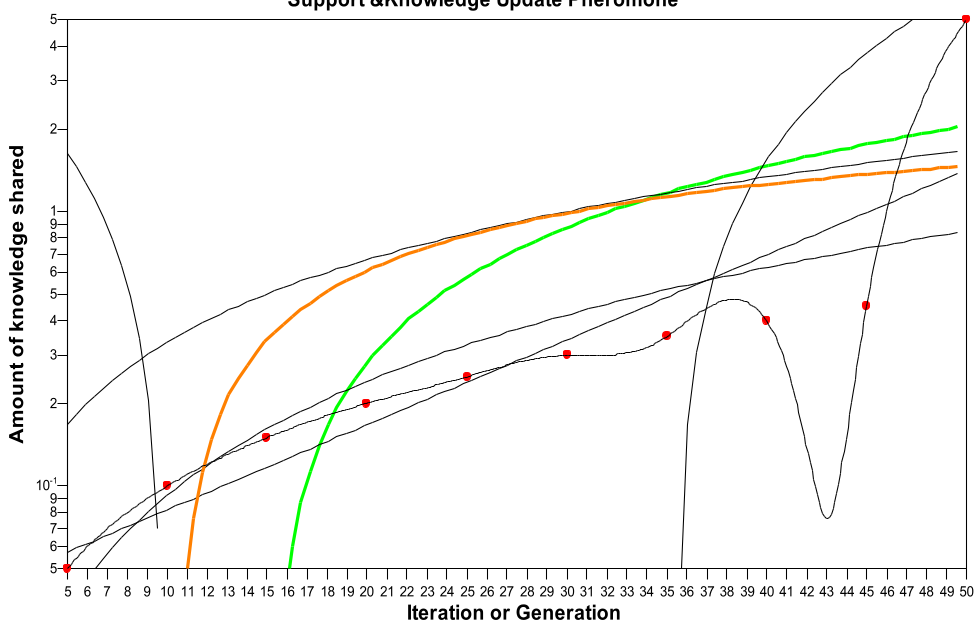
- Support Pheromones (): Represents the motivation and liking of a tool.
- Knowledge Update Pheromones (: Represents the gain in expertise through collaboration.
- Evaporation (): Represents cognitive barriers, forgetfulness, or loss of interest.
The probability of a "movement" (a decision or learning step) is calculated using the standard ACO rule, balancing the intensity of existing pheromones with a heuristic of the task's difficulty.
Experiments: Measuring Collective Emotion
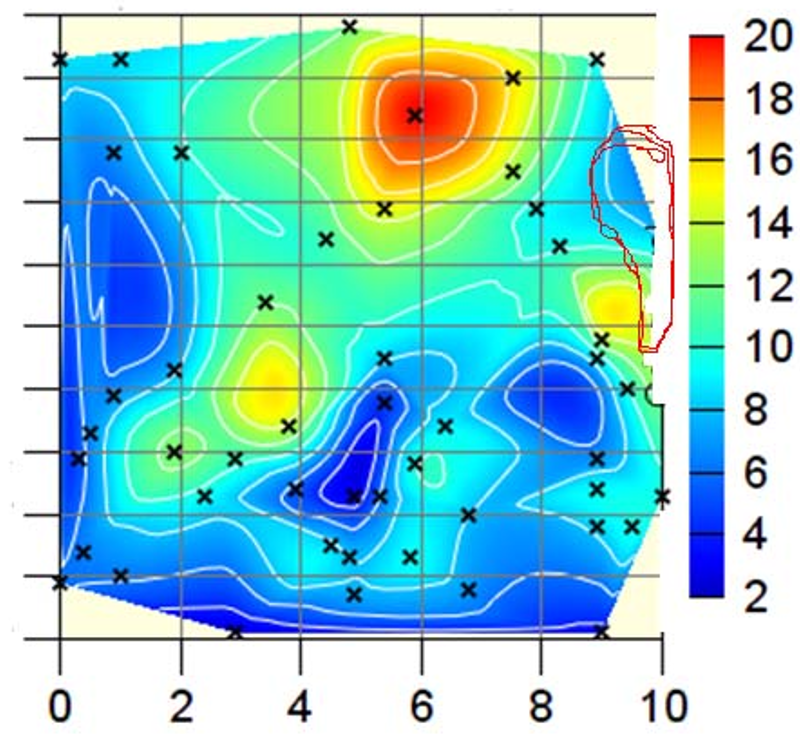
The study extended its validation beyond the IDE and into the Social Network Paradigm. By crawling data from temporal events (specifically social media interactions), they visualized how collective intelligence emerges.
Key Findings:
- Reinforcement: Pheromones are reinforced as long as there is "support behavior." This means that in a team, collective momentum can often override individual limitations.
- Arousal Mapping: Using a gradation scale (0-10), the authors mapped "deepest arousal" (red zones) in social networks, where intense opinion exchange leads to rapid emotional transition and cognitive maturity.
- Entropy and Perception: The plot of social network instances yielded a closed-loop Eigenvalue (ρ = 0.34), suggesting a stable, predictable pattern of how groups reach consensus or emotional alignment.
Critical Insight: The Two Sides of Digital Interaction
The paper offers a profound reflection on Social Psychology. While collective intelligence facilitates "emotional maturity" through cognitive enrichment, the lack of face-to-face cues in digital "stigmergy" can lead to:
- Positive Outcomes: Reduced isolation, rapid knowledge gain, and task-orientation.
- Negative Outcomes: "Shallow emotions," deception, and the risk of internet addiction due to the lack of "genuine connectivity."
Conclusion & Future Outlook
This work marks a shift from viewing programming as a purely logical task to seeing it as a distributed biological system. The authors suggest that the next step is Hybrid Intelligence—combining fuzzy logic with ant colonies to create more empathetic and efficient project management tools.
Takeaway for Tech Leaders: To scale a software team, don't just look at the code; look at the pheromones. Are your tools and culture encouraging "support pheromones," or are your cognitive barriers causing your "knowledge trails" to evaporate too quickly?