
VR-Based Cognitive Rehabilitation: Transforming Autism Therapy through Immersive Environments
Cognitive Rehabilitation for Autism Children Mental Status Observation Using Virtual Reality Based Interactive Environment
The paper proposes a three-level Virtual Reality (VR) based Cognitive Rehabilitation Therapy designed to observe and improve the mental status of children with autism. Using Head-Mounted Devices (HMD) and Leap Motion controllers, the system facilitates interactive house environments to enhance attention, reasoning, and social behavior, achieving "promising improvement" in behavioral responses and emotional engagement among five participants.
TL;DR
This study presents a structured Virtual Reality (VR) rehabilitation platform designed specifically for children with autism. By leveraging a 3-level interactive environment, the system targets core deficits in attention, emotion, and language. Results from a pilot study show that VR provides a "predictable" space that reduces anxiety and improves cognitive functioning, especially when instructions are provided in the child's native language.
Perspective: Why VR for Autism?
Autism is characterized by a "triad" of challenges: social development, communication, and repetitive behaviors. Traditional therapy can be unpredictable, often overwhelming children with too much sensory information. The research intuition here is brilliant yet simple: Computers are predictable. By creating a synthetic world, we can simplify input stimuli to a level that is tolerable and engaging for an autistic child.
Methodology: The Three Levels of Cognitive Healing
The authors don't just throw children into a game; they utilize a progressive pedagogical shift across three distinct levels of mental state observation.
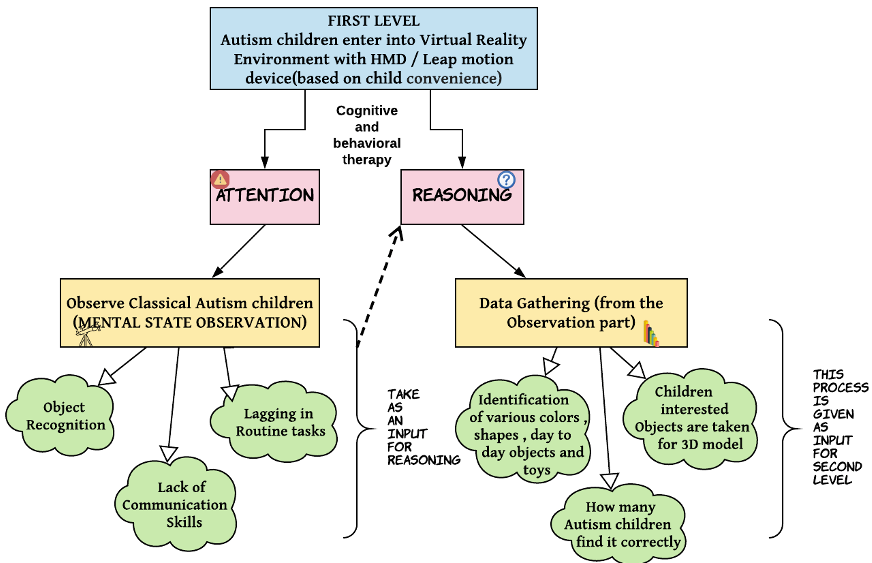
Level 1: Attention & Reasoning
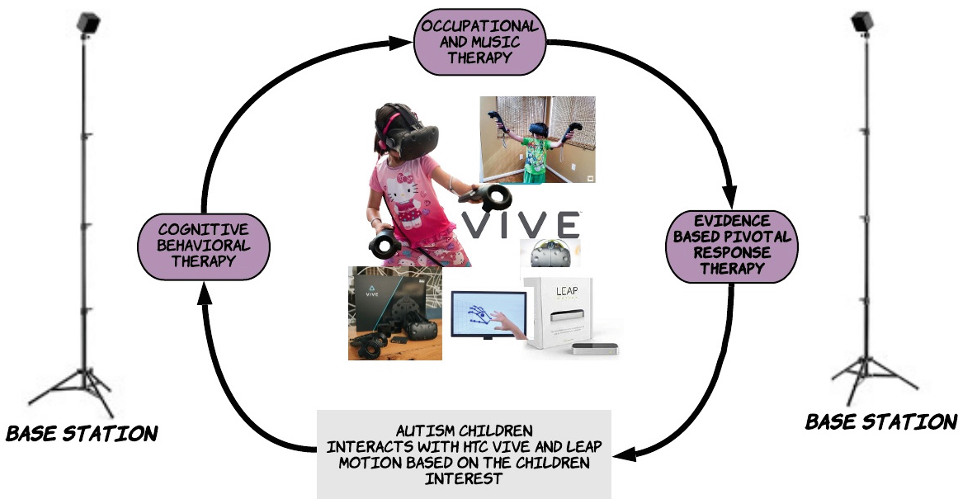
The focus here is on daily routine tasks. Using HMDs or Leap Motion, children navigate a virtual house.
- Goal: To build recognition and reasoning skills.
- Metric: The therapist observes the level of response and repeats tasks until the child achieves recognition.
Level 2: Occupational and Music Therapy
This stage targets emotional regulation. Children interact with virtual musical instruments and organize colorful objects.
- The Leap Motion Advantage: The study found that while mild autism children could handle HMDs, those with medium-level autism often preferred the Leap Motion device for "wire-free" hand movement.
Level 3: Decision Making & Language Mastery
In a bold move for localized therapy, the authors incorporated Tamil language instructions. By hearing their native tongue, children exhibited better task compliance and language understanding when exploring the virtual house model.
Experimental Insights: Does it Work?
The pilot study involved five children (3 boys, 2 girls) aged 7 to 11.
| Observation Category | Performance/Response |
|---|---|
| Mild Autism Group | High engagement across all 3 levels; successful task completion. |
| Medium Autism Group | Significant struggle with HMD hardware; improved performance via Leap Motion. |
| Emotional State | Predominantly "Happy" and "Positive" interactions recorded. |
| Language Impact | Improved understanding when instructions transitioned from English to Tamil. |
Critical Analysis & Future Outlook
The core achievement of this paper is demonstrating that VR isn't just a gaming tool—it is a Theory of Mind Machine (ToMM). It allows children to "practice" social and cognitive interactions in a low-stakes environment.
Limitations: The sample size (n=5) is small, which is typical for pilot clinical studies but limits statistical generalization. Furthermore, "hardware fatigue" remains a barrier for medium-to-severe autism cases.
The Road Ahead: The authors propose moving toward Augmented Reality (AR) with Avatar characters. Imagine an AR companion that mimics a child's actions, encourages them through song, and helps generalize these virtual skills into the real world. This work paves the way for a future where neurodivergent therapy is personalized, immersive, and digitally empowered.
Conclusion
By blending Cognitive Behavioral Therapy with modern VR hardware, this research proves that we can create a "safe harbor" for autism rehabilitation. Integrating native language and gesture-based controls is not just a technical choice—it's a human-centric one that significantly lowers the barrier to effective treatment.