
Cognitive Stigmergy: Why Dictators and Terrorist Cells are Structurally Resilient
Cognitive stigmergy: A study of emergence in small-group social networks Action editor: Margery Doyle and Leslie Marsh
This paper introduces the concept of "Cognitive Stigmergy" and the "Follow-the-leader" algorithm to explain the emergence of leadership in small-group social networks. By simulating artificial termites and network rewiring, the study demonstrates that maximizing betweenness centrality recreates the topological structure of the 9/11 terrorist network, achieving a 99.2% correlation in rank order.
TL;DR
How do leaders emerge in a group without a formal hierarchy? This paper suggests it happens through Cognitive Stigmergy—a self-organizing process where individuals "grab power" by positioning themselves at the crossroads of information. By maximizing a metric called Betweenness, social networks naturally evolve into "Small Worlds" with a dominant center, a structure that makes them incredibly difficult to overthrow from within.
Background Positioning: This work bridges biological swarm intelligence (termites) with Social Network Analysis (SNA), providing a theoretical mechanism for the "function follows form" observation in covert networks like the 9/11 hijacker cell.
The Problem: The Mystery of Emergent Control
We know what a "led" network looks like: it has a hub. In the 9/11 network, Mohammad Atta was the clear center. But how did he get there? Prior work often assumes a "top-down" assignment or a "popularity contest" (Preferential Attachment). However, these don't explain the specific resilience of small, high-stakes groups. The author argues that existing models miss the Motivation: actors want to control the flow of information to gain intermediary power.
Methodology: Termites and Rewiring Logic
The author uses a two-step simulation approach to find the "hidden rules" of social growth:
- Artificial Termite Experiment: Termites move "wood chips" (nodes) and create links based on three rules: Degree (popularity), Radius (closeness), or Betweenness (power).
- Follow-the-Leader Algorithm: A random network is "rewired" iteratively. A link is moved to a new node only if that node has higher "Betweenness" than the current one.
The Core Insight
By alternating between Directed Betweenness (which creates a "who reports to whom" hierarchy) and Undirected Betweenness (which pulls everyone closer together), the network shrinks its diameter. This creates a "Small World" where the leader is only a few hops from everyone, but all communications must pass through them.
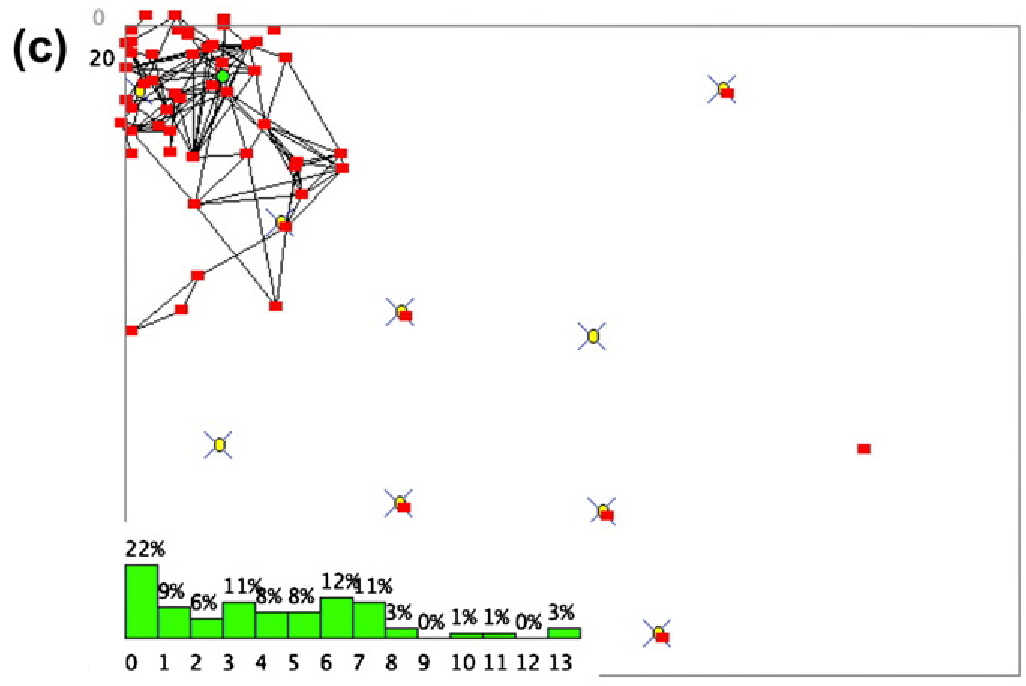 Note: The images above show how simple stimulus-response rules in termites (stigmergy) result in complex, non-random network architectures.
Experiments and Results: The 9/11 Benchmark
The author compared the simulated networks to the actual 150-link network of the 9/11 hijackers.
- The Signature of Power: Betweenness-maximizing stigmergy produced a 99.2% correlation with the hierarchy found in the 9/11 data.
- Infrastructure vs. Social: Interestingly, physical networks (power grids, pipelines) do not follow this rule. They are constrained by geography and cost, whereas social networks are constrained only by the human desire for influence.
Resilience: The Contagion of Dissent
To test the strength of these structures, the author simulated a "sentiment virus."
- Pro-Leader Sentiment starts at the center.
- Anti-Leader Sentiment (Rebel) starts at a random edge.
In random networks, the rebels win easily. But in the 9/11 structure, the leader acts as a "bottleneck." Because almost all communication paths pass through the leader, they effectively "block" the spread of the rebel virus to other nodes.
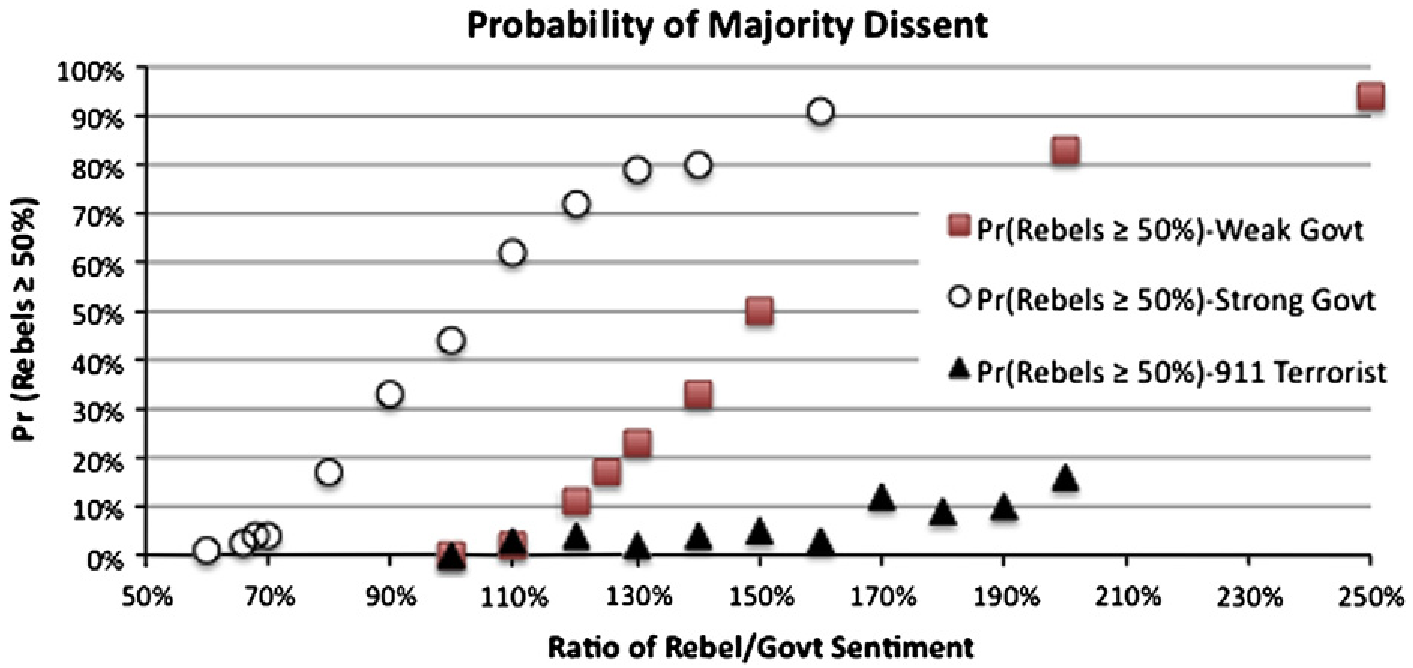 The chart demonstrates that structured networks (triangles) are significantly more resilient to overthrow than random networks (circles).
Critical Insight & Conclusion
Takeaway
The study proves that Betweenness = Resilience. A network that evolves to maximize the power of its intermediaries becomes a "survivalist" structure. It isn't just that these groups have strong leaders; it's that their topology acts as a shield against internal dissent.
Limitations
- Sample Size: The 9/11 network is small (62 nodes). As groups grow beyond "Dunbar's Number" (approx. 150), these mechanics might break down or require sub-clusters.
- Static Snapshot: The model treats the network as a finished product, whereas real social groups are in constant flux.
Future Outlook
This theory of "Cognitive Stigmergy" explains why "Web 2.0" and modern social platforms lead to "Influencer" hierarchies so quickly. Algorithms that suggest "who to follow" are essentially automated versions of the Betweenness-maximization rule, reinforcing structural bottlenecks in our digital discourse.