
CGNN: Optimizing Social Cohesion and Spatial Efficiency in Road-Social Networks
Cohesive Group Nearest Neighbor Queries Over Road-Social Networks
The paper introduces the Cohesive Group Nearest Neighbor (CGNN) query, a novel task that finds optimal activity assembly points on a road network while maximizing the social closeness (k-core) of a specific number of attendees. The authors propose a filtering-and-verification framework that outperforms baseline enumeration methods by orders of magnitude in search efficiency across large-scale road-social datasets.
TL;DR
Organizing a group hangout is more than just finding the closest Starbucks; it’s about finding the right people who actually like each other and a place they can all reach. This paper introduces the Cohesive Group Nearest Neighbor (CGNN) query, which simultaneously optimizes for the "most cohesive" social group (using k-core theory) and the most efficient meeting point on a real road network.
Background & Motivation
Most existing Location-Based Social Network (LBSN) tools treat social and spatial data as separate silos. Traditional Group Nearest Neighbor (GNN) algorithms find a point that minimizes , but they assume the group is already decided. On the other hand, social discovery tools might find you a group of friends but ignore if they are currently 50 miles apart.
The authors identify a "sweet spot": Automated Activity Planning. The goal is to select attendees including a query user such that their social "closeness" is maximized while the meeting point is within a distance threshold .
The Core Challenge: The Complexity of "Best Friends"
Finding the most cohesive group of size is computationally expensive (). In a social network like Facebook or Twitter with millions of users, enumerating every possible combination of friends is impossible. Furthermore, road network distances aren't straight lines—they require expensive graph traversals (Dijkstra/INE).
Methodology: The CGNN Framework
The paper tackles this with a multi-layered approach:
1. Social Cohesion via Heuristics
Instead of exact enumeration, the authors use k-core decomposition. A -core is a subgraph where every member has at least neighbors. To find the "most cohesive" group of size , they propose the Largest Incidence (Li) heuristic.
- Intuition: Greedily pick the person who has the most existing connections to the current group. This rapidly builds a high-density "cluster" of friends.
2. Filtering & Road-Network Indexing
To avoid searching the entire city, they use a G-tree index to partition the road network.
- Pruning: If the shortest road distance between two potential attendees is , they can never meet at a point within distance of both. This allows the system to prune candidates before even looking at the map.
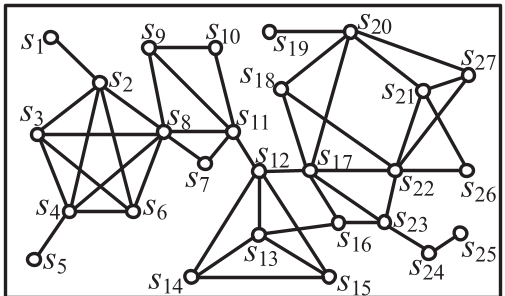 Figure 1: The dual-layer model. The top layer (Social) filters for cohesion, while the bottom layer (Road) calculates travel costs.
3. The Verification Loop
The "Round-Robin" optimization is the secret sauce. It doesn't just find a group and then check the distance; it iteratively uses spatial constraints to refine the social group search. If a group of friends is socially perfect but geographically impossible, the algorithm backtracks immediately.
Experimental Validation
The authors tested their framework on massive datasets, including the Twitter social graph and the Western USA road network (6.2M vertices).
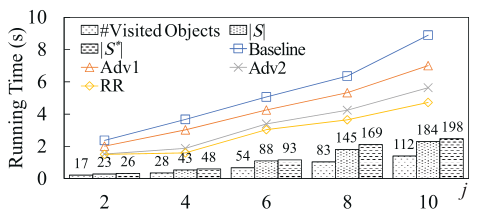 Figure 2: Query processing time vs. group size (c). Note how the 'RR' (Round-Robin) method stays significantly more efficient than the baseline as the group size grows.
Key Findings:
- Efficiency: The proposed heuristics achieve near-optimal results (90% accuracy) while being 1000x faster than exact search.
- Scalability: The system handles groups of up to 64 people across continent-scale road networks in just 1-5 seconds.
Critical Analysis & Conclusion
This paper successfully bridges graph theory (k-cores) and spatial databases. By introducing the Intrinsic Distance Restriction, they prove that social and spatial pruning are not independent—they are two sides of the same coin.
Limitations: The current model assumes user locations are static at the time of the query. For a truly "impromptu" planning service, the algorithm would need to account for moving users (velocity/trajectory).
Future Work: The authors suggest adding "User Preferences." Imagine not just finding a "cafe," but one that matches the specific dietary preferences of the most cohesive group of attendees. That is the next frontier for LBSNs.