
Cohesive Group Nearest Neighbor Queries: Bridging Social Closeness and Spatial Efficiency
Cohesive Group Nearest Neighbor Queries on Road-Social Networks under Multi-Criteria
2020-02-18
Summary
Problem
Method
Results
Takeaways
Abstract
The paper explores two novel query types, Cohesive Group Nearest Neighbor (CGNN) and Multi-Criteria CGNN (MCGNN), on road-social networks. It proposes a most cohesive k-core model to find optimal attendee groups and several efficient search frameworks (filtering-and-verification, threshold-based expansion) to identify top-j activity assembly points.
## TL;DR
Organizing an offline gathering involves more than just finding a central location; it requires finding a group of friends who actually like each other and a venue they all appreciate. This paper introduces **CGNN** and **MCGNN** queries to solve this. It provides a mathematical framework to find the "most cohesive" k-core group of attendees while simultaneously optimizing for travel distance and POI ratings on massive road-social networks.
## Background: The Social-Spatial Gap
In traditional Location-Based Social Networks (LBSNs), group queries typically ask: "Find a point $o$ that minimizes the sum of distances for users in set $Q$." However, this ignores two critical real-world factors:
1. **Social Cohesion**: A group where everyone knows each other (a clique or a core) is better for a party than a group of strangers.
2. **Multi-Criteria Preferences**: Users care about venue ratings as much as they care about the 5-mile drive.
## Methodology: The Most Cohesive k-core
The authors define the **Most Cohesive k-core** ($G_{kmax}$) as the group of $c$ attendees that includes the query user and maximizes the "coreness" (minimum degree within the subgraph). This ensures the group has the "maximally favorable atmosphere."
### 1. Social Pruning and Heuristics
Since finding the exact most cohesive group is NP-hard (combinatorial explosion), the authors propose **Social-Distance-Based Pruning (SD)**. By Theorem 7, any user further than $c-1$ hops from the initiator can be safely ignored. They then use the **Largest Incidence (Li)** heuristic, which greedily selects users with the most connections to the currently formed group.
### 2. Spatial Indexing with G-Trees
To avoid the "curse" of Dijkstra's algorithm on continental-scale road networks, the paper employs a hierarchical tree index (similar to G-Trees). This allows for rapid range searches and network distance lookups without traversing every edge.
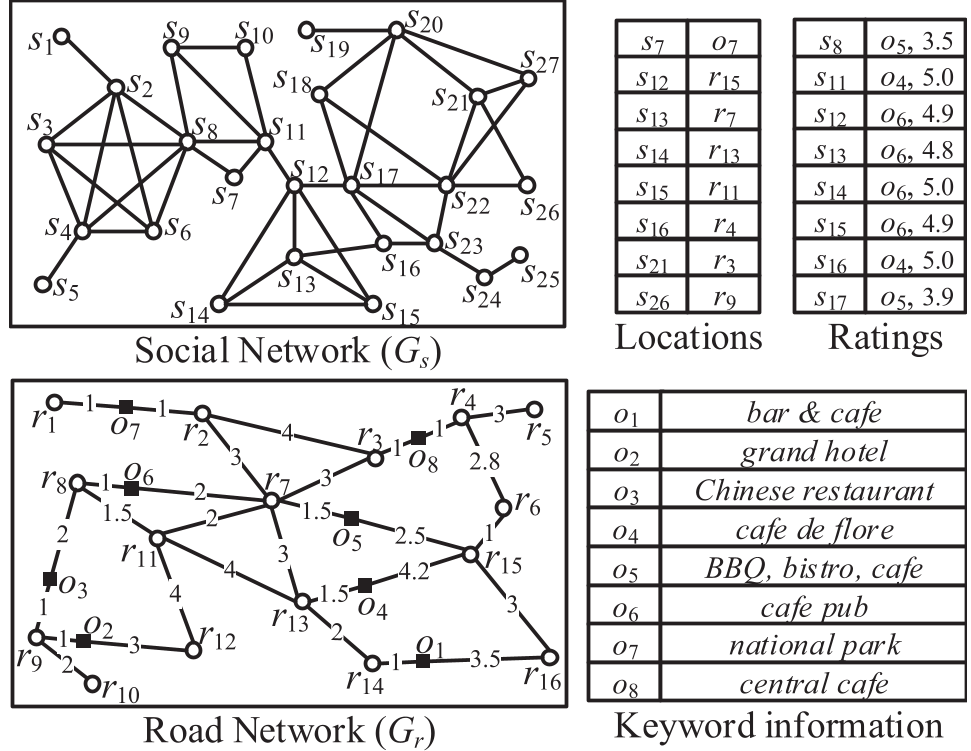
*Fig 1: The dual-layer model representing the social layer (interactions) and the road layer (POIs and segments).*
## Solving for Multi-Criteria (MCGNN)
The MCGNN query is significantly harder because it optimizes an overall score:
$$ heta(o, U) = \frac{\overline{R_s}(U, o)}{\alpha \cdot dist_{sum}(o, L_s(U))}$$
This balances average rating vs. total travel cost. To solve this efficiently, the authors propose:
* **Threshold Expansion (TE)**: Stops the search as soon as the upper bound of possible scores for unseen POIs falls below the current top-j results.
* **Holistic Expansion (HE)**: A more conservative approach that waits for edges to be seen by all query points, avoiding redundant shortest-path calculations.
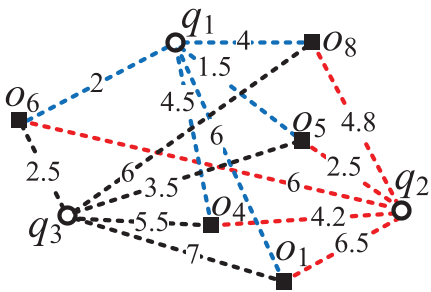
*Fig 2: The expansion process across multiple query points to find common candidate assembly points.*
## Experimental Insights
The authors tested their methods on diverse datasets, from Facebook's social graph to the Western USA's massive road network (6 million vertices).
* **Efficiency**: The **CGNN-opt** (using G-Trees and Intrinsic Distance Restrictions) was consistently 2x faster than standard range filtering.
* **Scalability**: Even when attendee size ($c$) increased to 64, the "Threshold Expansion" (TE-opt) strategy maintained a stable execution time, proving its viability for large-group planning.
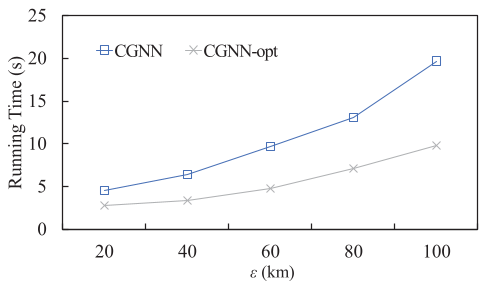
*Fig 3: Performance comparison of MCGNN algorithms under varying distance thresholds ($\epsilon$).*
## Critical Analysis & Future Outlook
The introduction of social cohesion via k-core is a superior inductive bias for group queries compared to simple distance-based clustering. However, the current model assumes a static road network.
**Limitations**: The model does not yet account for dynamic traffic conditions or user-specific keyword preferences (e.g., some users want 'bar', others want 'cafe').
**Future Work**: The authors suggest integrating distributed processing for even larger networks and incorporating individual user preference profiles to further refine the POI recommendations.
## Conclusion
This research moves beyond simple spatial points to a multi-dimensional understanding of "convenience." By solving the CGNN and MCGNN problems, the authors provide the technical backbone for the next generation of automated activity planning services.