
Game Theory Meets Social Networks: A New Blueprint for Measuring Cohesion
The cohesiveness of subgroups in social networks: A view from game theory
This paper introduces a formal family of cohesiveness measures for social networks by integrating Cooperative Game Theory with probabilistic graph analysis. The core method utilizes the Myerson value framework to evaluate how much economic or social "worth" a subgroup retains when its internal links are subjected to random disruption.
TL;DR
Social cohesion has long been measured by "density"—how many ties exist. But not all ties are created equal. This paper redefines cohesiveness through the lens of Game Theory, proposing that a group is only as cohesive as its ability to retain its "worth" (value) when its connections randomly fail. By combining Myerson games with probabilistic graphs, the authors provide a measure that captures the functional "stickiness" of a group against disruptive forces.
The "Why": Beyond Simple Density
Standard social network analysis (SNA) treats a network like a basic map. If there are many roads between houses, the neighborhood is "cohesive." However, this ignores the Motivation. Why are those people connected? Are they cooperating to build a park (convex game) or just living next to each other?
Prior works like White and Harary (2001) emphasized connectivity, but the authors of this paper argue that:
- Interests Matter: The goals of a group determine how much a disconnection hurts.
- Redundancy is Resilience: A group is cohesive if it can survive the loss of ties without losing its collective value.
Methodology: The Myerson Perspective
The authors introduce a Communication Situation , composed of a set of players, a coalitional game , and a graph .
1. The Core Formula
The cohesiveness of a subgroup is defined as the expected proportion of worth retained:
In plain English: We imagine every possible way the internal links of a group could fail (each link has a 50% chance of disappearing). We then calculate the average value the group still produces in these "broken" states compared to its original state.
2. The Logic of Worth
By using Superadditive Games (), the authors ensure that when a group splits into two, the sum of their individual values is less than or equal to their value together. This mathematically models the "cost" of social fragmentation.
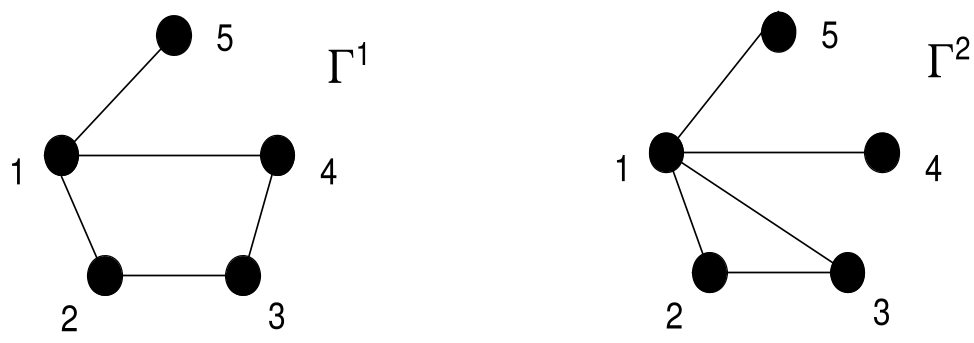 Figure 1: Two graphs with identical density (0.5) but different structures. The game-theoretic measure can distinguish which is more cohesive depending on the specific cooperative game defined.
Key Findings & Proofs
- Monotonicity: The authors prove that adding a link to a group never decreases its cohesiveness, satisfying a fundamental requirement for any SNA metric.
- The Chain vs. The Star: For a fixed number of nodes in a tree structure, the Chain is the least cohesive (most vulnerable to a single break), while the Star (with a central hub) is the most cohesive.
- The Clique Limit: As the number of nodes in a complete graph (clique) grows toward infinity, its cohesiveness converges to 1. This matches the sociological intuition that highly dense, large groups are effectively indestructible if every member is connected.
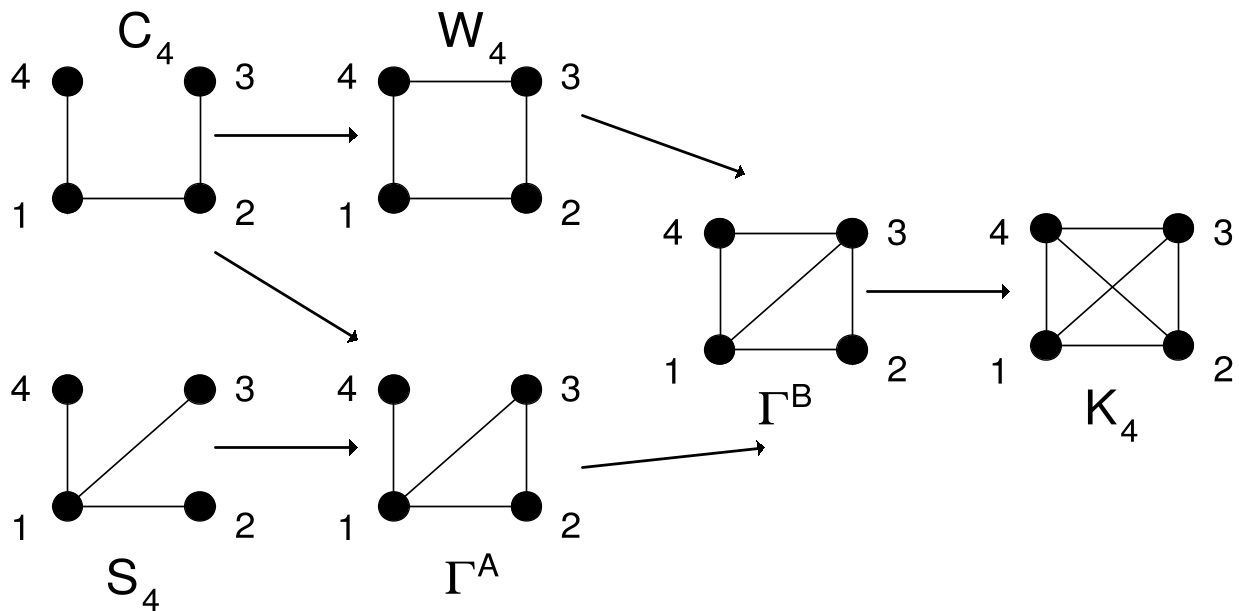 Figure 2: The six different 4-node connected graphs ordered by cohesiveness. The measure holds steady for all symmetric and convex games, aligning with descriptive measures of the past while adding mathematical depth.
Critical Analysis: Why This Matters for the Future
This paper bridges the gap between Structural Sociology and Mathematical Economics.
Major Strengths:
- It moves SNA from a static description to a functional analysis.
- It provides a unified framework that works for any type of group goal (by changing the game ).
Limitations:
- Computational Complexity: Summing over all subgraphs is NP-hard. For large networks, we would need to rely on Proposition 3.1 or Monte Carlo simulations to estimate cohesiveness.
- Static Nature: The graph is fixed. In the real world, nodes react to disconnections by forming new ties (endogenous networks).
Conclusion
The cohesiveness of a group isn't just about who knows whom; it’s about what that group is trying to achieve. By treating a social network as a "probabilistic Myerson game," we can finally quantify the resilience of communities in a way that reflects their true value.