
Cold Comfort Matters: Why Your Chatbot Needs a Psychotherapist’s Touch
Cold Comfort Maers -How Channel-Wise Emotional Strategies Help in a Customer Service Chatbot
This paper introduces a task-oriented emotional strategy (ES) framework for customer service chatbots, leveraging psychotherapy techniques like affect reflection. Implemented in Lenovo's "Moli" chatbot, it demonstrates that channel-specific emotional intelligence significantly improves user satisfaction and system usability across social media and web platforms.
TL;DR
Researchers from Lenovo have discovered that for customer service chatbots, empathy is just as important as efficiency—but only if delivered correctly. By applying psychotherapy techniques to their chatbot "Moli," they found that users on social media crave human-like emotional depth, while webpage users prefer professional brevity. This "channel-wise" strategy significantly boosts satisfaction and makes the "cold comfort" of a machine feel surprisingly warm.
Problem & Motivation: The "Emotion-Logic" Divide
In the world of automated customer service, we often treat chatbots as purely logical engines: Input problem -> Process -> Output solution. If the user gets angry, we tack on a generic "I'm sorry for the inconvenience."
The authors argue this is a fundamental mistake. They analyzed 560,000 conversation turns and found that:
- Emotion is pervasive: Over 2.8% of cases involve explicit emotional triggers, with anger being the dominant state.
- The "Cold Effort" Myth: Many developers believe emotional responses are a waste of time. However, a user's emotional state is the primary predictor of their satisfaction—even if the technical problem eventually gets solved.
- Context Paradox: A strategy that works on Facebook might feel intrusive or "cringe" on a technical support webpage.
Methodology: Chatbots on the Couch
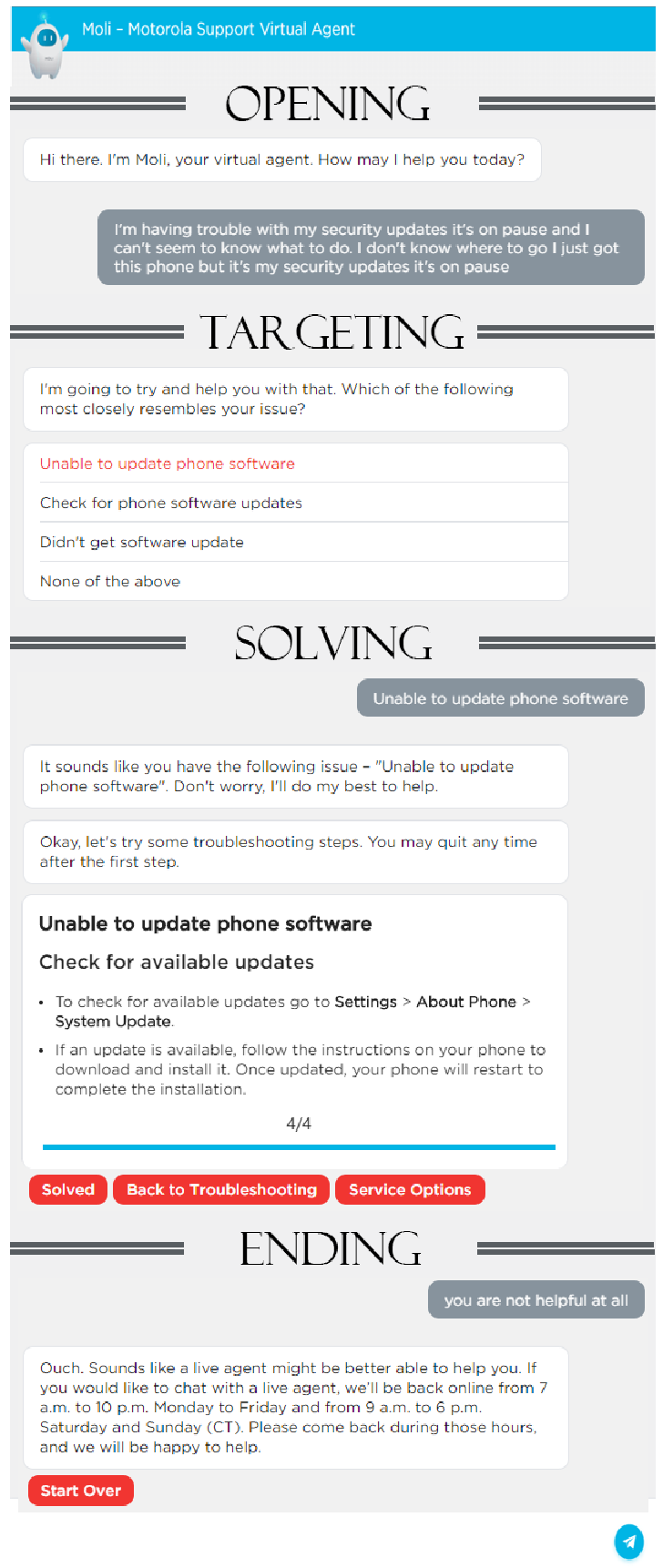
The core innovation of this paper is the adaptation of Clinical Psychotherapy Techniques into the dialogue flow of a chatbot. Instead of just apologizing, the "Moli" chatbot uses three sophisticated strategies:
- Affect Reflection (AR): Identifying the user's emotion and mirroring it back (e.g., "I can see you're frustrated with the speaker issue"). This helps users feel understood and self-regulate.
- Affect Expression (AE): The bot expresses its own "feeling" about a problem (e.g., "I feel frustrated that all agents are busy"). This builds a proactive human-machine bond.
- Content Reflection (CR): Summarizing the user's complex complaint to show the bot is "listening."
Integrated Dialogue Architecture
The researchers mapped these strategies across four distinct stages of service:
Experiments: The Wizard of Oz and the Channel Effect
To test these strategies, the team conducted a "Wizard of Oz" study (where a human simulates the AI's logic) comparing three levels: ES (Full Emotional Strategy), BA (Brief Apology), and NER (No Emotion Response).
Key Findings:
- ES is the Clear Winner: Users in the ES group reported significantly higher satisfaction and lower emotional arousal compared to the NER group.
- The Social vs. Web Divide:
- Social Media: Users expect a "human-like" persona. They preferred the rich, psychotherapeutic ES responses.
- Webpage: Users are in "task mode." They found the deep emotional strategies slightly distracting and preferred the "Brief Apology" (BA)—short, professional, and direct.
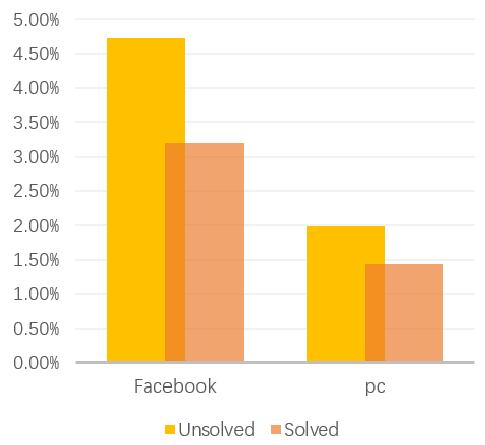 Figure: The data shows social media users exhibit significantly more emotion than those on webpages, necessitating a more robust emotional response.
Critical Analysis & Conclusion
Takeaway
The paper proves that emotion and task-solving are interconnected. A chatbot's failure to solve a problem triggers an emotional response, which in turn makes the user less likely to follow the bot's instructions. Breaking this cycle requires more than a template apology; it requires "Affective Intelligence."
Limitations
- The "Silent" Angry User: The study primarily identified anger through keywords. Some users might be "quietly fuming," and by the time they vent, it might be too late for the bot to intervene.
- Transfer Timing: Determining exactly when to give up and transfer to a live agent remains a challenge. The authors suggest a "three-strike" rule, but more adaptive triggers are needed.
Future Outlook
As we move toward LLM-based chatbots (like GPT-4), this paper provides a vital roadmap. It suggests that LLMs shouldn't just be "polite"; they should be prompted to act like therapists on social media and like efficient secretaries on technical portals. The future of AI service is not just about being smart—it's about being contextually empathetic.