
Bridging the Ghost Business Gap: Solving POI Cold-Start via Crowdsourcing
Cold-start Point-of-interest Recommendation through Crowdsourcing
The paper introduces Feature-based POI Recommendation (FPR), a system designed to solve the Point-of-Interest (POI) cold-start problem by crowdsourcing data from multiple social networks. It utilizes fuzzy clustering and aspect-based sentiment analysis to incorporate new businesses into a hybrid recommendation framework, outperforming SOTA baselines like USG and CRCF on the Yelp dataset.
TL;DR
When a new restaurant opens, traditional recommendation systems (like Yelp) often ignore it because it lacks historical "check-in" data—the dreaded POI Cold-Start Problem. This paper introduces FPR (Feature-based POI Recommendation), a framework that hunts for data on new businesses across other social networks (Foursquare, Google Places) to build a predictive profile, ensuring new businesses get the visibility they deserve and users get the novelty they crave.
The "New Business" Blind Spot
Most modern recommenders are "data-hungry." They use Collaborative Filtering (CF) to say: "Users who liked X also liked Y." But what if Y just opened yesterday?
- Prior Work Failure: Systems like USG or SELR rely on internal historical logs. If a POI isn't in their database with a critical mass of reviews, it’s invisible.
- The Vicious Cycle: If a new POI isn't recommended, no one visits. If no one visits, there’s no data. If there's no data, it's never recommended.
Methodology: The FPR Blueprint
The authors break the cycle using a five-step pipeline that treats the internet as a single, unified source of truth.
1. Aspect-Based Feature Extraction (APIF)
Instead of just looking at stars, the system uses Natural Language Processing (NLP) to extract nouns (aspects) and adjectives (sentiments).
- Example: "The pizza was delicious but the wait was long."
- Result: Pizza (+), Service (-).
2. Fuzzy Feature Clustering
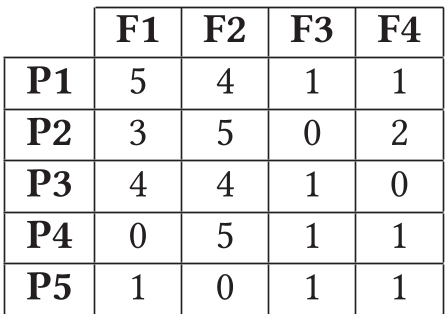
POIs aren't just "Restaurants." They are clusters of features. Using Fuzzy C-means, a POI can belong to multiple clusters (e.g., a "Quiet Ambiance" cluster and a "Great Parking" cluster). This allows cold-start POIs to be mapped to existing clusters based on their crowdsourced descriptions.
3. Crowdsourcing the "Cold"
The system identifies a POI missing from Yelp and queries the Foursquare and Google Places APIs. It effectively "borrows" the history from other platforms to jumpstart the internal profile.
4. The RecScore Formula
The final recommendation isn't just about similarity; it's about physics and logic. The RecScore combines:
- Geographic Distance: How close is the user?
- Feature Similarity: Does the POI have what the user likes?
- Collaborative Filtering: Adjusted cosine similarity to account for user rating biases.
Experimental Battleground
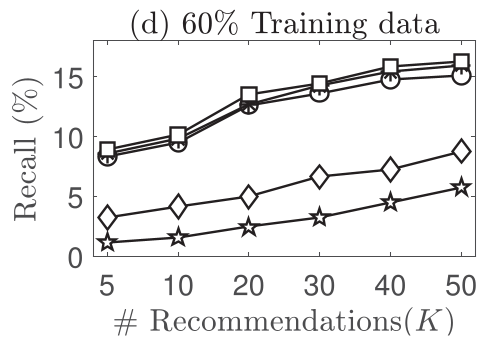
Testing against a massive Yelp dataset (75k+ POIs, 2M+ reviews), the results were telling:
- Accuracy: FPR maintained superior Recall across both sparse (10% training) and dense (90% training) data scenarios.
- Recovery SOTA: In the crucial task of "recovering" marked cold-start POIs, FPR achieved a success rate of 88% in active regions like Arizona.
- Ranking: Using Mean Reciprocal Rank (MRR), the authors proved that their relevant recommendations weren't just in the list—they were near the top.
Critical Insights & Future Outlook
While FPR is a massive leap for item-side cold-start, it still has limitations:
- Platform Ghosting: If a POI exists on no social network, FPR still can't help. The authors suggest using neighboring POI data as a future proxy.
- Temporal Drift: A POI that was "hot" in 2020 might be "cold" in 2024. Future versions must integrate time-decay factors.
The Takeaway? Recommender systems can no longer be silos. To solve the cold-start problem, we must treat the web as a global graph of features, not just a private collection of check-ins.