
Collab-RAG: Small Models Leading Giants in Complex Multi-Hop RAG
Collab-RAG: Boosting Retrieval-Augmented Generation for Complex Question Answering via White-Box and Black-Box LLM Collaboration
Collab-RAG is a collaborative training framework for complex multi-hop QA that pairs a white-box Small Language Model (SLM) decomposer with a black-box Large Language Model (LLM) reader. It achieves SOTA results on five multi-hop datasets, outperforming existing black-box-only methods by up to 14.2%.
TL;DR
The RAG landscape is shifting from "retrieve-then-generate" to "plan-retrieve-generate." Collab-RAG introduces a collaborative framework where a white-box Small Language Model (SLM) acts as a specialized query decomposer, while a black-box Large Language Model (LLM) serves as an evidence reader. By using iterative preference optimization (DPO) driven by the LLM's feedback, the system enables a 3B model to outperform a 32B giant in complex question decomposition, boosting accuracy by up to 14.2%.
Problem & Motivation: The Multi-Hop Wall
Standard RAG systems are hitting a plateau when faced with complex, multi-hop questions (e.g., "What is the average winter temperature in the region where WXBX is located?").
- Retrieval Noise: A single-step retrieval based on a complex query often returns documents related to the entities but not the specific logic required, leading to "hallucination by distraction."
- The Black-Box Dilemma: State-of-the-art models like GPT-4 are often black boxes. We cannot fine-tune them for specific tasks easily, and their zero-shot query decomposition is frequently suboptimal.
- Cost of Supervision: Creating high-quality human annotations for multi-step reasoning chains is prohibitively expensive.
The authors' insight is simple yet profound: higher-quality question decomposition leads to better final answers. Therefore, we can use the final answer accuracy of a black-box LLM as a "reward signal" to train a small, agile white-box model to become a master planner.
Methodology: The Collaborative Loop
Collab-RAG treats the RAG pipeline as an environment where the SLM (Decomposer) and LLM (Reader) interact.
1. The Workflow
The SLM breaks the complex question into . For each sub-question, the retriever searches the corpus, and the LLM generates an intermediate answer. This process repeats until a final answer is synthesized.
2. Iterative Preference Optimization
Instead of simple distillation, Collab-RAG uses Iterative DPO.
- Warmup: The SLM is first fine-tuned via rejection sampling (SFT) on successful trajectories.
- Preference Learning: The system samples multiple decompositions. A rule-based reward (Format + Accuracy) distinguishes "Effective Decompositions" (Pairs that led to the right answer) from "Ineffective Decompositions."
- Iteration: Unlike static DPO, this is performed over multiple rounds, allowing the SLM to explore better decomposition strategies as its own policy evolves.
 Figure 1: The iterative training framework showing the feedback loop between the LLM Reader and SLM Decomposer.
Experiments & Results: Efficient Intelligence
The results prove that "bigger is not always better" for specialized tasks like decomposition.
- SOTA Performance: Across datasets like HotpotQA and MusiQue, Collab-RAG consistently outperforms strong baselines like IRCOT and FLARE.
- Efficiency Milestone: A fine-tuned 3B Qwen model achieved higher accuracy in question decomposition than a frozen 32B model and even rivaled a 72B model.
- Generalization: The SLM trained using feedback from
GPT-4o-minigeneralizes remarkably well when paired with other readers likeGPT-4oor open-sourceLlama-3.
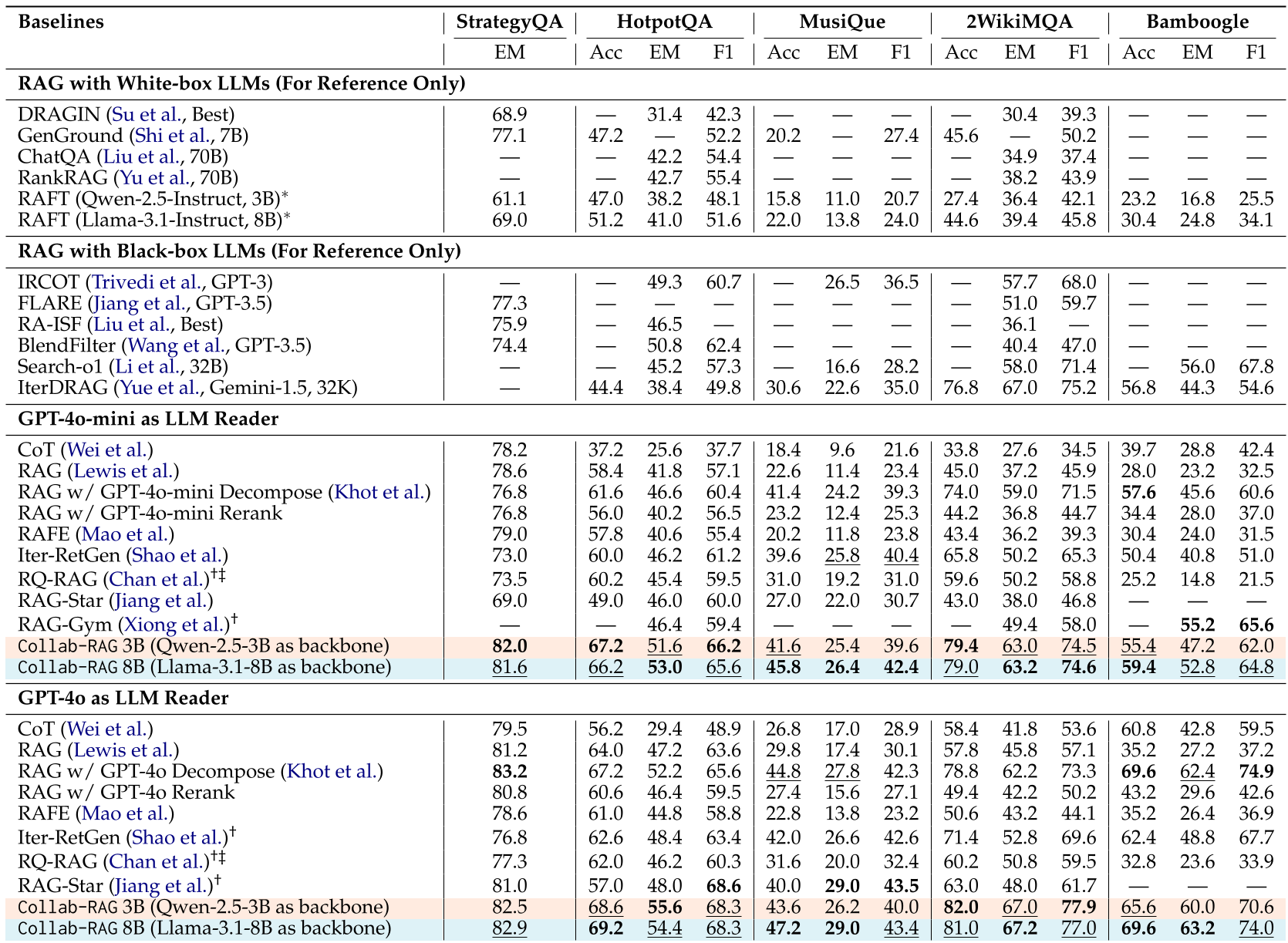 Table 1: Comprehensive comparison against white-box and black-box RAG baselines.
Deep Insight: Why Why Does This Work?
The core success of Collab-RAG lies in the alignment of the decomposer to the reader's specific capabilities. Standard decomposition methods (like zero-shot prompting) might produce a "human-logical" decomposition that the LLM reader cannot actually fulfill given the specific retrieval corpus. Collab-RAG, through DPO, trains the SLM to produce sub-questions that the specific RAG environment (retriever + current corpus + LLM capacity) is actually capable of answering.
Conclusion & Future Work
Collab-RAG demonstrates a scalable path for RAG evolution: using small, white-box models as intelligent orchestrators for black-box giants. It effectively bridges the gap between complex reasoning and efficient retrieval without the need for massive compute or human labeling.
Future Outlook: The authors suggest extending this to online reinforcement learning, where the decomposer can adapt to real-time user feedback or changing document corpora on the fly.
Takeaway: If you want to solve complex QA, don't just throw a bigger model at it—train a small model to ask the right questions.