
Collabio: Breaking the Barrier of Personalization through Social Human Computation
Collabio: A Game for Annotating People within Social Networks
Collabio is a social tagging game deployed on Facebook that incentivizes users to generate descriptive tags for their friends. By blending "Games with a Purpose" (GWAP) mechanics with social accountability, it achieves high-quality, crowdsourced personalization data that outperforms traditional profile scraping.
TL;DR
Collabio is a Facebook-based game that turns the act of "knowing your friends" into a competitive data-gathering tool. By having friends guess each other's traits to unlock points, it successfully mines high-fidelity personal information—ranging from musical tastes to technical expertise—that is invisible to search engines and standard profile scrapers.
Academic Context: This work sits at the intersection of Human Computation and Social Computing, building on the "Games with a Purpose" (GWAP) paradigm but pivoting from anonymous mass-contribution to high-accountability social group collaboration.
Problem & Motivation
Most personalization data is either explicit (what you tell the system about yourself) or implicit (what the system infers from your clicks). However, there is a third, richer category: latent social information—things your friends know about you that you haven't written down.
Prior attempts like IBM's Fringe focused on the enterprise but struggled with the "social" aspect of motivation. The authors identified a fundamental challenge: How do you motivate a small, specific group of people (one's friends) to provide accurate data without the benefit of the "wisdom of the crowd" usually required to filter out noise and trolls?
Methodology: The "Guess and Reveal" Loop
Collabio’s core innovation is its interface design, which utilizes a "hidden" tag cloud to prevent herd mentality and ensure the authenticity of the information provided.

The Mechanics:
- Obscured Tags: When a user visits a friend's page, tags they haven't guessed yet are shown as dots (●●●●). This provides a visual hint of word length while preventing the user from simply "copying" what others said.
- Scoring Strategy: Points are awarded based on tag popularity. If you guess a tag that 10 other people also guessed, you gain 11 points. This incentivizes users to think of characteristics that are both true and widely recognized.
- Social Spread: High-scoring friends are listed on a "People who know [User] best" leaderboard, effectively gamifying intimacy and friendship.
- The Bot Seed: To solve the "cold start" problem, a "Collabio Bot" seeds the cloud with public data to encourage the first few tags.
Experiments and Results
The researchers conducted a dual-pronged evaluation: a user survey and a "Human-as-an-Upper-Bound" scraping test.
Reliability vs. Popularity
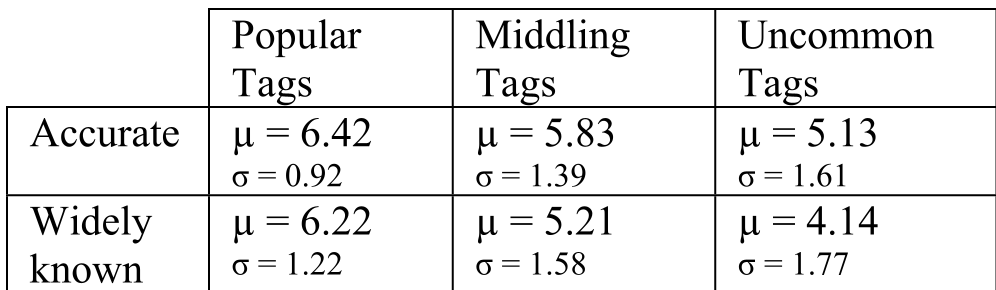
The study categorized tags into Popular, Middling, and Uncommon. Surprisingly, while accuracy decreased slightly for uncommon tags, it remained high across the board. The social pressure of being "connected" on Facebook acted as a natural filter against abuse.
Information Novelty
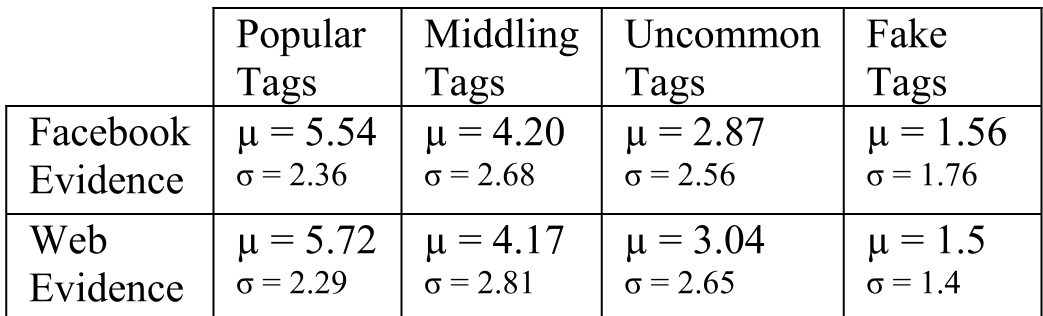
In one of the most compelling parts of the study, the authors hired raters to try and "find" these tags using only the web and Facebook profiles. As shown in the table below, while Popular tags (like "MIT" or "HCI") were easy to find, Uncommon tags (the more personal traits) were nearly impossible for outsiders to verify, yet internal friends reported them as highly accurate.
Deep Insight & Conclusion
Takeaway
Collabio proves that social context is a viable substitute for redundancy. In traditional GWAP (like the ESP Game), you need thousands of anonymous pairs to agree to ensure a label is correct. In Collabio, the "social tax" of potentially offending a friend or appearing "wrong" to a shared network provides the same, if not better, validation.
Limitations
- Scale Limitation: The method relies on an existing social graph. It cannot generate data for isolated individuals.
- Privacy Concerns: While Collabio allows users to delete tags, the act of friends revealing "quirky habits" could lead to social friction or unintended data exposure.
Future Impact
As LLMs increasingly rely on "System 2" reasoning and deeper personalization, mechanisms like Collabio offer a blueprint for harvesting the "dark matter" of human data—the things we know about each other that haven't yet been digitized.