
Collabmap: Engineering Trust and Incentives in Crowdsourced Emergency Mapping
Collabmap: Crowdsourcing Maps for Emergency Planning
This paper introduces Collabmap, a crowdsourcing platform designed to generate high-fidelity evacuation maps for emergency planning by identifying routes from buildings to roads. Using a micro-task workflow and a consensus-based trust mechanism, it effectively harnesses both local community knowledge and global online labor (Amazon Mechanical Turk) to achieve SOTA accuracy in complex geospatial data creation.
TL;DR
Collabmap is a specialized crowdsourcing framework that bridges the gap between raw satellite imagery and actionable emergency evacuation maps. By decomposing complex mapping into minute-long micro-tasks and trialing different incentive models, the researchers demonstrated that a combination of Lottery-based rewards and Gamified competition is the "sweet spot" for generating high-quality geospatial data at scale.
Background: The "Last Mile" Problem in Disaster Simulation
When a disaster strikes—like an oil refinery explosion—seconds matter. Emergency planners need high-fidelity simulations to predict how 10,000 residents will navigate from their front doors to safe road networks.
The problem? Most digital maps are "blind" to the connection between a building and a road. They show the house and the street, but not the fences, gardens, or walls in between. Historically, this "last mile" of data required manual surveying. Collabmap asks: Can we use the crowd to draw these lines?
Methodology: The Divide-and-Conquer Workflow
The core of Collabmap is a sophisticated adaptive workflow. Rather than asking one person to map an entire neighborhood, the system breaks the process into five distinct atoms of work:
- Building Identification: Outline the structure.
- Building Verification: A secondary peer votes on the outline's validity.
- Route Identification: Draw paths from building exits to roads.
- Route Verification: Checking for structural logic (e.g., "Can a human walk through this?").
- Completion Verification: Determining if all possible exits have been identified.

Crucially, the system uses a consensus-based trust mechanism. A contribution only moves forward if it achieves a +3 majority score, ensuring that "spammers" or low-effort participants don't corrupt the dataset.
The Incentive Experiment: Social vs. Monetary vs. Competitive
One of the paper's most significant contributions is its "in the wild" study of human motivation. The authors deployed Collabmap under three different regimes:
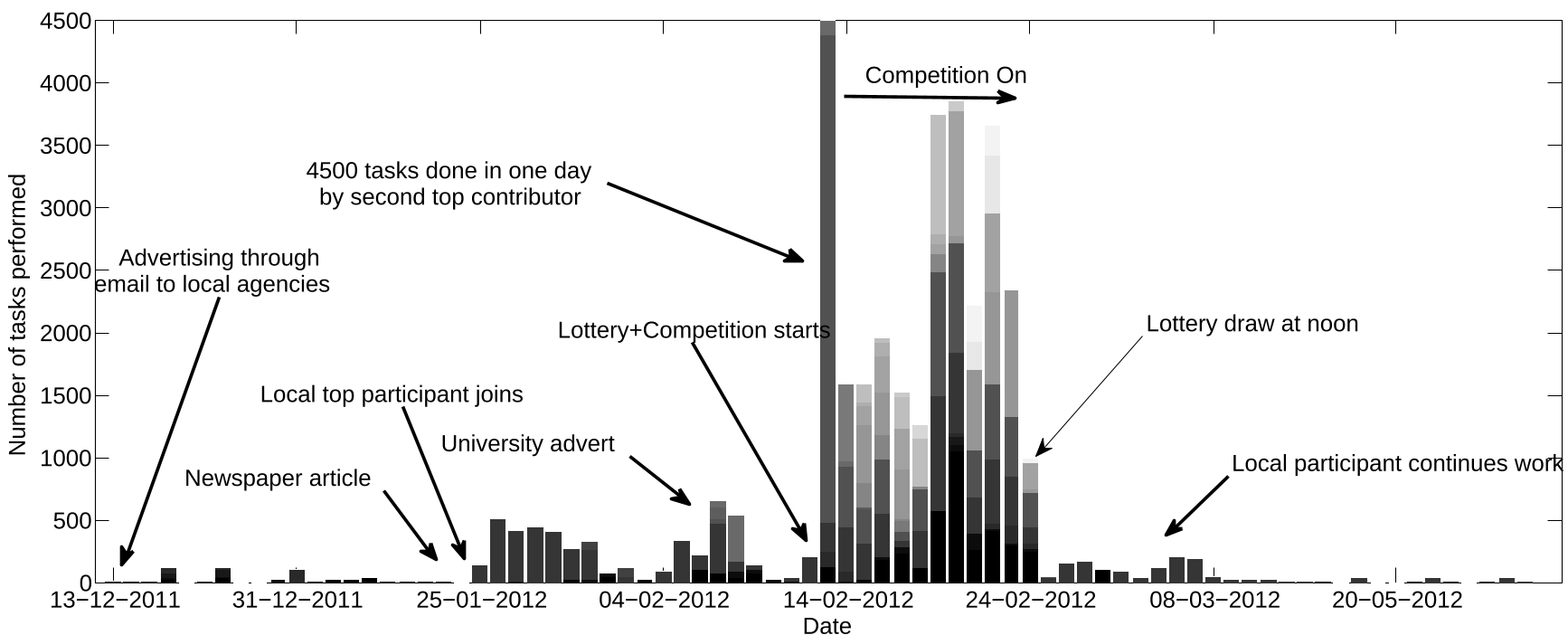
- Phase 1: Purely Social/Altruistic: Targeted at the local community for "public good." Result: Negligible participation.
- Phase 2: Lottery Rewards: Users earned tickets for a chance to win £300. Result: Participation increased among students, but task rates remained low.
- Phase 3: Lottery + Competition: Added a guaranteed £100 prize for the top contributor and a leaderboard. Result: Explosion in activity. The competitive drive to "beat the person above me" led top contributors to map thousands of buildings in days.
Local Knowledge vs. The Mechanical Turk
The study also benchmarked local volunteers against Amazon Mechanical Turk (AMT). The contrast was stark:
- Speed: AMT was lightning fast (44 tasks/min), while local users were slower (1.7 tasks/min).
- Quality: 35% of AMT building outlines were rejected for poor quality (e.g., drawing buildings as simple triangles to save time). In contrast, the local deployment had only an 8% rejection rate.
- Intuition: Local users (like "Participant T") identified routes that were invisible on satellite maps because they actually knew the area.

Strategic Insights & Conclusion
The results from Collabmap suggest three major takeaways for the future of "Human-in-the-loop" systems:
- Gamification is Required: Even for socially valuable tasks (like planning for disasters), people are far more motivated by competition than by pure altruism.
- Verify, then Verify Again: The "Find-Fix-Verify" pattern is essential when dealing with anonymous crowds, especially when the "Ground Truth" is ambiguous or outdated.
- Hybrid Crowds: The ideal mapping system should use AMT for high-speed, easy tasks (basic outlines) and reserve local, expert crowds for the nuanced verification and high-stakes routing.
Collabmap proves that while the "crowd" is powerful, it is also strategic and prone to error. Engineering the incentives is just as important as engineering the algorithms.