
SocialCrowd: Balancing Collaboration and Competition via Leak-Aware Clustering
Be a Collaborator and a Competitor in Crowdsourcing System
The paper introduces SocialCrowd, a data-leak-aware crowdsourcing framework that optimizes the formation of collaborative yet competitive worker teams. It utilizes a Markov chain-based approach to quantify implicit data propagation and a novel clustering algorithm, DLTD, to ensure zero inter-team information leakage.
TL;DR
In modern crowdsourcing, teams often compete for rewards while working on sensitive tasks. Traditional platforms ignore the "social leak"—the risk that competing teams might share information through mutual social connections. SocialCrowd addresses this by using Markov chains to map data propagation risks and a specialized clustering algorithm (DLTD) to ensure that competitors remain strictly isolated, achieving a 0% leakage rate compared to the failure of standard methods like K-means.
Background: The Invisible Leak in Social Crowdsourcing
Crowdsourcing has evolved from simple micro-tasking (like Amazon Mechanical Turk) to complex, knowledge-intensive problem solving. In these environments, social relationships are a double-edged sword. While they facilitate collaboration within a team, they also act as conduits for data leaks between competing teams. The core challenge is: How can we form teams that maximize local expertise while ensuring no sensitive information "hops" through a social network to a competitor?
The SocialCrowd Architecture
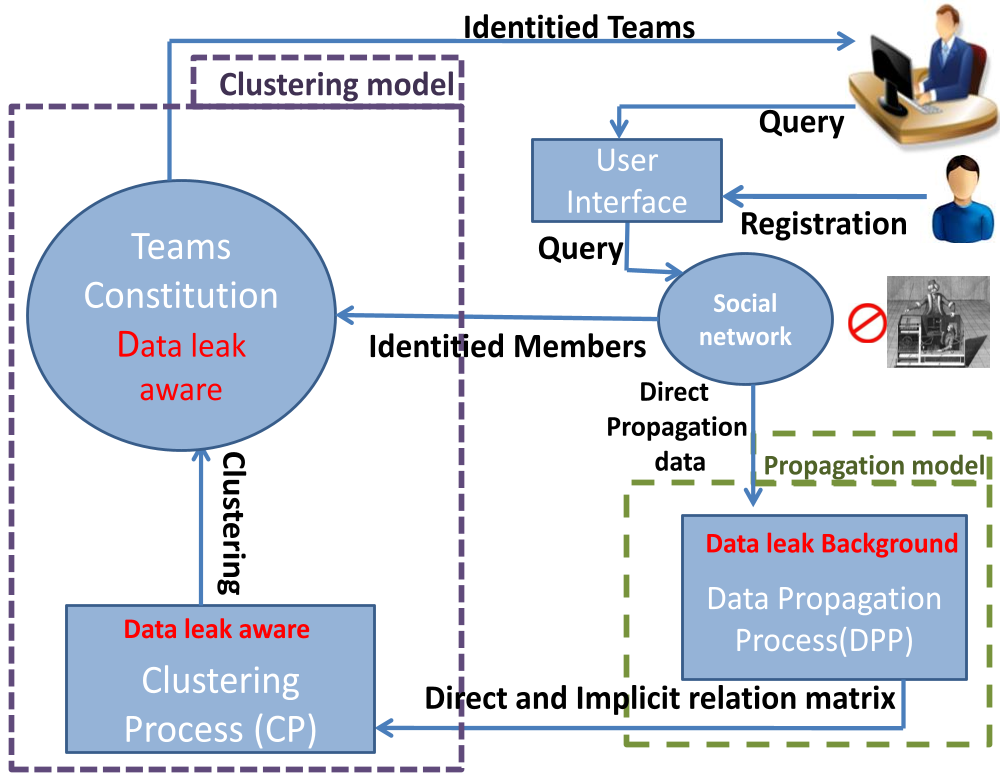
The proposed system, SocialCrowd, operates through a three-tier pipeline:
- Data Propagation Discovery: Calculating how far information can travel.
- Clustering Component: Grouping users based on leakage distance.
- Team Constitution: Finalizing teams based on skill and social constraints.
Methodology: From Logic to Math
1. Modeling Propagation with Markov Chains
Information flow in a social network isn't just about direct friends; it's about "friends of friends." The authors use a Markov Chain model because data propagation at any step depends only on the current holder of the information.
The High Data Propagation Discovery (HDPD) algorithm computes an energy function , representing the max probability of data reaching member . This ensures that even if a direct link doesn't exist, the system identifies "invisible" paths where data might leak (e.g., Alice Mickael David).
2. DLTD: The Zero-Leak Clustering Algorithm
Standard clustering (like K-means) tries to minimize distance to a center. SocialCrowd’s Data Leak free Team Discovery (DLTD) uses a threshold . If the propagation probability between two people is higher than , they must be in the same team to prevent them from being competitors who leak data to each other.
Experimental Evidence
The authors compared DLTD against K-means across social networks of varying sizes (500 to 5,000 members).
Leakage Protection
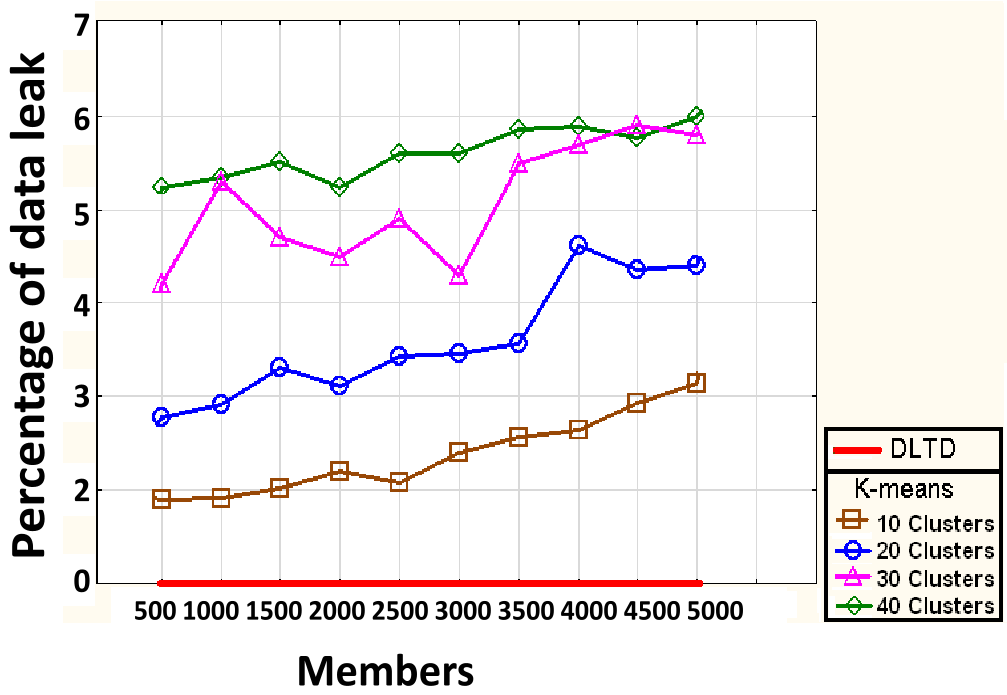
The most striking result is the efficacy of the DLTD approach. While K-means consistently fails to prevent leaks—showing an increasing leakage rate as the network grows—DLTD maintains a perfect 0% leakage.
Computational Trade-offs
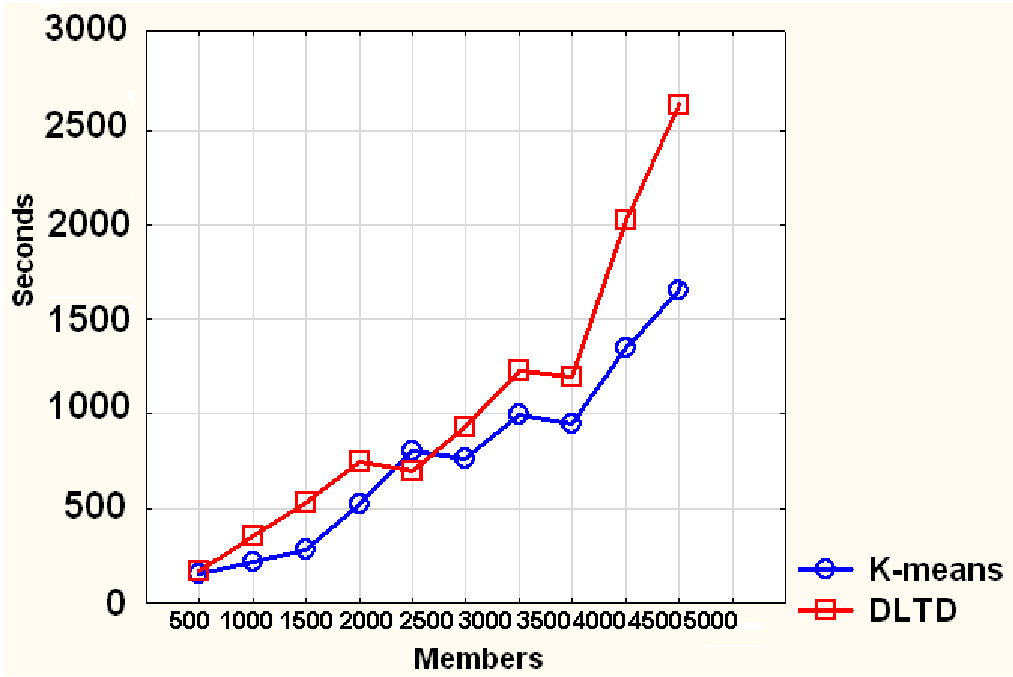
The cost of this security is execution time. DLTD is more computationally intensive than K-means because it explores all possible valid clustering solutions rather than converging on a single local minimum.
Critical Insight & Conclusion
This paper identifies a critical flaw in current enterprise crowdsourcing: social connectivity is a security liability. By treating data propagation as a probabilistic Markov process, SocialCrowd provides a mathematical framework to define "safe" competition.
Limitations:
- The complexity of DLTD is in the theoretical worst case, making it potentially sluggish for massive networks (e.g., millions of nodes).
- The model assumes propagation probabilities can be accurately estimated from historical sharing data, which may not always be available.
Future Work: The authors suggest adding heuristics to the clustering algorithm to handle the complexity, which would be essential for real-time deployment in global-scale social networks.