
Birds of a Feather: Deciphering the Social DNA of Scientific Collaboration
Collaboration patterns in theoretical population genetics
This study analyzes co-authorship patterns in theoretical population genetics (1900–1980) to demonstrate that scientific collaboration mirrors general social network behaviors. By applying "homophily indices" to a database of nearly 8,000 documents, the authors confirm that scientific "invisible colleges" adhere to predictable social structures like the "birds of a feather" effect.
TL;DR
Does scientific collaboration happen by merit alone, or are we bound by the same social instincts as any other community? This classic study examines eight decades of theoretical population genetics data to prove that "Invisible Colleges" follow the same structural laws as general social networks: scientists overwhelmingly prefer to collaborate with peers of similar professional "status," a phenomenon known as homophily.
The Social Logic of Science
In sociology, the adage "birds of a feather flock together" isn't just a cliché; it’s a measurable structural parameter. Previous research by Peter Blau suggested that social relations emerge more frequently between similar persons. But does this hold true for the supposedly objective world of theoretical science?
The authors argue that scientific communities are essentially "social networks" where the "status" of an individual (measured by their productivity) dictates their connectivity. The core motivation was to see if the inverse relationship between status-distance () and contact preference ()—found in friendships and marriages—could explain the co-authorship patterns in the Felsenstein bibliography (1900-1980).
Methodology: Mapping the Status Matrix
To quantify these social dynamics, the researchers moved beyond raw counts to a multi-dimensional representational model.
- Status Classification: Authors were grouped by their productivity (), using a logarithmic scale proposed by de Solla Price. This creates an hierarchy where "Status 1" represents newcomers (1 paper) and higher statuses represent the "Scientific Elite."
- The Homophily Index (): Instead of just counting collaborations, the authors calculated an index that shows how much a specific pair-wise collaboration deviates from random chance.
This formula allows us to see "preference" by filtering out the noise of total publication volume.
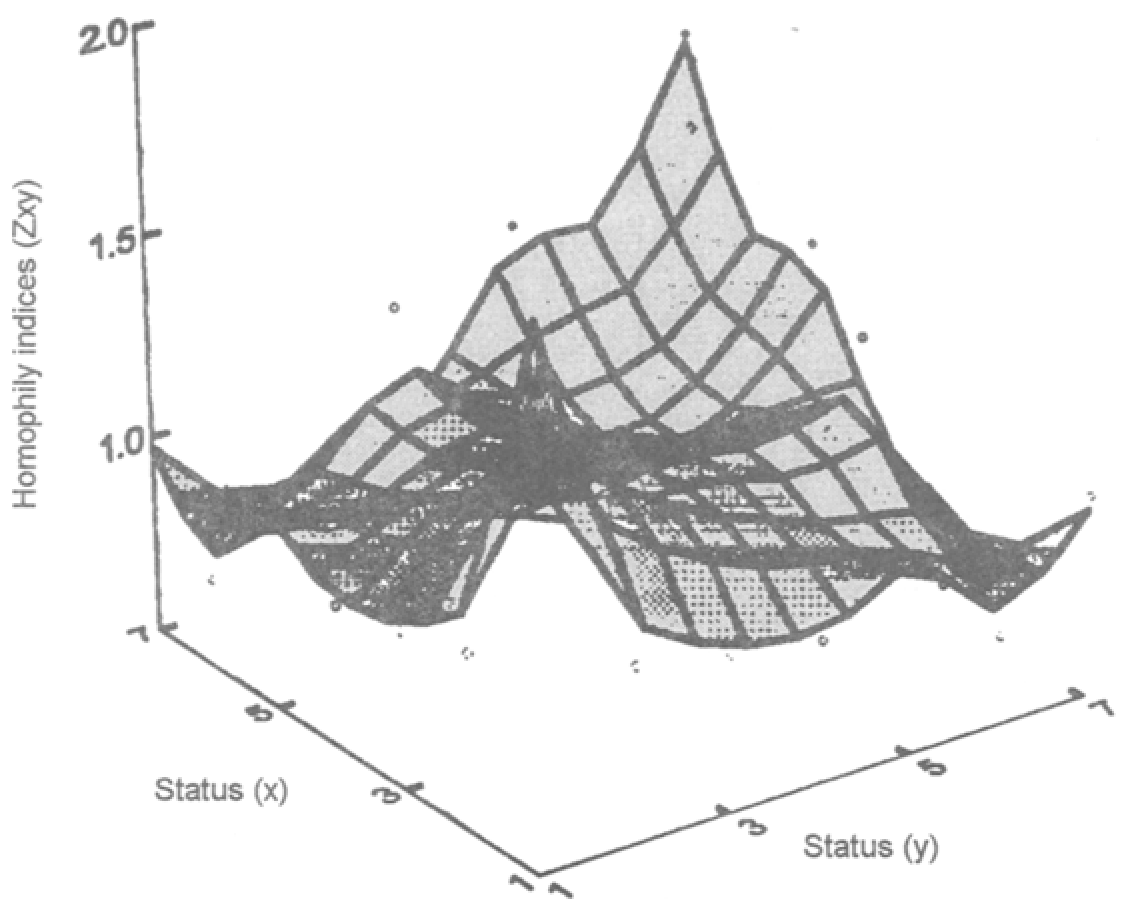 Figure 1: The Three-Dimensional Representation of Homophily Indices, showing the peaks and valleys of a collaborative community.
Key Insights: The U-Curve and the Diagonal
The study’s results are strikingly visual and validate three core social properties:
1. The Homophily Peak (Diagonal)
In the collaboration matrix, the highest index values are found along the main diagonal where . This means that a scientist with 10 papers is far more likely to collaborate with another scientist with 10 papers than with a "novice" or a "superstar."
2. The Edge Effect
Perhaps the most fascinating finding is the "Edge Effect" (U-Curve). Collaboration preference is strongest at the extremes: the "Elite" (high status) and the "Novices" (low status) are the most insular, sticking to their own kind even more than those in the middle of the productivity spectrum.
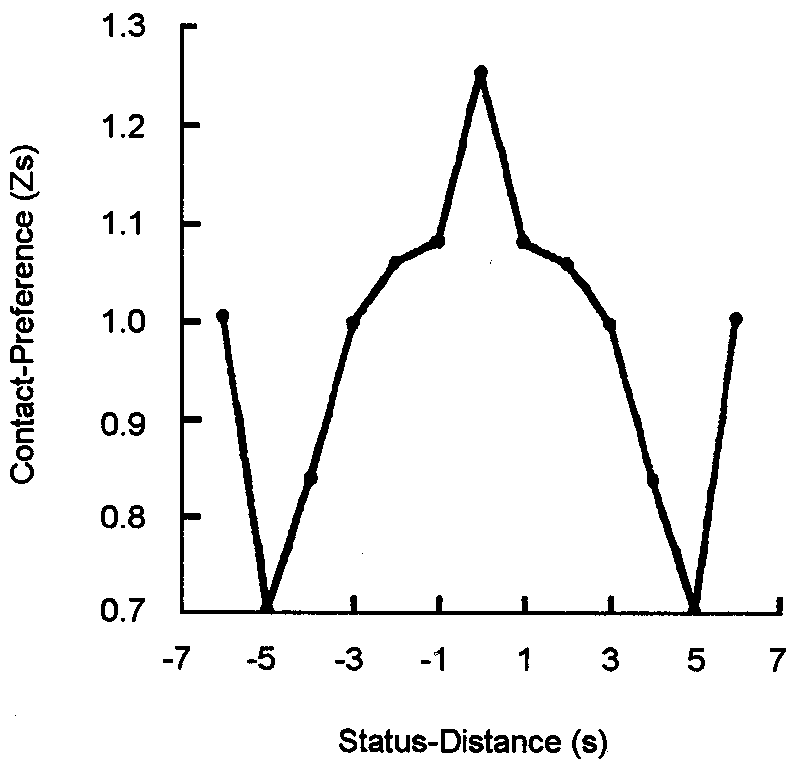 Figure 2: The clear inverse relationship: as the status distance () increases, the preference for contact () drops sharply.
Why It Matters
This paper serves as a bridge between Scientometrics and Sociology. It suggests that the "Invisible College"—the informal network of researchers that drives a field forward—is not a meritocratic free-for-all. Instead, it is a highly structured social system.
Implications for Today:
- Knowledge Flow: If scientists only "flock" with similar peers, how do new ideas permeate from the periphery to the center?
- Research Policy: Encouraging cross-status collaboration (e.g., senior-junior grants) might be necessary to break the natural social "insularity" found in these networks.
Conclusion & Limitations
While the 1900-1980 dataset provides a stable view of the "second phase" of scientific growth, the digital age has likely introduced new variables. Today's "Open Science" and global digital platforms might mitigate the status-distance effect, or conversely, AI-driven recommendation engines might accidentally amplify it.
The takeaway remains timeless: To understand the progress of science, we must first understand the social architecture of the scientists themselves.